
Exploring the Meaning of Oudamos in Greek
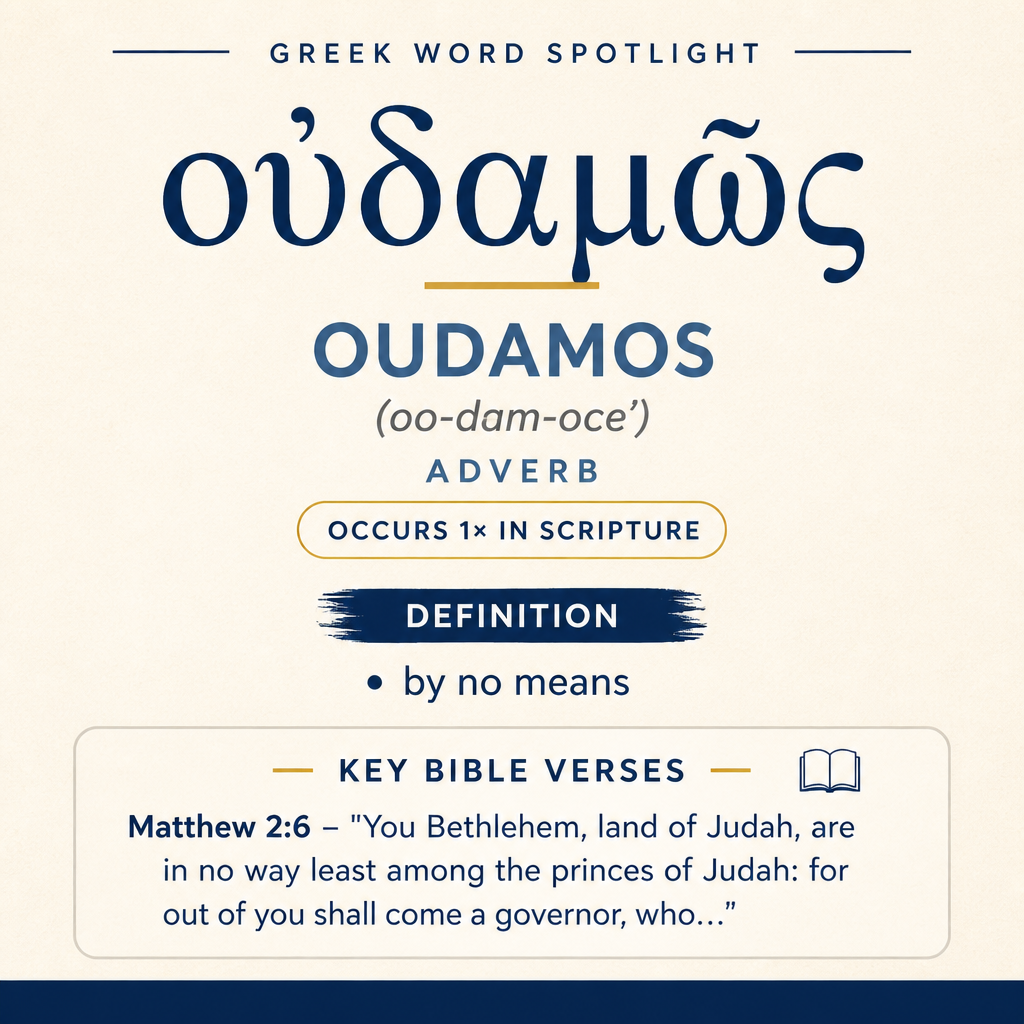
οὐδαμῶς means “by no means” and appears once in Scripture, in Matthew 2:6.
Scripture Occurrence
It occurs 1 time in Scripture. The occurrence is in Matthew 2:6.
Learn More →Verse Context
In Matthew 2:6, it is used in the line, “are in no way least among the princes of Judah.”
Learn More →οὐδαμῶς means “by no means” and appears in a single New Testament citation of Scripture in Matthew’s account of the Messiah’s birthplace. In that setting it strengthens a denial: Bethlehem is emphatically not to be treated as least among Judah’s rulers.
Root and Related Words
οὐδαμῶς is derived from the related form οὐδείς (oudeis), meaning “none” (Strong’s G3762). The relationship ties the adverb’s force to an absolute negating idea: a denial stated as excluding any exception.

Occurrences
“‘You Bethlehem, land of Judah, are in no way least among the princes of Judah: for out of you shall come a governor, who shall shepherd my people, Israel.’ ” (Matthew 2:6)
Here οὐδαμῶς (“in no way”) functions inside a quotation that contrasts Bethlehem’s apparent smallness with its destined significance. The line does not merely say that Bethlehem is “not least,” but denies the claim in the strongest terms: it is in no way least among the “princes of Judah.” This adverb sharpens the sentence’s evaluative statement about rank and importance, disallowing any reading that Bethlehem might still be considered least in some respect or from some angle. Within the flow of the quotation, the emphatic denial (“are in no way least…”) is immediately grounded by a reason introduced with “for”: “for out of you shall come a governor.” The point of the intensified negation is therefore not abstract; it supports a concrete claim about what will come from Bethlehem—leadership (“a governor”) and care (“who shall shepherd my people, Israel”).

The wording also places the negation alongside a formal, public-sounding assessment: Bethlehem is addressed directly (“You Bethlehem, land of Judah”), and the comparison class is stated (“among the princes of Judah”). οὐδαμῶς marks the assessment as categorical. In this scene, the quotation is meant to settle a question of identification and location, and the adverb’s force matches that purpose: it speaks as though the verdict is settled beyond dispute. The denial is not aimed at a trivial detail; it is bound to the claim that the coming ruler’s origin elevates Bethlehem’s standing within Judah.
Sense and Usage
As an adverb meaning “by no means,” οὐδαμῶς expresses a full, decisive negation—language used when a speaker excludes an option entirely rather than simply disagreeing. In Matthew 2:6 it modifies an evaluative predicate (“least”), turning a simple negative (“not least”) into an emphatic rejection (“in no way least”). That intensity matters because the statement is comparative (“among the princes of Judah”): comparisons can leave room for qualifications or alternate measures, but οὐδαμῶς closes that room. The effect is to make the claim resilient against counterarguments that might appeal to Bethlehem’s size, prominence, or reputation; the adverb demands that none of those considerations overturn the stated conclusion.
The placement of the adverb also shapes how the quotation is heard. The line begins with direct address and identification (“You Bethlehem, land of Judah”), then makes the evaluative judgment with emphatic negation, and only then gives the rationale (“for out of you shall come a governor”). In that structure οὐδαμῶς acts like a hinge between address and explanation: it heightens the judgment that must be accepted before the reason is supplied. The result is a tightly argued statement: Bethlehem’s status is affirmed in the strongest negative form, and that affirmation is immediately tied to the promised emergence of a shepherding ruler. In this way, “by no means” is not an ornament of style but a rhetorical marker of certainty, pressing the reader to treat the claim as firm and definitive.
Imagery
Although οὐδαμῶς is a small word, the scene it serves in Matthew 2:6 carries vivid civic and pastoral imagery: a town named and located (“Bethlehem, land of Judah”), a hierarchy of leaders (“princes of Judah”), and the promise of a coming ruler (“a governor”) whose rule is described in the gentle, guiding terms of a shepherd (“who shall shepherd my people, Israel”). The adverb’s emphatic denial gives that imagery a sense of public proclamation—Bethlehem’s standing is declared as settled, not up for revision.
Sources: Lexical data from Strong’s Exhaustive Concordance and the Translators Brief Lexicon of Extended Strongs for Greek (STEPBible, CC BY). Occurrence data from the Translators Amalgamated Greek New Testament (STEPBible, CC BY). Scripture quotations from the World English Bible (public domain).





