Exploring the Meaning of Ouchi in Greek
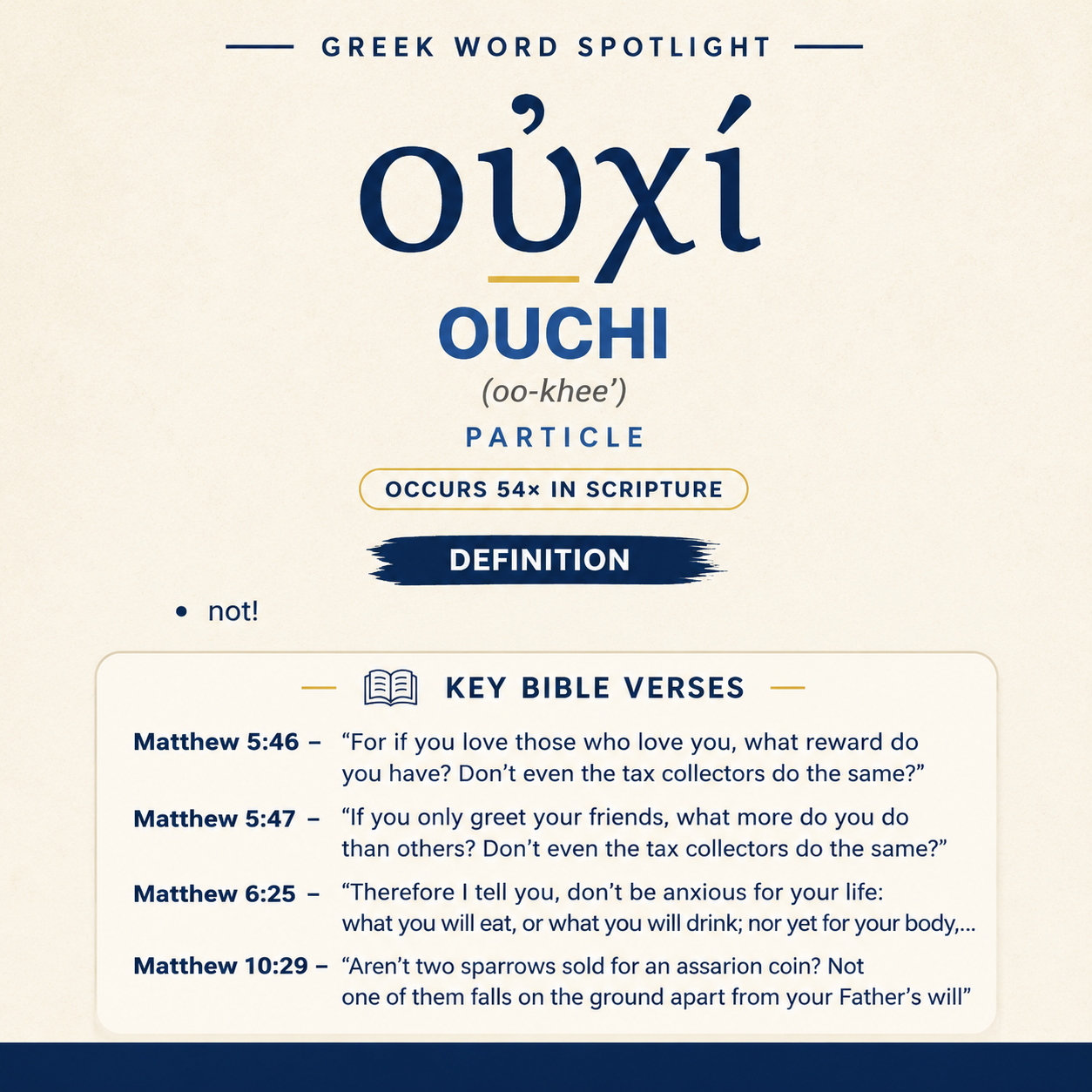
οὐχί means “not!” and occurs 54 times in Scripture, including Matthew 5:46–47, 6:25, 10:29, 12:11, 13:27, 13:56, and 18:12.
Core Meaning
οὐχί means “not!” It functions as a forceful negation in the cited passages.
Learn More →Matthew Examples
It appears in rhetorical questions such as “Don’t even the tax collectors do the same?” (Matthew 5:46–47). It also occurs in “don’t be anxious” (Matthew 6:25) and “Aren’t two sparrows sold…?” (Matthew 10:29).
Learn More →Scripture Frequency
οὐχί occurs 54 times in Scripture. The provided examples include several occurrences in Matthew (5, 6, 10, 12, 13, 18).
Learn More →οὐχί expresses a forceful negation (“not!”) that commonly appears in pointed questions and emphatic refusals. In these passages it sharpens contrasts, presses hearers toward an obvious conclusion, or directly blocks an unwanted proposal.
Occurrences
Matthew 5:46
“For if you love those who love you, what reward do you have? Don’t even the tax collectors do the same?” (Matthew 5:46)
Here οὐχί drives a rhetorical question meant to collapse any claim to moral distinction. The speaker compares the audience’s love for reciprocal lovers with the behavior of “the tax collectors,” and the negation presses the expected answer: this kind of love is not exceptional. The punch of “Don’t even…?” turns the comparison into a rebuke by implying that the standard being met is only the most ordinary one.
Matthew 5:47
“If you only greet your friends, what more do you do than others? Don’t even the tax collectors do the same?” (Matthew 5:47)
Again οὐχί sets the listener up to concede the point. The question is not seeking new information; it forces agreement that greeting “your friends” does not exceed common social courtesy. The negation intensifies the critique: the behavior under review does not rise above what is already practiced by the very group just named for contrast.
Matthew 6:25
“Therefore I tell you, don’t be anxious for your life: what you will eat, or what you will drink; nor yet for your body, what you will wear. Isn’t life more than food, and the body more than clothing?” (Matthew 6:25)
In this saying, οὐχί introduces a question that anchors the preceding command not to be anxious. The negation functions as a lever: it pushes the hearer to admit that “life” exceeds “food” and “the body” exceeds “clothing.” The expected “yes” (life is more) makes anxiety about necessities appear out of proportion to what life and body truly are within the sentence’s framing.
Matthew 10:29
“Aren’t two sparrows sold for an assarion coin? Not one of them falls on the ground apart from your Father’s will,” (Matthew 10:29)
οὐχί introduces an appeal to shared knowledge: sparrows are cheap and common (“sold for an assarion coin”). That concession about low value becomes the setup for the following assurance. The negation in the opening question presses agreement that the animals are ordinary and inexpensive, so that the next line—“Not one of them falls… apart from your Father’s will”—lands with greater force. The rhetoric depends on the listener granting the first point, and οὐχί helps secure that grant.
Matthew 12:11
“He said to them, “What man is there among you, who has one sheep, and if this one falls into a pit on the Sabbath day, won’t he grab on to it, and lift it out?” (Matthew 12:11)
In this scenario, οὐχί frames a practical, morally intuitive response. The picture is concrete: a single sheep, a pit, and a time when action is debated (“on the Sabbath day”). The negation makes the question bite: the normal human reaction is assumed, and the audience is pressed to admit it. By forcing agreement about what someone “won’t” fail to do, the question establishes the standard of compassion and urgency as self-evident.
Matthew 13:27
“The servants of the householder came and said to him, ‘Sir, didn’t you sow good seed in your field? Where did these darnel weeds come from?’” (Matthew 13:27)
Here οὐχί appears on the servants’ lips as they register surprise and seek explanation. The negation assumes a prior fact—good seed was sown—and uses that assumed fact to highlight the contradiction posed by “darnel weeds.” The force is investigative: by insisting (as a question) on what should be true, the servants sharpen the mystery of how the present situation could have arisen.
Matthew 13:56
“Aren’t all of his sisters with us? Where then did this man get all of these things?” (Matthew 13:56)
In this exchange, οὐχί supports a skeptical inference. The speakers point to familiarity—“all of his sisters with us”—and the negation presses the shared recognition of that familiarity. Once that is conceded, their follow-up question (“Where then…?”) frames “all of these things” as unexpected and difficult to account for. οὐχί thus helps turn local knowledge into an argument against the surprising scope of what they observe.
Matthew 18:12
““What do you think? If a man has one hundred sheep, and one of them goes astray, doesn’t he leave the ninety-nine, go to the mountains, and seek that which has gone astray?” (Matthew 18:12)
οὐχί draws the audience into the story by asking them to supply the obvious pastoral response. The question expects agreement that the shepherd will act decisively for the one that “goes astray,” even at the cost of leaving “the ninety-nine.” The negation helps the scenario function as an appeal to common sense: the shepherd’s seeking is presented not as surprising but as what one would naturally do in such a case.
Matthew 20:13
““But he answered one of them, ‘Friend, I am doing you no wrong. Didn’t you agree with me for a denarius?” (Matthew 20:13)
In this reply, οὐχί becomes a legal-sounding insistence on the terms of an agreement. The speaker denies wrongdoing and then turns the denial into a pointed reminder: the worker “agree[d]… for a denarius.” The negation compels the listener to admit the contract, making the complaint appear inconsistent with what was freely accepted. The rhetorical effect is to close the argument by fastening the case to an acknowledged fact.
Luke 1:60
“His mother answered, “Not so; but he will be called John.”” (Luke 1:60)
οὐχί stands here as an unambiguous refusal. The mother’s “Not so” is not merely negative; it blocks an alternative and immediately replaces it with a decisive naming: “he will be called John.” The strength of οὐχί suits the moment’s firmness: the refusal is brief, and the following clause supplies the settled resolution.
Luke 4:22
“All testified about him, and wondered at the gracious words which proceeded out of his mouth, and they said, “Isn’t this Joseph’s son?”” (Luke 4:22)
οὐχί introduces a question that expresses tension between what is heard (“gracious words”) and what is presumed from familiarity (“Joseph’s son”). The negation presses the audience’s shared assumption about identity, as if to say the point should be undeniable. The question’s force lies in how it tries to constrain interpretation: their recognition is used to set limits on what they think can follow from the words they are hearing.
Luke 6:39
“He spoke a parable to them. “Can the blind guide the blind? Won’t they both fall into a pit?” (Luke 6:39)
In this parable-like line, οὐχί frames the inevitable outcome. The image is simple and physical: blind leading blind, both ending in a pit. The negation does not invite debate; it forces assent to what follows from the premise. By pushing the hearer to admit the certainty of falling, οὐχί intensifies the warning embedded in the picture.

Sense and Usage
Across these occurrences, οὐχί functions as an emphatic negative that frequently appears in questions designed to secure agreement rather than to gather information. In Matthew 5:46–47, it sharpens moral comparison by forcing the hearer to concede that ordinary reciprocity matches what “even the tax collectors” do. In Matthew 6:25, the same force supports an exhortation: the question is posed so the listener must admit the greater reality of “life” and “the body,” and that admission undercuts anxiety about food and clothing.
Several contexts show οὐχί operating as a hinge between an assumed fact and a pressing inference. The servants in Matthew 13:27 use it to insist on what the householder did (“didn’t you sow good seed…?”), thereby intensifying the puzzle of the weeds. The landowner in Matthew 20:13 uses it to lock the dispute to an acknowledged agreement (“Didn’t you agree…?”). In both scenes, οὐχί has the practical effect of putting the burden of consistency on the listener: once the assumed point is granted, the conclusion is difficult to evade.
οὐχί also appears as blunt refusal (Luke 1:60), where its emphatic quality fits a decisive correction followed by a firm alternative. Elsewhere it underscores the inevitability built into an image or scenario. The shepherd seeking the straying sheep (Matthew 18:12), the man lifting a sheep from a pit (Matthew 12:11), and the blind leading the blind (Luke 6:39) are framed as outcomes the audience should find undeniable. In these uses, οὐχί does more than negate: it presses the obviousness of what the speaker wants the hearer to recognize.
Imagery in Context
The emphatic “not!” of οὐχί often rides on vivid, everyday pictures: cheap sparrows sold for a coin (Matthew 10:29), a sheep in a pit (Matthew 12:11), a field where weeds appear among good seed (Matthew 13:27), a shepherd leaving ninety-nine to search the mountains (Matthew 18:12), and blind travelers heading toward a pit (Luke 6:39). In each case, the negation strengthens the scene’s natural logic, urging the hearer to concede what the picture itself makes hard to deny.
Sources: Lexical data from Strong’s Exhaustive Concordance and the Translators Brief Lexicon of Extended Strongs for Greek (STEPBible, CC BY). Occurrence data from the Translators Amalgamated Greek New Testament (STEPBible, CC BY). Scripture quotations from the World English Bible (public domain).