Exploring the Meaning of Orthros in Greek
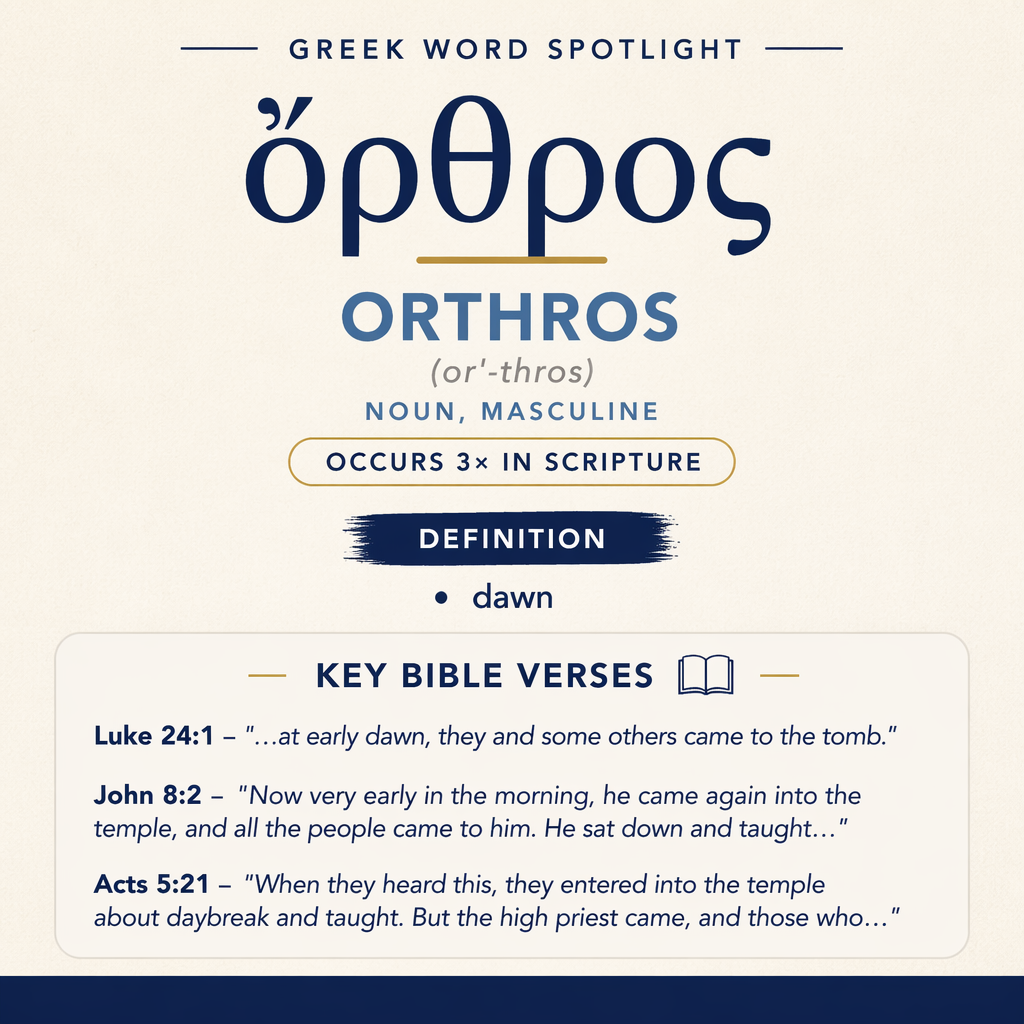
ὄρθρος means “dawn” and appears in Luke 24:1, John 8:2, and Acts 5:21.
Core Meaning
ὄρθρος is defined as “dawn.” It denotes the early time of day in these passages.
Learn More →Scripture Occurrences
The word occurs 3 times in Scripture. It appears in Luke 24:1, John 8:2, and Acts 5:21.
Learn More →Context Snapshots
In Luke 24:1 it describes early dawn at the tomb. In John 8:2 and Acts 5:21 it marks very early temple teaching.
Learn More →ὄρθρος is used for the time of dawn, appearing in scenes where decisive action begins at the first light of day: a visit to a tomb, teaching in the temple, and teaching in the temple again under pressure. In each setting, the word anchors what follows to the earliest part of the morning.
Root and Related Words
ὄρθρος is connected with the related word oros (ὄρος), “mountain” (Strong’s G3735).

Occurrences
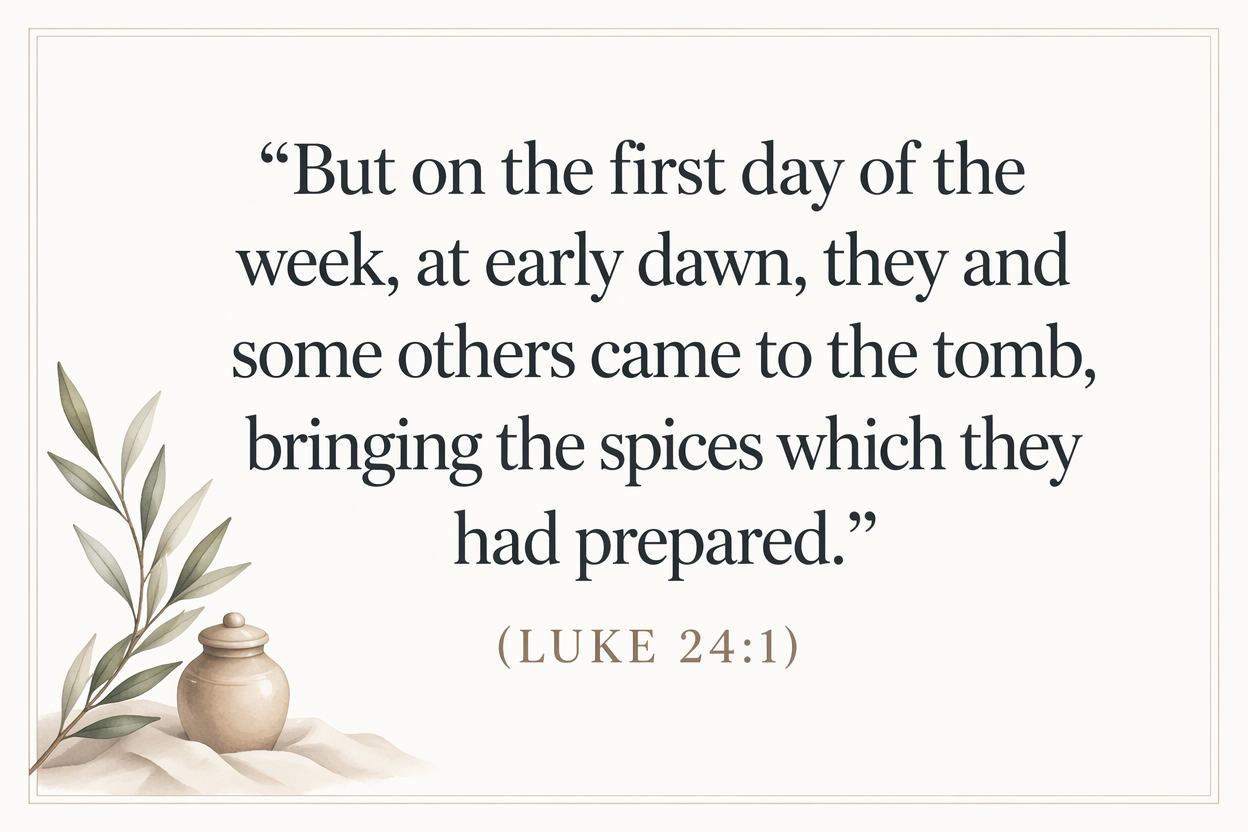
“But on the first day of the week, at early dawn, they and some others came to the tomb, bringing the spices which they had prepared.” (Luke 24:1)
Here ὄρθρος marks the timing of a purposeful journey: “they and some others came to the tomb” at the very start of the day. The narrative emphasizes both preparation and immediacy—“bringing the spices which they had prepared”—and “early dawn” frames that prepared act as something undertaken without delay. The word places the movement toward the tomb in the low light of morning, the transition point where night has ended but the day has only just begun. In the flow of the sentence, the temporal phrase sits prominently near the front, setting the scene before any other detail is given. Dawn becomes the boundary marker for a new sequence of events on “the first day of the week,” and the visit is presented as the first activity of that new day.
“Now very early in the morning, he came again into the temple, and all the people came to him. He sat down and taught them.” (John 8:2)
In this occurrence, ὄρθρος locates Jesus’ return to a public place—“he came again into the temple”—at the earliest morning hour. The timing does more than supply a clock reading: it shapes the picture of gathering and instruction. Because it is “very early in the morning,” the scene carries the sense of beginning—teaching takes place at the start of the day, and the people’s response is immediate: “all the people came to him.” The word helps connect Jesus’ arrival, the crowd’s arrival, and the act of teaching into one morning moment. It sets a rhythm of early public presence: he comes, the people come, he sits, and he teaches. Dawn thus functions as the frame for accessibility and instruction in a space associated with communal life (“the temple”).
“When they heard this, they entered into the temple about daybreak and taught. But the high priest came, and those who were with him, and called the council together, and all the senate of the children of Israel, and sent to the prison to have them brought.” (Acts 5:21)
Here ὄρθρος (“about daybreak”) again sets the hour for teaching in the temple, but the surrounding details heighten the sense of urgency and tension. The action begins with responsiveness: “When they heard this, they entered into the temple about daybreak and taught.” Dawn marks the earliest feasible moment for their obedience and public speech, placing their teaching at the outset of the day’s public business. The verse then contrasts their dawn activity with the later arrival of authorities: “But the high priest came, and those who were with him, and called the council together… and sent to the prison to have them brought.” By anchoring the teaching at daybreak, the word sharpens the sequence: instruction is already underway in the temple while the official apparatus is only beginning to assemble. The timing underscores how quickly the teachers act, and how the day’s unfolding events include parallel movements—teaching in the temple on one side, the convening of council and enforcement on the other.
Sense and Usage
Across these passages, ὄρθρος consistently names dawn as an operational time: people move, arrive, gather, and speak when the day first opens. In Luke 24:1, dawn is tied to a journey and an offering of prepared spices; the word highlights that the visit to the tomb is undertaken at the first opportunity, before the day’s routines take hold. In John 8:2, dawn belongs to public teaching: the early hour becomes the setting where Jesus is present in the temple and the people assemble to hear him. In Acts 5:21, dawn is again linked to temple teaching, but the narrative places it within a developing confrontation; the daybreak teaching stands at the head of a chain of events that includes the mobilization of the high priest and council.
Because the same definition fits all three contexts, the distinctiveness of ὄρθρος in these verses lies in what dawn does narratively. First, it marks beginnings—each verse portrays dawn as the threshold where significant action starts. Second, it conveys immediacy: the actors do not wait for the day to mature; they act at its very start (“at early dawn,” “very early in the morning,” “about daybreak”). Third, it organizes the day’s story: by fixing the opening hour, the text can contrast later developments (such as official gatherings) with what has already begun in the temple or at the tomb. The word therefore functions as more than a general time reference; it becomes a way of depicting initiative and setting the pace of what follows.
Notably, two of the three occurrences place dawn in the temple (John 8:2; Acts 5:21). In both, ὄρθρος frames teaching as an early-morning public act, and the temple as a place where the day’s interactions can begin as soon as morning arrives. The remaining occurrence places dawn at a tomb (Luke 24:1), where the early hour frames a visit shaped by preparation and intent. Taken together, the uses show dawn as a moment of transition into activity: movement toward a destination, gathering to a teacher, and entry into a public space for instruction.
Imagery
In these passages, ὄρθρος carries the imagery of first light falling on places of consequence: a tomb approached with spices (Luke 24:1) and a temple entered for teaching (John 8:2; Acts 5:21). Dawn is the quiet edge of day, when travel begins, doors are entered, and voices begin to speak; the word attaches that edge-of-day atmosphere to actions that set the course for what comes next.
Sources: Lexical data from Strong’s Exhaustive Concordance and the Translators Brief Lexicon of Extended Strongs for Greek (STEPBible, CC BY). Occurrence data from the Translators Amalgamated Greek New Testament (STEPBible, CC BY). Scripture quotations from the World English Bible (public domain).