Exploring the Meaning of Orphanos in Greek
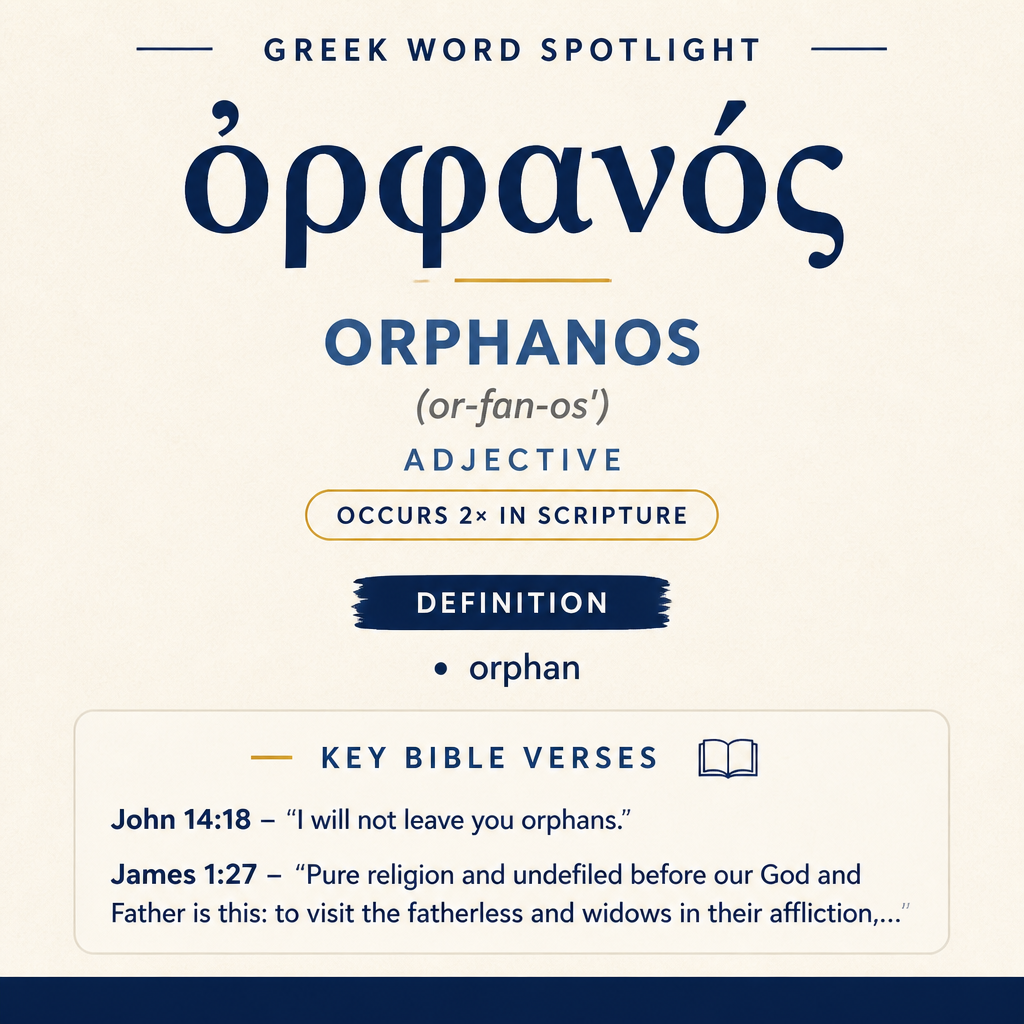
ὀρφανός means “orphan” and appears twice in Scripture, in John 14:18 and James 1:27.
Scripture Occurrences
The word occurs 2 times in Scripture: John 14:18 and James 1:27.
Learn More →Verse Context
In John 14:18, Jesus says He will not leave His disciples orphans. In James 1:27, it appears in a call to visit the fatherless and widows.
Learn More →ὀρφανός means “orphan.” It appears in John 14:18 and James 1:27, where it frames both a promise of continued presence and a practical measure of “Pure religion” expressed in care.
Occurrences
John 14:18: “I will not leave you orphans. I will come to you.”
Here ὀρφανός functions as the condition Jesus denies for his followers: they will not be left in the state denoted by “orphans.” The sentence is tightly balanced—first a refusal (“I will not leave you orphans.”), then an answering assurance (“I will come to you.”). The word therefore sharpens the emotional and relational weight of the promise by naming what would otherwise happen if he did not “come.” In this line, “orphans” is not an abstract label but a concrete relational outcome: being left behind without the person whose presence anchors them. The force of the statement depends on the contrast between being “left” and being met with an active return—“I will come to you.” ὀρφανός supplies the vivid descriptor for what “left” would mean in human terms, and the second sentence directly counters that prospect with presence.
The wording also shows how the term can be applied as a comparison for the disciples’ situation without turning the sentence into a discussion of social status or legal standing. The focus stays on abandonment versus coming, absence versus presence. In this setting, ὀρφανός gives language to vulnerability created by separation, so that the promise is heard not merely as a travel plan (“I will come”) but as a refusal to abandon those who might otherwise be exposed and unsupported.
James 1:27: “Pure religion and undefiled before our God and Father is this: to visit the fatherless and widows in their affliction, and to keep oneself unstained by the world.”
In James, the word appears within a definition-like statement: “Pure religion and undefiled before our God and Father is this….” ὀρφανός is rendered here by the phrase “the fatherless,” paired with “widows,” and both are located “in their affliction.” The term therefore identifies a group marked by loss and lack of protection, and it is presented as a test case for religious purity as it appears “before our God and Father.” By placing “the fatherless” first in the pair, the sentence highlights them as a principal object of tangible attention: “to visit the fatherless and widows.” The verb “to visit” sets the action in the realm of deliberate personal engagement rather than distant concern; ὀρφανός, as “fatherless,” names those for whom such attention is particularly needed.
The surrounding phrasing adds a moral frame. The care offered to “the fatherless and widows” is not isolated philanthropy but part of what is “undefiled” in God’s sight, joined to the parallel concern “to keep oneself unstained by the world.” Thus ὀρφανός is used not simply to categorize a vulnerable person but to anchor an ethical demand that is both outward (visiting those in affliction) and inward (remaining unstained). The word draws the reader’s attention to people whose affliction is intensified by the absence implied in “fatherless,” and it places responsiveness to that affliction inside the definition of what counts as “Pure religion.”
Sense and Usage
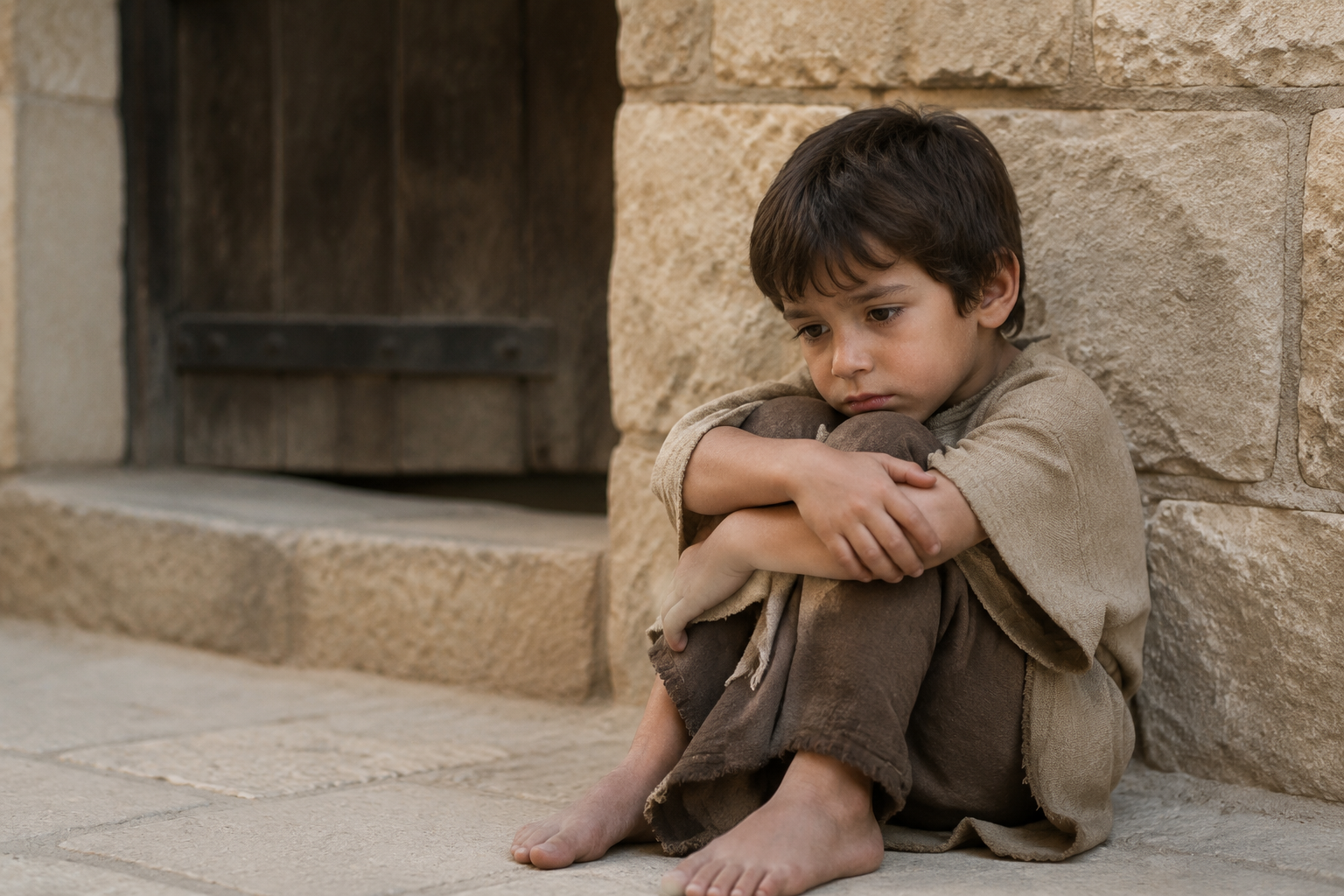
Across these two passages, “orphan” is used to name a state of deprivation that is relationally and socially recognizable. John 14:18 uses the term in a promise that focuses on presence—Jesus will not “leave” his followers in the condition described by ὀρφανός, because he will “come.” The word therefore serves as a compressed picture of what absence would do to them: it would place them in a vulnerable position defined by being left without the one they depend upon. The term’s power in that line lies in how quickly it communicates the feared outcome; it is a single word that evokes a complete scenario of being left behind, without needing additional explanation.
James 1:27 uses the word in a concrete social direction: “to visit the fatherless and widows in their affliction.” Here the word is not a metaphor for discipleship but a direct reference to those whose lives are shaped by a missing parent. By pairing “the fatherless” with “widows,” James presents “orphan” as one of the clearest examples of affliction that calls for compassionate action. The association with “affliction” in the same clause ensures that the term is not treated merely as a demographic label; it carries an expectation that the reader will recognize a burden attached to that status. The word functions as a moral summons: if religion is to be “pure” and “undefiled,” it must take account of those who bear this kind of loss.
Read together, the two occurrences show the flexibility of ὀρφανός while staying within the same basic meaning. In John, “orphans” becomes a way to describe what it would mean to be left without the coming presence of Jesus; the emphasis is on the prevention of that condition. In James, “the fatherless” is the group to be sought out and visited; the emphasis is on meeting people who already live in that condition. One text speaks from the side of promise (“I will come to you”), the other from the side of practice (“to visit”). The common thread is that “orphan” names a situation that calls for presence—either the presence promised by Jesus or the presence brought by the visitor who comes to the afflicted.
The way each passage is framed also shapes how the term is heard. John 14:18 is a direct personal assurance, brief and emphatic, with the term appearing as the emotional center of what will not happen to “you.” James 1:27 is a public criterion for evaluating “Pure religion,” with the term appearing as part of a list that defines what such religion does. The same meaning therefore touches two different registers: the intimate register of being left or not left, and the communal register of caring for those in affliction. In both, ὀρφανός points to a condition in which support and care are especially needed, and it works as a spotlight word, bringing that need into sharper view within the sentence.
Imagery in Context
In John 14:18, the imagery is immediate: being “left” as “orphans” is set against the comfort of “I will come to you.” The word gives the absence a name so that the promised coming can be felt as rescue from that named condition. In James 1:27, the image is of approach and attention—“to visit the fatherless and widows in their affliction”—so that “pure” and “undefiled” religion is pictured not as a private idea but as movement toward those whose lives are marked by loss.
Sources: Lexical data from Strong’s Exhaustive Concordance and the Translators Brief Lexicon of Extended Strongs for Greek (STEPBible, CC BY). Occurrence data from the Translators Amalgamated Greek New Testament (STEPBible, CC BY). Scripture quotations from the World English Bible (public domain).