Exploring the Meaning of Orneon in Greek
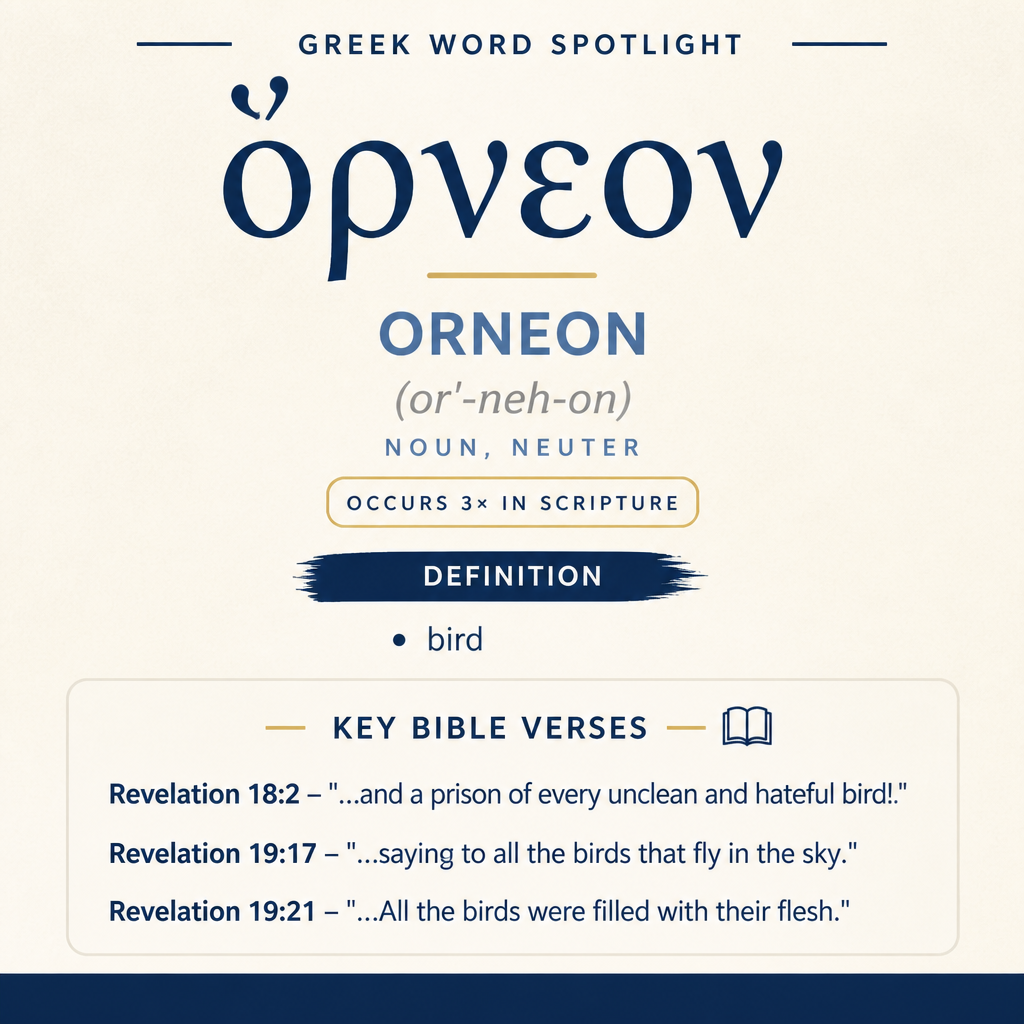
ὄρνεον means “bird” and appears three times in Scripture: Revelation 18:2; 19:17; 19:21.
Revelation Context
In Revelation 18:2, it appears in the proclamation over fallen Babylon the great.
Learn More →Scene of Birds
In Revelation 19:17 and 19:21, it refers to birds in end-time scenes, including “the birds that fly in the sky.”
Learn More →ὄρνεον refers to a “bird” and appears in three scenes in Revelation, where birds function as part of vivid end-time imagery. In these passages the term is tied to places described as prisons and to the aftermath of judgment.
Root and Related Words
ὄρνεον (Orneon) is related to ὄρνις (ornis), “hen” (Strong’s G3733).

Occurrences
Revelation 18:2: “He cried with a mighty voice, saying, “Fallen, fallen is Babylon the great, and she has become a habitation of demons, a prison of every unclean spirit, and a prison of every unclean and hateful bird!”
Here ὄρνεον occurs in a triple description of what Babylon “has become”: a habitation of demons, a prison of every unclean spirit, and a prison of every unclean and hateful bird. The bird is presented as one element in a catalog of occupants associated with uncleanness and hostility (“unclean and hateful”). The term contributes a concrete image: a place characterized not by ordered human life but by confinement—“a prison”—where such birds belong as part of Babylon’s new condition after her fall.
Revelation 19:17: “I saw an angel standing in the sun. He cried with a loud voice, saying to all the birds that fly in the sky, “Come! Be gathered together to the great supper of God,”
In this vision an angel “standing in the sun” addresses “all the birds that fly in the sky,” summoning them with imperatives: “Come! Be gathered together.” ὄρνεον here is not tied to a particular species; instead the scope is expansive (“all the birds”) and defined by their natural domain (“fly in the sky”). The word helps populate the scene with living creatures capable of responding as a collective audience to a heavenly announcement. The gathering is directed toward “the great supper of God,” so the birds are positioned as participants in an event framed as a meal.
Revelation 19:21: “The rest were killed with the sword of him who sat on the horse, the sword which came out of his mouth. All the birds were filled with their flesh.”
This occurrence follows the description of a decisive defeat: “The rest were killed with the sword of him who sat on the horse.” The birds reappear as the ones who are “filled with their flesh.” ὄρνεον thus contributes to the portrayal of the aftermath. The statement does not focus on flight or song but on feeding: the birds become the consuming agents who fill themselves from the dead. As in 19:17, the language is comprehensive (“All the birds”), underscoring the scale of what has happened and the completeness of the result.
Sense and Usage
Across these three passages, ὄρνεον (“bird”) remains a straightforward creature-term, yet it is deployed to carry heavy imagery. In Revelation 18:2 the bird belongs to a setting described with confinement language (“a prison”), and the bird is qualified morally and emotionally (“unclean and hateful”), placing it within a cluster of beings tied to defilement and menace. The sense is still “bird,” but the descriptive modifiers color how the reader imagines the birds: not as neutral wildlife but as fitting inhabitants of a ruined, ominous place.
In Revelation 19:17 the birds are framed by movement and space: they “fly in the sky.” The emphasis falls on their visibility and reach—creatures that traverse the open air, summoned by a voice that carries across the scene. The same basic sense becomes an instrument for depicting a wide summons: the angel calls not a small group but the entire class of sky-flying birds, gathering them toward a single event.
Revelation 19:21 completes the movement set up in 19:17: the birds are no longer merely called but are pictured as having eaten to satisfaction—“filled with their flesh.” The progression across the chapter uses the term in a consistent, literal way (birds as birds) while shifting the birds’ role from summoned hearers to feeders at the result of judgment. The effect is to show the birds as part of the created order that responds to, and is involved in, what unfolds: a desolated city becomes a prison even for birds (18:2), and a battlefield becomes a place where birds gather and feed (19:17, 19:21).
Imagery
In these scenes ὄρνεον supplies concrete, sensory detail: a ruined place with “every unclean and hateful bird” (Revelation 18:2), an open sky full of birds addressed by a radiant-positioned angel (Revelation 19:17), and birds “filled” after the sword’s work (Revelation 19:21). The word’s ordinariness as a creature-name heightens the starkness of the visions: familiar animals occupy unfamiliar roles in the portrayal of fall, summons, and aftermath.
Sources: Lexical data from Strong’s Exhaustive Concordance and the Translators Brief Lexicon of Extended Strongs for Greek (STEPBible, CC BY). Occurrence data from the Translators Amalgamated Greek New Testament (STEPBible, CC BY). Scripture quotations from the World English Bible (public domain).