
Exploring the Meaning of Ophthalmos in Greek
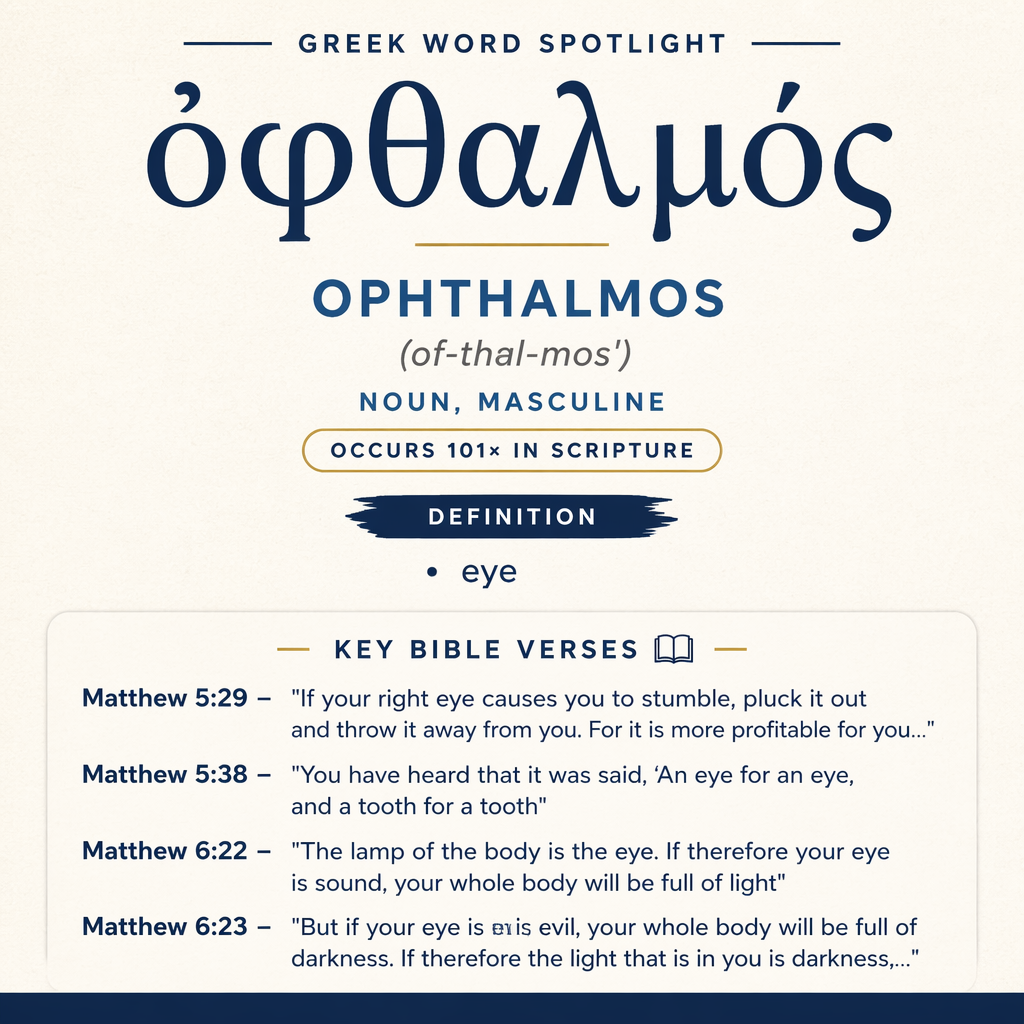
ὀφθαλμός (Ophthalmos) means “eye” and occurs 101 times in Scripture, including Matthew 5–7 and Matthew 9:29.
Core Meaning
ὀφθαλμός means “eye.” In Matthew it appears in teachings and narratives using the eye as a key image.
Learn More →Matthew’s Teachings
Matthew 5:29 and 5:38 mention the “right eye” and “an eye for an eye.” Matthew 6:22–23 contrasts a “sound” eye with an “evil” eye.
Learn More →Speech and Healing
Matthew 7:3–5 uses the eye in the “speck” and “beam” illustration about judging others. Matthew 9:29 records Jesus touching their eyes in healing.
Learn More →ὀφθαλμός means “eye.” In these passages it appears in legal citation, moral instruction, healing narratives, and sayings about perception, where the eye functions both as a bodily organ and as a focal image for inner orientation and discernment.
Occurrences
Matthew 5:29 — “If your right eye causes you to stumble, pluck it out and throw it away from you. For it is more profitable for you that one of your members should perish, than for your whole body to be cast into Gehenna.”
Here ὀφθαλμός is singled out as a specific bodily member (“your right eye”) whose influence can be so dangerous that drastic action is pictured. The saying anchors moral seriousness in the concreteness of the body: the eye is not treated as a small, neutral part but as something that can become the occasion of stumbling, with consequences that implicate “your whole body.”
Matthew 5:38 — “You have heard that it was said, ‘An eye for an eye, and a tooth for a tooth.’”
In this remembered maxim, ὀφθαλμός stands as a unit of loss or injury in a measured standard of recompense. The eye functions as a concrete example of something precious and irrecoverable, paired with “a tooth,” to express proportionality.
Matthew 6:22 — “The lamp of the body is the eye. If therefore your eye is sound, your whole body will be full of light.”
ὀφθαλμός is used as an image of how the body’s condition is affected by what the eye is like. The eye is portrayed as “the lamp of the body,” so that a “sound” eye corresponds to a body “full of light.” The word’s contribution is to locate the discussion of light and fullness in a familiar organ associated with seeing and guidance.
Matthew 6:23 — “But if your eye is evil, your whole body will be full of darkness. If therefore the light that is in you is darkness, how great is the darkness!”
Again ὀφθαλμός is the controlling element: the quality of “your eye” determines whether the “whole body” is characterized by darkness. The contrast with the prior saying is sharpened: the same bodily organ can be described as “evil,” and that moral descriptor is made to explain an inward outcome—darkness that is so deep it can be mistaken for light.
Matthew 7:3 — “Why do you see the speck that is in your brother’s eye, but don’t consider the beam that is in your own eye?”
ὀφθαλμός provides the setting for a vivid comparison. The “brother’s eye” contains a “speck,” but “your own eye” contains a “beam,” making the eye the location where judgment and self-judgment are dramatized. The word allows a small bodily detail to expose a larger problem of perception and evaluation.
Matthew 7:4 — “Or how will you tell your brother, ‘Let me remove the speck from your eye;’ and behold, the beam is in your own eye?”
The eye is the place where one person proposes delicate help—removing a speck from another’s eye—yet the speaker’s own eye contains an obstruction. ὀφθαλμός keeps the scenario concrete: the act of correction is pictured as careful, close work, and hypocrisy is shown by the mismatch between what one offers to do and one’s own condition.
Matthew 7:5 — “You hypocrite! First remove the beam out of your own eye, and then you can see clearly to remove the speck out of your brother’s eye.”
Here ὀφθαλμός is tied explicitly to clarity of sight (“then you can see clearly”). The eye is not only the site of the “beam” and “speck” but also the organ through which right action becomes possible: self-correction precedes the ability to assist another effectively.
Matthew 9:29 — “Then he touched their eyes, saying, ‘According to your faith be it done to you.’”
In this healing scene, ὀφθαλμός refers plainly to the physical eyes that can be touched. The touch makes the healing personal and direct, and the connection between Jesus’ action and his words (“According to your faith…”) places the eyes at the center of what is about to change for them.
Matthew 9:30 — “Their eyes were opened. Jesus strictly commanded them, saying, ‘See that no one knows about this.’”
ὀφθαλμός remains literal and bodily: “Their eyes were opened” narrates the result of the preceding touch. The opened eyes also introduce the command that follows, and the scene implicitly moves from restored sight to responsibility in what they do with what has happened.
Matthew 13:15 — “for this people’s heart has grown callous, their ears are dull of hearing, they have closed their eyes; or else perhaps they might perceive with their eyes, hear with their ears, understand with their heart, and would turn again; and I would heal them.’”
Here ὀφθαλμός participates in a triad with “ears” and “heart,” bringing bodily imagery into a description of spiritual and moral receptivity. The people “have closed their eyes,” and the alternative is stated in terms of perception: they “might perceive with their eyes.” The eye thus becomes a pivotal image for openness versus refusal, tied to the possibility of turning and healing.
Matthew 13:16 — “But blessed are your eyes, for they see; and your ears, for they hear.”
ὀφθαλμός is addressed directly and is called “blessed” because of what it does: “they see.” The eye is again paired with “ears,” but the emphasis is positive—seeing is a gift that marks the difference between those who receive and those who close themselves off.
Matthew 17:8 — “Lifting up their eyes, they saw no one, except Jesus alone.”
In this brief narrative note, ὀφθαλμός frames a change in what is visible: “Lifting up their eyes” leads to a focused sight—“they saw no one, except Jesus alone.” The eye here is the means by which the moment is registered, and the wording spotlights the narrowing of attention to a single figure.

Sense and Usage
Across these occurrences, ὀφθαλμός stays anchored in the concrete “eye,” yet it is repeatedly used to speak about more than anatomy. Some sayings keep the bodily sense front and center to convey urgency and value: the “right eye” can be spoken of as a “member” whose loss is imagined in order to warn about a path that endangers the “whole body” (Matthew 5:29). The cited standard “An eye for an eye” likewise treats the eye as a concrete measure of proportional loss (Matthew 5:38), underscoring its weight by making it the representative example in a formula about fairness.
Other uses draw on what eyes do—admit light, enable sight, locate what one looks at—to express the state of the whole person. Calling the eye “the lamp of the body” links a bodily organ to the body’s condition of being “full of light” or “full of darkness” (Matthew 6:22–23). In these lines the eye becomes a kind of gateway: the description of the eye as “sound” or “evil” is immediately connected to what fills the whole body, and the striking paradox (“the light that is in you is darkness”) intensifies the warning by keeping the image of the eye implicit throughout.
In Matthew 7:3–5, the eye is the stage for an intentionally exaggerated picture that exposes misdirected attention. The “speck” and “beam” are located “in” the eye, so that the problem is not simply outside behavior but perception and the readiness to correct someone else. The concluding line makes the function of the eye explicit: removing the beam leads to seeing “clearly,” which then qualifies one to remove the speck from a brother’s eye. The eye thus ties together self-awareness, clarity, and the credibility of helping actions.
Narrative uses in Matthew 9:29–30 and Matthew 17:8 keep the eye literal while showing its narrative power. Touching “their eyes” presents healing as tangible and personal, and “Their eyes were opened” states the result with plain physicality. In Matthew 17:8, lifting up the eyes and then seeing “no one, except Jesus alone” portrays attention and recognition through the simple movement and function of the eyes; the eye is the means by which the scene’s new simplicity is perceived.
Finally, Matthew 13:15–16 places eyes alongside ears and heart, integrating bodily organs with responsiveness. Closing the eyes depicts refusal in an embodied way, while perceiving “with their eyes” depicts the possibility of receptive understanding that would lead to turning and healing. The blessing pronounced over “your eyes” because “they see” (Matthew 13:16) reinforces the motif that seeing can signify receptivity—still expressed through the ordinary, concrete language of the eye.
Imagery
The passages repeatedly make the eye a threshold image: it can be something to guard (Matthew 5:29), something of great worth (Matthew 5:38), and something whose condition affects the whole person’s experience of light and darkness (Matthew 6:22–23). It can also be obstructed by hypocrisy (Matthew 7:3–5), opened by healing touch (Matthew 9:29–30), closed by a calloused posture (Matthew 13:15), or lifted to see only what remains before them (Matthew 17:8).
Sources: Lexical data from Strong’s Exhaustive Concordance and the Translators Brief Lexicon of Extended Strongs for Greek (STEPBible, CC BY). Occurrence data from the Translators Amalgamated Greek New Testament (STEPBible, CC BY). Scripture quotations from the World English Bible (public domain).





