Exploring the Meaning of Ontos in Greek
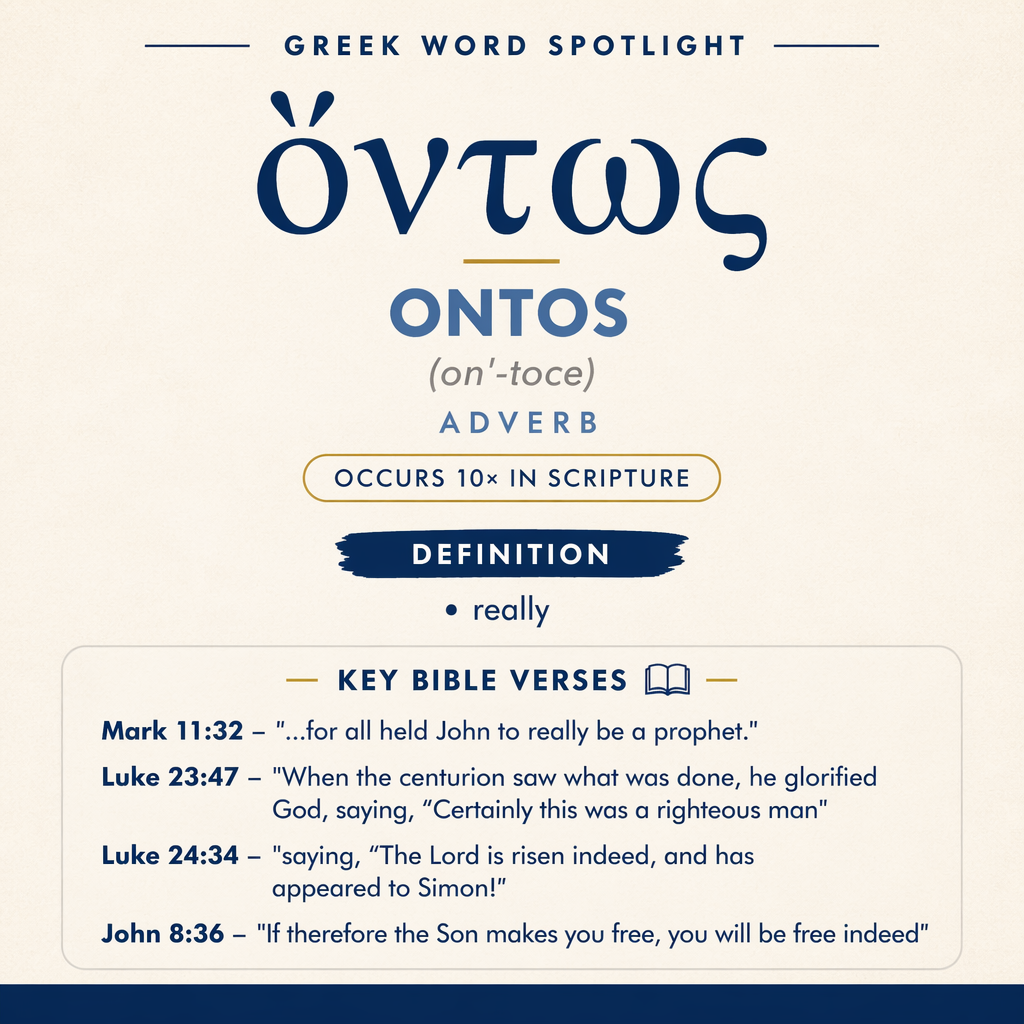
ὄντως means “really/indeed” and occurs 10 times in Scripture, including Mark 11:32; Luke 23:47; Luke 24:34; and John 8:36.
Core Meaning
ὄντως is used to affirm something as genuinely true: “really,” “certainly,” or “indeed.”
Learn More →Gospel Examples
It strengthens statements like “John to really be a prophet” (Mark 11:32), “Certainly this was a righteous man” (Luke 23:47), and “The Lord is risen indeed” (Luke 24:34).
Learn More →Apostolic Usage
It appears in teaching such as “you will be free indeed” (John 8:36) and “Honor widows who are widows indeed” (1 Timothy 5:3; 5:5).
Learn More →ὄντως expresses the idea of what is real or genuine, marking a statement as corresponding to reality rather than appearance, rumor, or assumption. In the New Testament it appears in scenes of public opinion, confession, reassurance, and pastoral instruction, repeatedly pressing the question of what truly is the case.
Occurrences
“If we should say, ‘From men’ ”—they feared the people, for all held John to really be a prophet.” (Mark 11:32)
Here ὄντως strengthens the crowd’s assessment of John: he was not merely treated as if he were a prophet or spoken of in prophetic terms; he was held to be one in reality. Within the sentence, the adverb functions as the decisive reason the speakers “feared the people”: the people’s settled conviction about John’s true status creates social pressure and makes a merely strategic answer dangerous.

“When the centurion saw what was done, he glorified God, saying, “Certainly this was a righteous man.”” (Luke 23:47)
In this confession, ὄντως (rendered “Certainly”) attaches to the centurion’s judgment and presents it as a conclusion drawn from what he “saw.” The statement is framed as more than a passing remark; it is an affirmation of what is truly the case about the man described as “righteous,” voiced as praise to God in response to the observed events.
“saying, “The Lord is risen indeed, and has appeared to Simon!”” (Luke 24:34)
ὄντως intensifies the proclamation “The Lord is risen,” insisting on the reality of the resurrection as an established fact rather than a hopeful report. The added clause, “and has appeared to Simon,” supports that insistence by anchoring the claim in an appearance, so that “indeed” functions as a stamp of actuality on the announcement being shared.
“If therefore the Son makes you free, you will be free indeed.” (John 8:36)
In this conditional promise, ὄντως distinguishes a freedom that is real from any freedom that might be claimed without effect. The adverb falls on the second clause (“you will be free indeed”), highlighting the result of the Son’s action as freedom in truth and in fact—freedom that corresponds to what the word “free” properly signifies in the sentence.
“And thus the secrets of his heart are revealed. So he will fall down on his face and worship God, declaring that God is among you indeed.” (1 Corinthians 14:25)
Here ὄντως appears in the mouth of an onlooker responding to revealed “secrets.” The person’s bodily reaction (“fall down on his face”) and worship culminate in a declaration about God’s presence: “God is among you indeed.” The adverb underscores that this is not a polite religious compliment or a vague spiritual impression; it is presented as recognition of a real presence inferred from what has occurred.
“Is the law then against the promises of God? Certainly not! For if there had been a law given which could make alive, most certainly righteousness would have been of the law.” (Galatians 3:21)
Although the verse uses emphatic language twice (“Certainly not!” and “most certainly”), ὄντως serves to reinforce the certainty of the argument’s conclusion. The adverb contributes to the tight logical structure: it marks the hypothetical outcome (“righteousness would have been of the law”) as a genuinely consequent result if the stated condition were true, thereby sharpening the force of the reasoning.
“Honor widows who are widows indeed.” (1 Timothy 5:3)
In this instruction, ὄντως narrows the category “widows” to those who truly fit the designation intended by the command. The adverb functions as a qualifier with practical consequences: honor is directed not merely to anyone bearing the label, but to those whose situation corresponds to what “widow” is meant to denote in this context.
“Now she who is a widow indeed and desolate, has her hope set on God, and continues in petitions and prayers night and day.” (1 Timothy 5:5)
ὄντως again defines the true instance of “widow,” now described with accompanying features: “desolate,” hoping in God, and persisting “in petitions and prayers night and day.” The adverb does not simply intensify emotion; it anchors a profile. The sentence presents a “widow indeed” as one whose circumstances and pattern of life align with the reality the community is to recognize and respond to.
“If any man or woman who believes has widows, let them relieve them, and don’t let the assembly be burdened, that it might relieve those who are widows indeed.” (1 Timothy 5:16)
Here ὄντως marks a distinction that governs responsibility. Those “who believes” and “has widows” must “relieve them,” so that the assembly is not burdened and can focus its relief on “those who are widows indeed.” The adverb thus serves an allocating function: it helps separate cases where private support is possible from cases where genuine need qualifies someone for the assembly’s care.
“laying up in store for themselves a good foundation against the time to come, that they may lay hold of eternal life.” (1 Timothy 6:19)
In this line, the verse concludes with “eternal life” as the goal to be seized. ὄντως contributes an emphasis on the reality of that life—life not merely spoken about but genuinely grasped—so that the exhortation’s horizon is not an abstract ideal but something presented as truly attainable and worth preparing for.

Sense and Usage
Across these passages ὄντως consistently functions as an adverb of reality, pressing speech toward what is genuine. In narrative settings it marks judgments formed from observation and shared conviction. Mark 11:32 portrays a public consensus: John was held to be a prophet in reality, and that conviction shapes the leaders’ fear. Luke 23:47 likewise places ὄντως on a verdict drawn from what the centurion “saw,” converting sight into a confident confession. Luke 24:34 uses it in proclamation, where the point is not simply that the claim is uplifting, but that it is a fact now being affirmed and supported by testimony (“has appeared to Simon”).
In declarative teaching, ὄντως distinguishes a promised condition from a weaker or merely apparent counterpart. John 8:36 sets “free indeed” as the real outcome when the Son acts; the adverb heightens the contrast between a word and its fulfillment. In 1 Corinthians 14:25, ὄντως appears in a response to disclosed “secrets,” where the reality of God’s presence is recognized as an implication of events that pierce through surface impressions. The adverb helps the confession function as a conclusion: revelation leads to worship, worship to declaration, and the declaration is marked as corresponding to reality.
In the pastoral instructions of 1 Timothy 5, ὄντως becomes a tool for careful definition. The repeated phrase “widow indeed” shows the adverb’s capacity to qualify a social designation by pointing to the true case, not simply the name. The context then supplies what “true” looks like in practice: a widow “indeed” can be described as “desolate,” as one who “has her hope set on God,” and as one who continues “in petitions and prayers night and day.” In 5:16, the same qualifier supports an orderly distribution of care: the assembly’s relief is reserved for those who genuinely fit the intended category, while others receive support from believing relatives. Here ὄντως is not abstract emphasis; it shapes concrete decisions.
Galatians 3:21 places ὄντως within argumentation where certainty matters. The passage’s emphatic tone frames the conclusion as firmly established: if the hypothetical condition were met, the consequent would follow in a real and decisive way. The adverb thus supports the firmness of the reasoning rather than introducing a new idea. Finally, in 1 Timothy 6:19, ὄντως strengthens the call to grasp “eternal life” as something real—an object of hope presented as substantive enough to orient present action (“laying up… a good foundation against the time to come”).
Imagery
Though ὄντως is a small word, these passages repeatedly place it at moments where reality breaks through uncertainty: a crowd’s settled conviction, a soldier’s confession, a resurrection announcement, freedom made effective, hidden “secrets” exposed, and the identification of genuine need. Its effect is to make speech answerable to what is truly so.
Sources: Lexical data from Strong’s Exhaustive Concordance and the Translators Brief Lexicon of Extended Strongs for Greek (STEPBible, CC BY). Occurrence data from the Translators Amalgamated Greek New Testament (STEPBible, CC BY). Scripture quotations from the World English Bible (public domain).