Exploring the Meaning of ‘odem in Hebrew
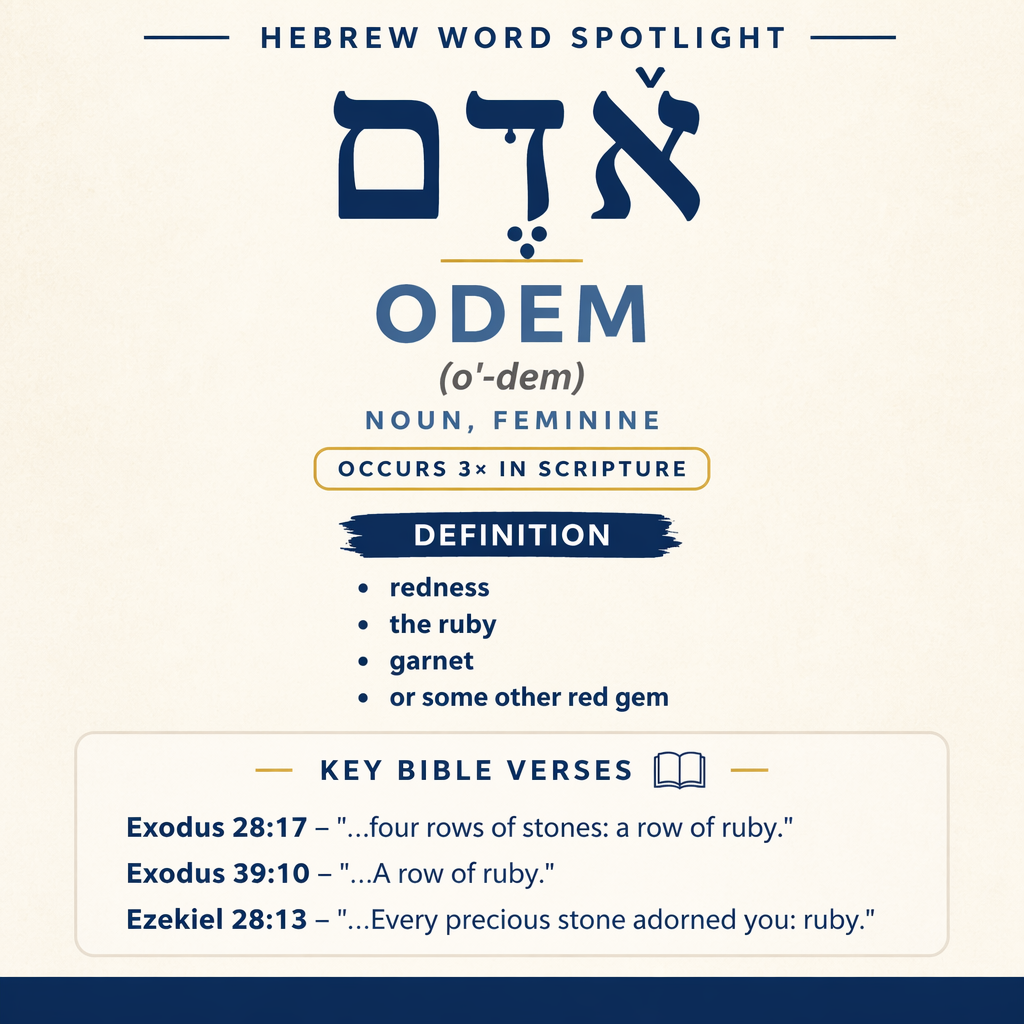
אֹדֶם means “redness” and refers to a ruby, garnet, or another red gem, appearing in Exodus 28:17, Exodus 39:10, and Ezekiel 28:13.
Core Meaning
אֹדֶם denotes “redness” and can refer to a ruby, garnet, or some other red gemstone.
Learn More →Priestly Stones
In Exodus 28:17 and 39:10, אֹדֶם names the first stone in the first row of the breastpiece settings.
Learn More →Eden Adornment
In Ezekiel 28:13, אֹדֶם is listed among the precious stones adorning one described as being in Eden, the garden of God.
Learn More →אֹדֶם (odem) denotes “redness,” and by extension “the ruby; garnet; or some other red gem.” In Scripture it appears in descriptions of precious stones used for sacred craftsmanship and in a poetic portrayal of lavish adornment.
Occurrences
“You shall set in it settings of stones, four rows of stones: a row of ruby, topaz, and beryl shall be the first row;” (Exodus 28:17)
Here odem is the first named stone in an ordered arrangement: “four rows of stones,” beginning with “a row of ruby.” The verse frames the gem as part of “settings of stones,” emphasizing careful placement and structured design. Odem functions as a marker of visual richness within a larger, intentionally organized set—one row among several, yet singled out as the starting point of the sequence. Its association with “settings” and “rows” places the term in the world of skilled workmanship, where color and material value are fitted into a patterned whole.
“They set in it four rows of stones. A row of ruby, topaz, and beryl was the first row;” (Exodus 39:10)
This verse restates the same ordered arrangement in a report of execution: “They set in it four rows of stones.” Odem again heads the first row, now in the completed work rather than the instruction. In this setting the term contributes a sense of faithful realization of a design: the gem is not merely imagined but “set” into place. The repetition of the sequence underscores that odem belongs to a defined set of materials selected for a particular crafted object, and that its placement is deliberate—its value lies not only in being a precious stone but also in being properly fitted into a larger arrangement of stones.
“You were in Eden, the garden of God. Every precious stone adorned you: ruby, topaz, emerald, chrysolite, onyx, jasper, sapphire, turquoise, and beryl. Gold work of tambourines and of pipes was in you. They were prepared in the day that you were created.” (Ezekiel 28:13)
In Ezekiel the word appears in a striking catalogue of splendor: “Every precious stone adorned you,” followed by a list in which “ruby” is named first. Odem contributes to the portrayal of adornment as overwhelming and comprehensive—an abundance of costly materials covering and decorating the subject of the address. The scene is set in “Eden, the garden of God,” and the gem functions within a depiction of pristine, elevated beauty. The verse also pairs the stone-adornment with “Gold work of tambourines and of pipes,” presenting odem alongside precious metal craftsmanship and elaborate preparation: “They were prepared in the day that you were created.” In this context, odem helps express the intensity of ornamentation: beauty that is not incidental but prepared and composed of prized materials.
Sense and Usage
Across these three occurrences, odem operates within the world of precious stones, where “redness” is not an abstract color term but a defining quality of a gem used for display and distinction. The definition allows for reference to “the ruby; garnet; or some other red gem,” and the verses consistently place odem among other named stones, suggesting that its significance is recognized by its place in a standard inventory of valuable materials. In Exodus, the gemstone sense dominates: odem is part of “settings of stones” arranged in “four rows,” an environment where visual effect, material worth, and craftsmanship converge. The gem is not mentioned alone; it is grouped with other stones (“topaz, and beryl”) and integrated into a structured pattern (“the first row”). This setting foregrounds the practical side of odem: a stone chosen for inclusion, measured into a row, and set into a crafted object.
At the same time, the underlying idea of “redness” gives odem a vivid visual role within these lists. The text does not describe hue directly, but the term’s sense implies a red stone whose color would be perceptible and significant in an arrangement of different gems. In a multi-stone setting, the distinctiveness of a red gem contributes to the overall visual richness and contrast implied by a “row” containing several varieties. Thus odem functions as a color-bearing, high-value material whose appearance is part of the intended effect of the finished work.
Ezekiel 28:13 extends the same gemstone usage into a more sweeping, imagistic portrayal. The gem is still part of a list, but the list now serves a rhetorical purpose: “Every precious stone adorned you.” In that sentence, odem participates in the image of total adornment, where the abundance of precious stones is itself the point. The word thus supports an aesthetic of magnificence—adornment that is comprehensive (“Every precious stone”), elevated in setting (“Eden, the garden of God”), and connected with fine workmanship (“Gold work”). While Exodus presents odem in ordered craftsmanship, Ezekiel presents it in luxuriant ornamentation; both uses are compatible with the definition, showing the term’s range from technical description within crafted settings to poetic accumulation within a depiction of splendor.
In each passage, odem appears first in its respective sequence. In Exodus it begins “the first row”; in Ezekiel it begins the list of “precious stone” adornments. This consistent initial placement gives the gem a prominent rhetorical position in the ordering of materials, whether the order is for construction or for evocative description. The word’s meaning—anchored in the idea of a red gemstone—naturally lends itself to prominence: red is a strong visual cue, and within a series of precious stones it functions as a striking element in the overall effect of beauty and value described by the text.
Imagery
Odem carries the imagery of intense, crafted beauty: a red gem set among other stones in precise rows, and a red gem included in a cascade of precious materials that “adorn” in Edenic splendor. In Exodus 28:17 and 39:10, the word evokes the careful work of setting stones into an ordered design. In Ezekiel 28:13, it evokes adornment so rich that it is described as “Every precious stone,” with odem standing at the head of the array, part of a prepared and richly worked creation.
Sources: Lexical data from Strong’s Exhaustive Concordance and the Open Scriptures Hebrew Lexicon. Occurrence data from the Westminster Leningrad Codex with STEPBible reference data (CC BY). Scripture quotations from the World English Bible (public domain).