Exploring the Meaning of Ochuroma in Greek
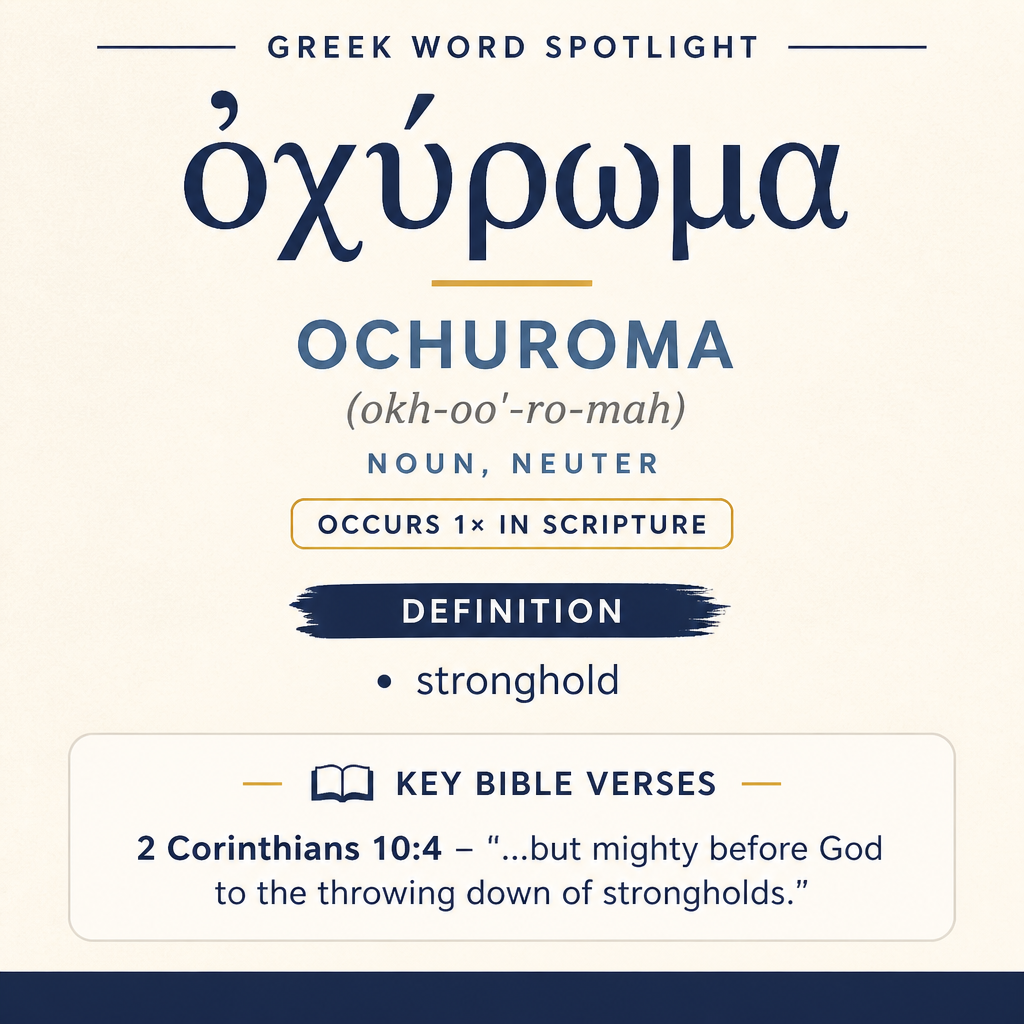
ὀχύρωμα means “stronghold” and appears once in Scripture in 2 Corinthians 10:4.
Scripture Occurrence
The word occurs 1 time in Scripture. Its single occurrence is in 2 Corinthians 10:4.
Learn More →Verse Context
In 2 Corinthians 10:4, it appears in the phrase “to the throwing down of strongholds.”
Learn More →ὀχύρωμα means “stronghold” and appears once in the New Testament, in Paul’s discussion of the character of Christian warfare. In its single use it is set within an image of conflict in which God-given power is directed toward the “throwing down” of such fortifications.
Root and Related Words
ὀχύρωμα is related (per Strong’s) to the verb echo (ἔχω), “to have/be” (Strong’s G2192). The relationship highlights the idea of something held or maintained—an established position that stands as a fixed presence within the imagery of conflict.

Occurrences
“for the weapons of our warfare are not of the flesh, but mighty before God to the throwing down of strongholds,” (2 Corinthians 10:4)
In 2 Corinthians 10:4, ὀχύρωμα names the target of an assault carried out by “the weapons of our warfare.” The verse contrasts two kinds of capacity: what is “of the flesh” and what is “mighty before God.” Within that contrast, “strongholds” function as the sort of object that resists ordinary force and therefore calls for power that is not merely human. The phrase “to the throwing down of strongholds” assigns ὀχύρωμα a concrete role in the sentence: it is not the battlefield itself, nor the weapon, but the entrenched structure that must be pulled down.
The verbal idea “throwing down” frames the stronghold as something elevated or established—something that stands until an opposing force brings it down. Paul’s imagery does not describe a slow erosion or negotiation; it portrays decisive reversal, where what is fortified is toppled. By pairing “mighty before God” with the action directed against these strongholds, the line portrays ὀχύρωμα as a serious obstacle—one that requires a kind of strength that comes “before God,” that is, in God’s presence and under God’s authority.
The same sentence also narrows the kind of warfare in view: it is “our warfare,” and its weapons are specifically distinguished from “the flesh.” In that setting, “strongholds” are not introduced as literal city defenses within the verse’s wording; rather, the term supports a figurative portrayal of resistance that confronts the community addressed. The word’s strength lies in its capacity to evoke the solidity of fortifications while the surrounding language insists that the effective counterforce is not physical but God-empowered.
Sense and Usage
The definition “stronghold” carries a spatial and structural feel: a stronghold is not merely a momentary obstacle but a defended position. In Paul’s single use, that sense is activated through two linked features in the verse: (1) the contrast between fleshly means and God-mighty means, and (2) the specified result, “the throwing down.” The first feature implies that the obstacle is not overcome by ordinary resources; the second implies that the outcome is the collapse of what has been fortified.
Because ὀχύρωμα appears in the plural (“strongholds”), the verse presents more than one fortified position. The plural supports the idea of repeated or multiple points of resistance—fortified places that stand in the way and thus become the objects of sustained conflict. The plural also widens the image: rather than a single central fortress, there are numerous strongholds, each requiring the same God-enabled effectiveness for their overthrow.
The placement of ὀχύρωμα after a statement about “the weapons of our warfare” makes the term serve as a kind of measure for those weapons. Weapons are judged by what they can accomplish; here, their described capability is precisely that they are “mighty before God” and therefore adequate “to the throwing down of strongholds.” In other words, the stronghold is the yardstick of difficulty: to throw down a stronghold is to overcome something that would normally seem secure. The word thus intensifies the portrayal of divine empowerment by naming a target that, by nature, is built to withstand attack.
The action implied toward ὀχύρωμα is not occupation or capture in the verse’s wording but demolition: “throwing down.” This shapes how “stronghold” is heard in the passage. The focus is on the removal of what has been fortified rather than the mere bypassing of it. That emphasis gives the word an image of entrenched resistance being undone—fortification meeting a superior power.
Imagery
In 2 Corinthians 10:4, ὀχύρωμα brings the picture of high, defended structures into a sentence about warfare whose weapons are “not of the flesh.” The stronghold image supplies weight and solidity to what must be opposed, while the “throwing down” language supplies the picture of collapse—fortifications coming down under a power described as “mighty before God.”
Sources: Lexical data from Strong’s Exhaustive Concordance and the Translators Brief Lexicon of Extended Strongs for Greek (STEPBible, CC BY). Occurrence data from the Translators Amalgamated Greek New Testament (STEPBible, CC BY). Scripture quotations from the World English Bible (public domain).