
Exploring the Meaning of Nous in Greek
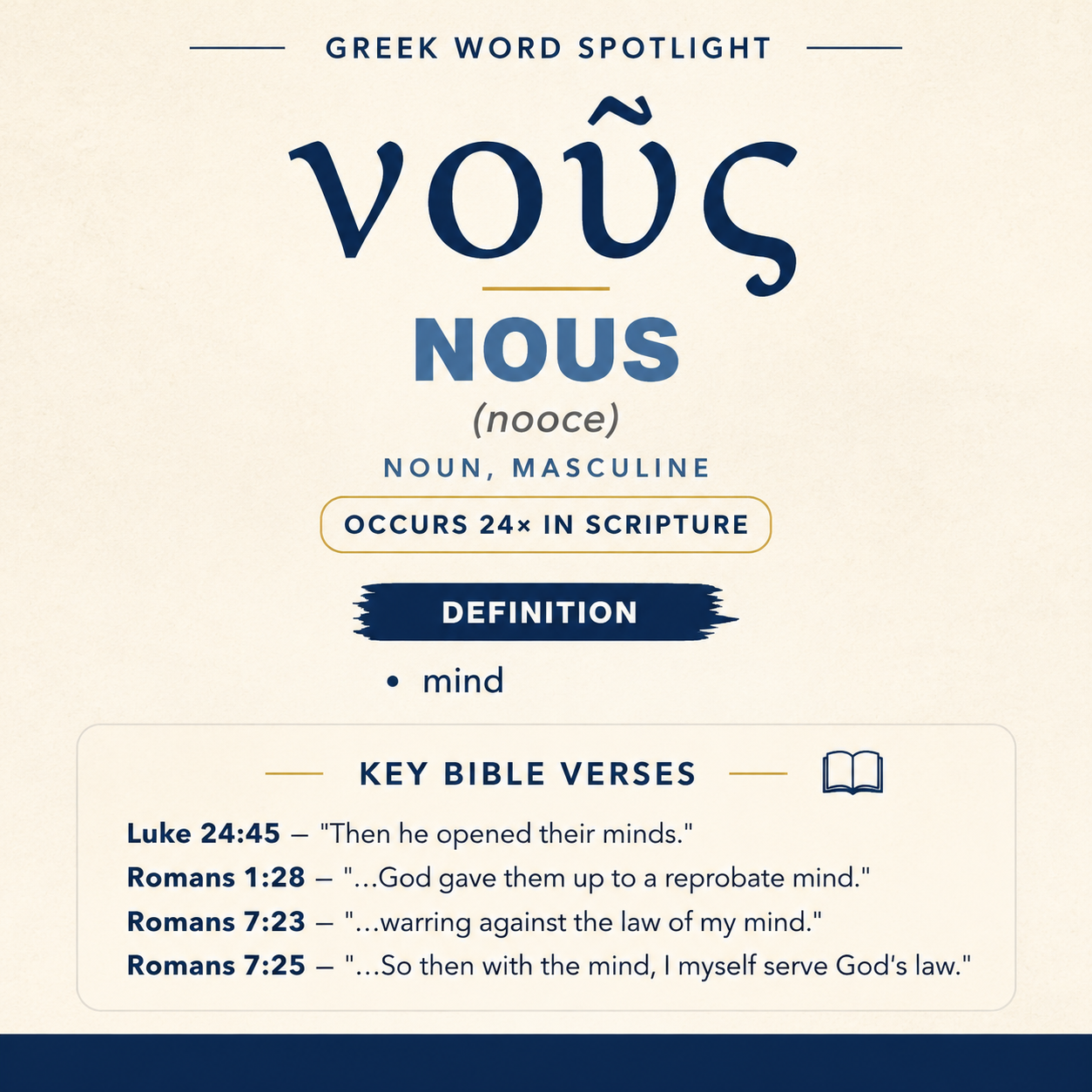
νοῦς (Nous) means “mind” in Greek and occurs 24 times in Scripture, including Luke 24:45 and multiple passages in Romans and 1 Corinthians.
Scripture Occurrences
νοῦς occurs 24 times in Scripture. Listed examples include Luke 24:45; Romans 1:28; 7:23, 7:25; 11:34; 12:2; 14:5; and 1 Corinthians 1:10.
Learn More →Usage Examples
Luke 24:45 says Jesus opened their minds to understand the Scriptures. Romans uses νοῦς in phrases like “reprobate mind” (1:28) and “renewing of your mind” (12:2).
Learn More →νοῦς means “mind.” In the passages where it appears, it names the inner faculty that can be opened to grasp Scripture, renewed for discernment, set on serving God’s law, or described as corrupted and misdirected.
Occurrences
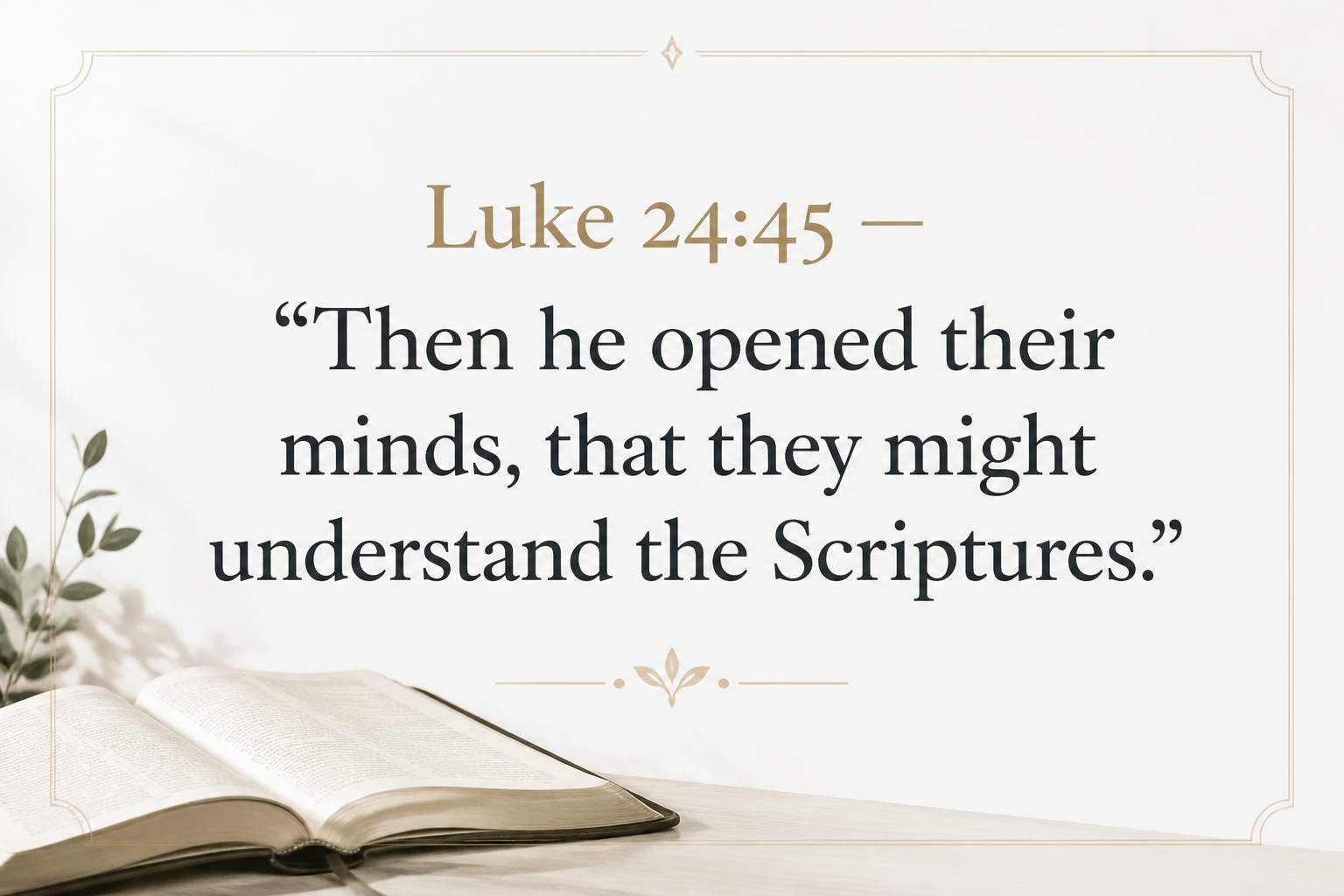
Luke 24:45 — “Then he opened their minds, that they might understand the Scriptures.”
Here νοῦς is the capacity for understanding, pictured as something that can be “opened.” The result of this opening is comprehension of “the Scriptures,” so the mind is presented as the place where understanding takes shape, not merely the storage of facts.
Romans 1:28 — “Even as they refused to have God in their knowledge, God gave them up to a reprobate mind, to do those things which are not fitting;”
In this scene, the mind is portrayed in moral and directional terms: a “reprobate mind” is linked to conduct—“to do those things which are not fitting.” The verse connects refusal in “knowledge” with being handed over to a mind that issues in distorted practice, showing the mind as an engine for decisions and actions.
Romans 7:23 — “but I see a different law in my members, warring against the law of my mind, and bringing me into captivity under the law of sin which is in my members.”
νοῦς is placed within an inner conflict. The “law of my mind” is opposed by “a different law in my members,” and the struggle is described as warfare that can end in “captivity.” The mind here is not neutral; it is aligned with a “law” and participates in resistance, yet can be overpowered by another force operating through the body (“members”).
Romans 7:25 — “I thank God through Jesus Christ, our Lord! So then with the mind, I myself serve God’s law, but with the flesh, sin’s law.”
This verse makes the mind the sphere of service: “with the mind…serve God’s law.” Set beside “with the flesh, sin’s law,” νοῦς marks the inward side of allegiance and obedience. The contrast assigns the mind a decisive role in orientation toward “God’s law,” even while acknowledging competing impulses tied to “the flesh.”
Romans 11:34 — ““For who has known the mind of the Lord? Or who has been his counselor?””
Here νοῦς refers to “the mind of the Lord,” presented as beyond ordinary human access (“who has known…”). The rhetorical question sets the Lord’s mind as the seat of counsel and wisdom, and it denies the possibility that anyone could stand over it as adviser (“his counselor”).
Romans 12:2 — “Don’t be conformed to this world, but be transformed by the renewing of your mind, so that you may prove what is the good, well-pleasing, and perfect will of God.”
νοῦς is the hinge between outward pressure (“this world”) and inward change (“be transformed”). Renewal of the mind is described as the means by which a person comes to “prove” God’s will in its qualities (“good, well-pleasing, and perfect”). The mind is thus the arena where transformation is effected and where discernment becomes possible.
Romans 14:5 — “One man esteems one day as more important. Another esteems every day alike. Let each man be fully assured in his own mind.”
The mind here is the locus of settled conviction amid differing judgments. The issue is evaluation (“esteems”) of days, and the instruction is not uniformity of conclusion but firmness: each should be “fully assured in his own mind.” νοῦς therefore names the internal place where a person reaches certainty and stability in a disputed matter.
1 Corinthians 1:10 — “Now I beg you, brothers, through the name of our Lord, Jesus Christ, that you all speak the same thing, and that there be no divisions among you, but that you be perfected together in the same mind and in the same judgment.”
In this appeal for unity, νοῦς is communal: “the same mind” belongs to a reconciled church life without “divisions.” The pairing with “the same judgment” ties mind to shared evaluation and purpose, and “be perfected together” frames the mind as something that can be brought into harmony through maturity and restoration of relationships.
1 Corinthians 2:16 — ““For who has known the mind of the Lord, that he should instruct him?” But we have Christ’s mind.”
The verse echoes the earlier question about knowing the Lord’s mind, then pivots to a claim of participation: “we have Christ’s mind.” νοῦς is again tied to instruction—no one can instruct the Lord—yet the community is described as possessing a mind characterized by Christ, which implies a shared perspective that stands over against merely human instruction.
1 Corinthians 14:14 — “For if I pray in another language, my spirit prays, but my understanding is unfruitful.”
In a discussion of prayer and intelligibility, νοῦς appears in the form rendered “understanding.” The contrast between “my spirit prays” and “my understanding is unfruitful” presents the mind as the part that bears fruit through comprehension. When speech is not understood, the mind’s productive role—grasping and forming meaningful content—is left inactive.
1 Corinthians 14:15 — “What is it then? I will pray with the spirit, and I will pray with the understanding also. I will sing with the spirit, and I will sing with the understanding also.”
Here the mind (“understanding”) is coordinated with “the spirit” in both prayer and singing. νοῦς contributes the element of intelligible, purposive engagement: praying and singing are not reduced to one inner dimension, but are to include the mind so that worship is consciously directed and grasped.
1 Corinthians 14:19 — “However in the assembly I would rather speak five words with my understanding, that I might instruct others also, than ten thousand words in another language.”
In the gathered church (“in the assembly”), νοῦς is linked to teaching value. “Five words with my understanding” are preferred because they enable instruction of others, while “ten thousand words in another language” lack that edifying effect. The mind here is the condition for intelligible speech that can build up the community through instruction.

Sense and Usage
Across these contexts, νοῦς consistently names the inner center of comprehension and judgment, but it is never portrayed as a merely private mental space. In Luke 24:45 it is opened so that Scripture can be understood, showing that the mind can be acted upon and enabled toward recognition. In Romans 12:2 the mind is renewed as the pathway to discerning God’s will; renewal is not described as an abstract improvement but as the means to test and recognize what aligns with God’s character and purpose.
Romans also places the mind within moral struggle and responsibility. Romans 1:28 depicts a “reprobate mind” resulting in conduct that is “not fitting,” binding mind and behavior together. Romans 7:23–25 develops a more internal drama, describing the mind as aligned with “God’s law” and yet contested by another “law” working through “members,” so that the mind can be the site of loyal service and also the front line in a battle that can lead to “captivity.” The mind is thus portrayed as capable of orientation and service, yet also vulnerable within the larger complexity of human experience.
Several occurrences present νοῦς as an object of comparison between divine and human perspectives. Romans 11:34 frames “the mind of the Lord” as unsearchable by any would-be counselor, highlighting the Lord’s incomparable counsel. 1 Corinthians 2:16 uses the same theme but draws out a community identity: “we have Christ’s mind.” Without expanding beyond the verse, the statement sets a contrast between the impossibility of instructing the Lord and the possibility of sharing a mind characterized by Christ, suggesting that νοῦς can describe not only an individual faculty but a shared stance among believers.
In congregational life and disputable judgments, νοῦς is the location of settled certainty and shared harmony. Romans 14:5 directs each person to be “fully assured” in his own mind regarding differing evaluations of days, emphasizing stability of conviction rather than external coercion. 1 Corinthians 1:10 shows the mind’s social dimension: unity includes being “perfected together in the same mind,” indicating that divisions are not only relational fractures but fractures in shared thinking and judgment.
Finally, 1 Corinthians 14 uses νοῦς for intelligible understanding in worship and speech. The repeated pairing with “spirit” shows that spiritual activity without understanding leaves the mind “unfruitful,” whereas prayer and song that include understanding involve the mind as an active participant. The preference for a few comprehensible words “that I might instruct others also” places the mind at the center of edification: it enables communication to carry meaning that can be received, understood, and taught.
Imagery
These passages picture the mind with vivid relational and functional imagery: a mind that can be “opened” to Scripture (Luke 24:45), “renewed” for discernment (Romans 12:2), pressed into service (Romans 7:25), or dragged toward “captivity” in inner conflict (Romans 7:23). The mind can also be spoken of in communal terms—“the same mind” (1 Corinthians 1:10) and “Christ’s mind” (1 Corinthians 2:16)—so that νοῦς carries the idea of a shared posture that shapes speech, judgment, worship, and instruction.
Sources: Lexical data from Strong’s Exhaustive Concordance and the Translators Brief Lexicon of Extended Strongs for Greek (STEPBible, CC BY). Occurrence data from the Translators Amalgamated Greek New Testament (STEPBible, CC BY). Scripture quotations from the World English Bible (public domain).




