Exploring the Meaning of Nounechos in Greek
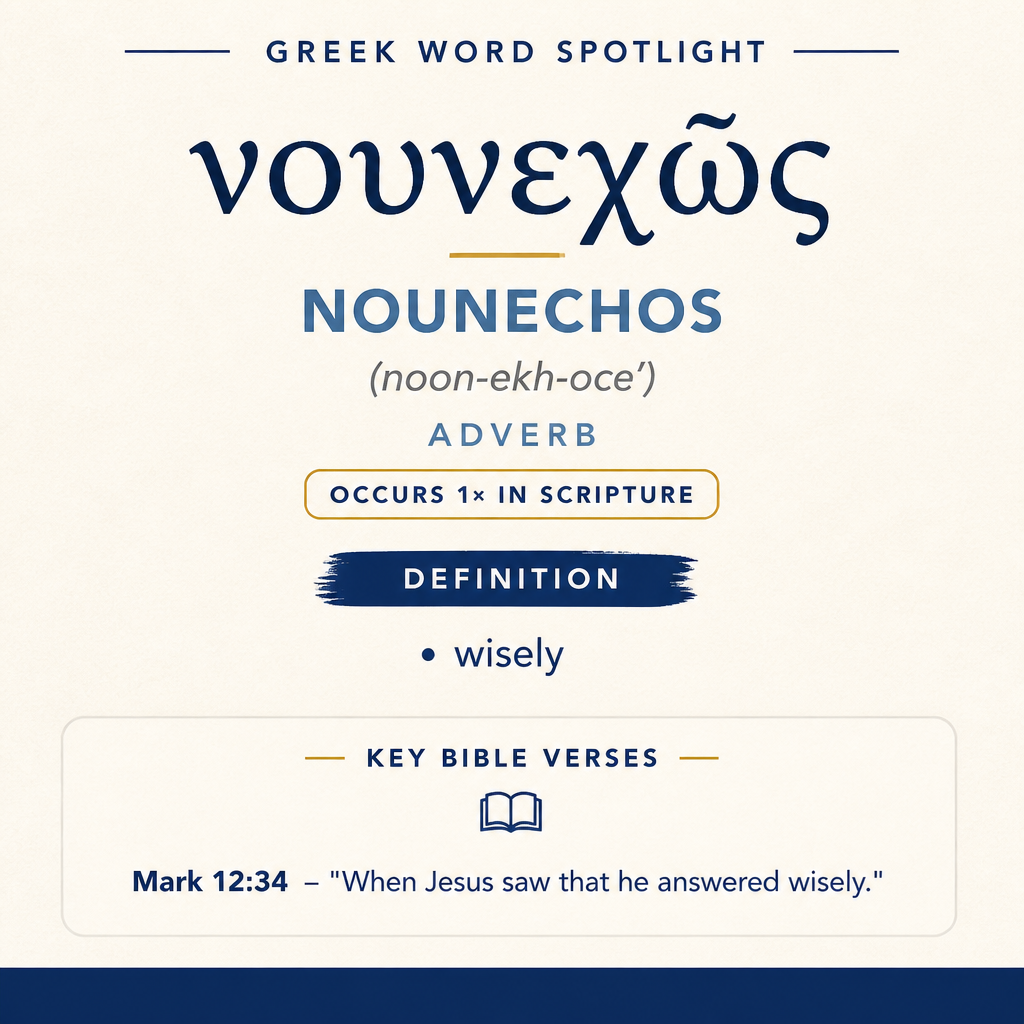
νουνεχῶς means “wisely” and appears once in Scripture, in Mark 12:34.
Context
In Mark 12:34, it describes how someone answered when Jesus observed his response.
Learn More →νουνεχῶς means “wisely” and appears in the Gospel scene where Jesus evaluates a scribe’s answer. The word marks the quality of the response that leads Jesus to speak of nearness to God’s Kingdom.
Root and Related Words
νουνεχῶς is connected with νοῦς (nous), “mind” (Strong’s G3563), and ἔχω (echo), “to have/be” (Strong’s G2192). Read together, these related words place νουνεχῶς in the realm of mental grasp and the possession or exercise of it, so that the adverb describes an answer as coming from a mind that is functioning as it should.

Occurrences
“When Jesus saw that he answered wisely, he said to him, “You are not far from God’s Kingdom.” No one dared ask him any question after that.” (Mark 12:34)
In this episode, νουνεχῶς attaches to the scribe’s answering and tells what sort of answering it was. The narrative does not portray Jesus merely hearing correct words; he “saw” something about the manner and quality of the response. By describing the answer as given “wisely,” the adverb points to an answer that displays discernment rather than rote repetition. It is the kind of response that invites assessment, because Jesus immediately responds to the scribe himself: “You are not far from God’s Kingdom.”
The adverb therefore functions as the hinge between the scribe’s speech and Jesus’ evaluation. Mark frames Jesus’ reply as triggered by the wise manner of the answer (“When Jesus saw…”), and the consequence is twofold in the quoted verse: first, a personal pronouncement about the man’s proximity to the Kingdom; second, a shift in the whole setting—“No one dared ask him any question after that.” The scene closes with silence from others, suggesting that the exchange has reached a kind of culmination. Within that closure, νουνεχῶς helps explain why the moment has weight: Jesus has encountered an answer marked by wisdom, and his recognition of it leaves the surrounding questioners without nerve to continue.
Sense and Usage
The force of “wisely” here is practical and observable: Jesus “saw” that the scribe answered in this way. νουνεχῶς is not presented as a hidden interior state inaccessible to the narrative; it is a quality evident in speech. In Mark 12:34, wisdom is tied to the act of answering—how the response is formed and offered—so the word highlights the competence of the reply as an act within a public exchange.
Because the adverb directly modifies answering, it also distinguishes between bare correctness and wisdom as a quality that can be recognized. The verse places νουνεχῶς before Jesus’ statement about God’s Kingdom, linking wise speech with being “not far” from that Kingdom. The wording does not equate wisdom with arrival, since “not far” still implies distance; yet it clearly treats wise answering as a significant indicator. νουνεχῶς, then, serves to mark a moment where Jesus acknowledges sound judgment in another person, and that acknowledgment becomes the ground for a measured commendation.
Finally, the closing line—“No one dared ask him any question after that”—shows νουνεχῶς working within the narrative’s social dynamics. A wisely given answer, recognized by Jesus, changes the room: questioning ceases. The adverb contributes to the sense that the exchange has resolved the tension of inquiry, not by shutting down discussion through force, but by bringing forth an answer that carries persuasive weight in the presence of Jesus’ authority.
Imagery
The single use of νουνεχῶς evokes the image of a public exchange in which a carefully formed answer is weighed and found sound. The scene’s movement—from a wise answer, to a Kingdom-focused assessment, to the silence of others—casts “wisely” as a quality that can steady a conversation and bring it to a decisive pause.
Sources: Lexical data from Strong’s Exhaustive Concordance and the Translators Brief Lexicon of Extended Strongs for Greek (STEPBible, CC BY). Occurrence data from the Translators Amalgamated Greek New Testament (STEPBible, CC BY). Scripture quotations from the World English Bible (public domain).