Exploring the Meaning of Nesteia in Greek
νηστεία means “fasting” and occurs 8 times in Scripture, including Matthew 17:21, Mark 9:29, Luke 2:37, Acts, and 1–2 Corinthians.
Core Meaning
νηστεία is defined as “fasting.” It appears in passages that directly mention fasting as a practice.
Learn More →Prayer and Fasting
Matthew 17:21 and Mark 9:29 link fasting with prayer. 1 Corinthians 7:5 also pairs fasting and prayer in a mutual marital context.
Learn More →Acts and Hardship
Acts 14:23 describes praying with fasting when appointing elders. 2 Corinthians 6:5 and 11:27 mention fastings among hardships and deprivations.
Learn More →νηστεία refers to fasting. It appears in Gospel scenes about deliverance, in the temple life of an aged widow, in the church’s practice of prayerful leadership, in a seasonal marker called “the Fast,” and in Paul’s descriptions of hardship and disciplined devotion.
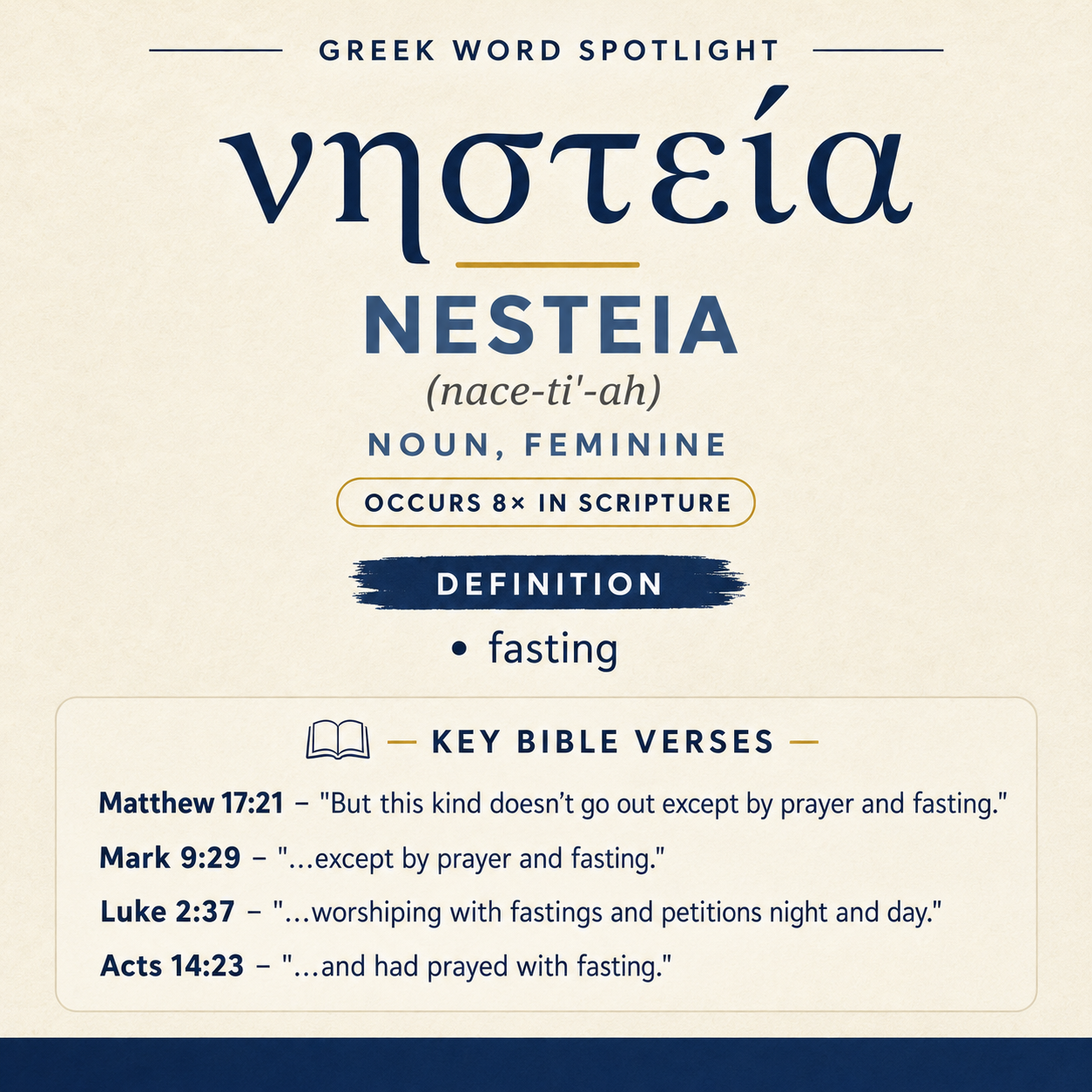
Occurrences
“But this kind doesn’t go out except by prayer and fasting.” (Matthew 17:21)
Here νηστεία is paired with prayer as an explicit condition attached to “this kind” going out. The saying frames fasting as part of a focused spiritual response to a stubborn, resistant situation: it stands alongside prayer as the stated means by which the desired outcome is obtained.

“He said to them, “This kind can come out by nothing, except by prayer and fasting.”” (Mark 9:29)
This parallel wording intensifies the exclusivity: “by nothing, except.” Within that tight construction, νηστεία is not an optional extra but belongs to what is named as the effective avenue for “this kind” to “come out.” The verse places fasting in a practical, outcome-oriented setting rather than as a mere ritual marker.
“and she had been a widow for about eighty-four years), who didn’t depart from the temple, worshiping with fastings and petitions night and day.” (Luke 2:37)
In this scene, νηστεία appears in the plural (“fastings”), presenting repeated or ongoing acts rather than a single event. The widow’s temple-centered life is described as “worshiping with fastings and petitions night and day,” so fasting is embedded in her continual worship practice, closely aligned with “petitions” and characterized by constancy (“night and day”).
“When they had appointed elders for them in every assembly, and had prayed with fasting, they commended them to the Lord, on whom they had believed.” (Acts 14:23)
Here νηστεία accompanies a congregationally significant action: appointing elders “in every assembly.” The phrase “had prayed with fasting” links fasting with prayer as the posture in which leaders are set in place and the communities are “commended…to the Lord.” Fasting functions as part of the community’s deliberate, reverent approach at a moment of responsibility and transition.
“When much time had passed and the voyage was now dangerous, because the Fast had now already gone by, Paul admonished them” (Acts 27:9)
In this narrative note, νηστεία appears as “the Fast,” a recognizable point on the calendar that helps explain why “the voyage was now dangerous.” Fasting here serves as a time marker: its passing signals a seasonal shift associated in the verse with increasing danger for travel. The term thus operates not only as a practice but as a known reference point for time and conditions.
“Don’t deprive one another, unless it is by consent for a season, that you may give yourselves to fasting and prayer, and may be together again, that Satan doesn’t tempt you because of your lack of self-control.” (1 Corinthians 7:5)
In marital instruction, νηστεία is again paired with prayer, but the setting is domestic and relational. The verse describes a limited period “by consent for a season” in which a couple may “give yourselves to fasting and prayer,” after which they should reunite. Fasting is treated as an intensive spiritual focus that can shape a couple’s temporary pattern of life, yet it is bounded by mutual agreement and concerns about temptation and self-control.
“in beatings, in imprisonments, in riots, in labors, in watchings, in fastings;” (2 Corinthians 6:5)
Here νηστεία is listed among hardships and exertions that mark Paul’s ministry experience. Placed alongside “beatings,” “imprisonments,” and “riots,” fasting is presented within a catalog of endurance rather than as a quiet devotional aside. The plural (“fastings”) suggests repeated episodes that belong to a larger pattern of strain and perseverance.
“in labor and travail, in watchings often, in hunger and thirst, in fastings often, and in cold and nakedness.” (2 Corinthians 11:27)
This second catalog is more expansive and pointed, and it places νηστεία near bodily need: “hunger and thirst,” then “fastings often.” The collocation allows fasting to be heard in close proximity to deprivation, even as the wording distinguishes “hunger and thirst” from “fastings.” The adverb “often” underscores frequency, making fasting a recurring feature within a broader picture of exposure (“cold and nakedness”) and sustained effort (“labor and travail,” “watchings often”).

Sense and Usage
Across these passages, νηστεία consistently denotes fasting, but its function varies with context. In Matthew 17:21 and Mark 9:29, fasting is tied to spiritual efficacy: it stands with prayer as the named means by which a difficult “kind” is expelled. The emphasis lies on the focused combination—prayer joined with fasting—within an exclusive formula (“except,” “by nothing, except”) that treats the pairing as decisive for that situation.
Luke 2:37 portrays fasting as a sustained rhythm of worship. The plural form (“fastings”) and the phrase “night and day” present fasting as recurring practice that accompanies petitions in a life oriented around the temple. This is fasting integrated into devotion over time, expressed as part of worship rather than described as preparation for a single crisis.
Acts 14:23 shows fasting within communal discernment and commissioning. The churches appoint elders, then “prayed with fasting” before commending them to the Lord. In this setting, fasting is not a private discipline only; it is woven into congregational action and accompanies prayer at a moment when leadership and trust in the Lord are foregrounded (“on whom they had believed”).
Acts 27:9 illustrates a different use: “the Fast” serves as a shared chronological reference. Even without describing the practice itself in that verse, the term is meaningful enough to anchor a judgment about conditions—“the voyage was now dangerous”—and to frame Paul’s admonition. νηστεία here has the communicative value of a known marker that signals the passage into a more perilous time for sailing.
In 1 Corinthians 7:5, fasting belongs to a carefully delimited season of spiritual concentration for a married couple. The verse guards the practice with boundaries: it must be “by consent,” it is “for a season,” and it is oriented toward “fasting and prayer.” The instruction then returns to reunion, connecting the limits of the fasting season with concerns about temptation and self-control. Fasting is thus treated as purposeful and real, but not allowed to disrupt ongoing marital responsibilities indefinitely.
Finally, in 2 Corinthians 6:5 and 2 Corinthians 11:27, fasting appears within apostolic hardship lists. In these contexts, fastings are not described as liturgical acts but as repeated experiences associated with ministry pressures and bodily strain. The repeated plural forms (“fastings,” “fastings often”) depict fasting as something that happens more than once and is characteristic of Paul’s lived conditions. Especially in 2 Corinthians 11:27, its proximity to “hunger and thirst” and other exposures gives it a concrete feel: fasting stands in the company of real deprivation and sleepless watchfulness, contributing to a portrait of endurance.
Imagery in Context
The passages supply two main kinds of imagery for νηστεία. One is concentrated spiritual engagement: prayer joined with fasting in moments of deliverance (Matthew 17:21; Mark 9:29), persistent worship (Luke 2:37), and weighty community decisions (Acts 14:23), including a temporary, agreed season within marriage (1 Corinthians 7:5). The other is embodied cost: fasting named among the rigors of ministry life (2 Corinthians 6:5; 2 Corinthians 11:27) and even used as a calendar hinge that signals danger at sea (Acts 27:9). Together these scenes keep fasting connected both to purposeful devotion and to the realities of time, weather, work, and the body.
Sources: Lexical data from Strong’s Exhaustive Concordance and the Translators Brief Lexicon of Extended Strongs for Greek (STEPBible, CC BY). Occurrence data from the Translators Amalgamated Greek New Testament (STEPBible, CC BY). Scripture quotations from the World English Bible (public domain).