Exploring the Meaning of Nazareth in Greek
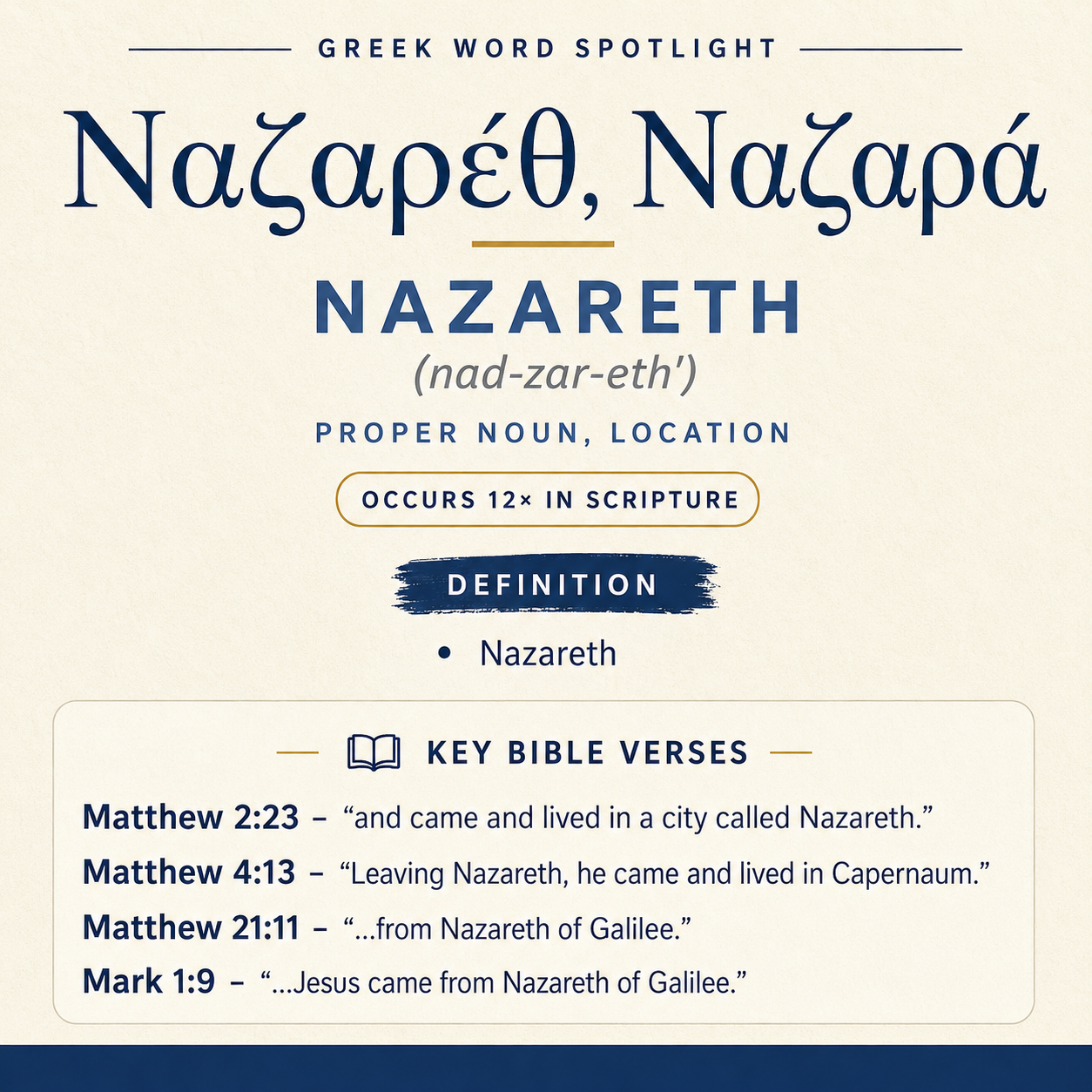
Ναζαρέθ / Ναζαρά means “Nazareth” and appears 12 times in Scripture, including Matthew, Mark, and Luke.
Gospel Occurrences
Nazareth appears in Matthew 2:23; 4:13; 21:11, Mark 1:9, and Luke 1:26; 2:4; 2:39; 2:51.
Learn More →Narrative Context
Jesus is identified as being from “Nazareth of Galilee” (Matthew 21:11; Mark 1:9). Joseph and Mary return to Nazareth after completing what was according to the law of the Lord (Luke 2:39).
Learn More →Nazareth is a place name used in the Gospels and in apostolic preaching to locate key moments in the story of Jesus. Across these passages it functions as a geographic anchor for origin, upbringing, movement, and public identification.
Occurrences
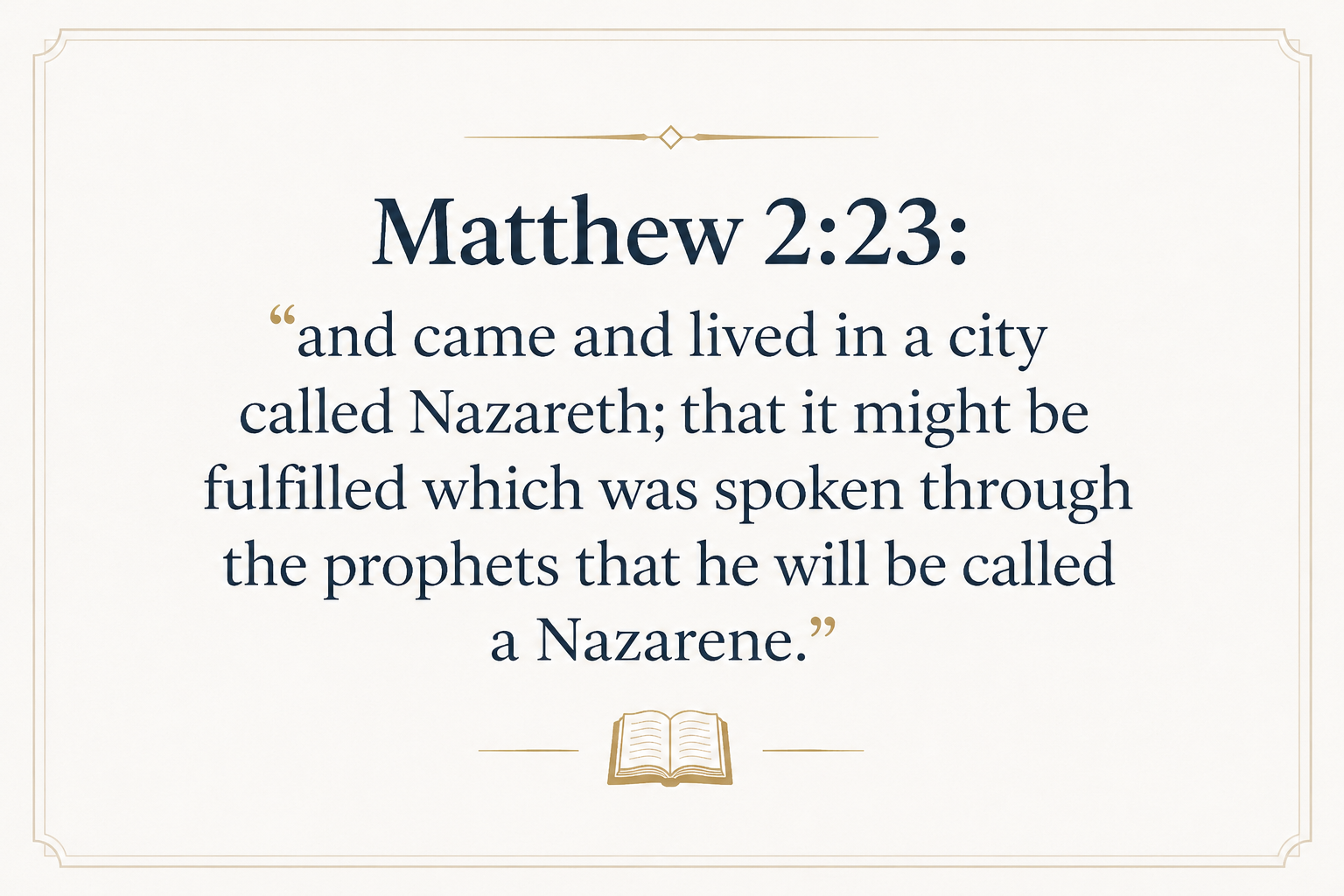
Matthew 2:23: “and came and lived in a city called Nazareth; that it might be fulfilled which was spoken through the prophets that he will be called a Nazarene.”
Here Nazareth is introduced as a “city” where Jesus lives, and the narrative ties that residence to the public label “a Nazarene.” The place name does more than mark an address: it supplies the geographic basis for a designation that will follow him.
Matthew 4:13: “Leaving Nazareth, he came and lived in Capernaum, which is by the sea, in the region of Zebulun and Naphtali,”
Nazareth is the point of departure. The verb “Leaving” makes the location a reference point for a change in residence, contrasted with Capernaum “by the sea.” In this sentence Nazareth functions as the earlier home base that is deliberately left behind.
Matthew 21:11: “The multitudes said, “This is the prophet, Jesus, from Nazareth of Galilee.””
Nazareth appears in the crowd’s identification of Jesus. The phrase “from Nazareth of Galilee” pairs the town with its larger region, presenting Nazareth as a defining element in how the public names and locates him: the prophet’s origin is stated with a specific hometown.
Mark 1:9: “In those days, Jesus came from Nazareth of Galilee, and was baptized by John in the Jordan.”
Nazareth again marks origin, but now within a travel-and-action sequence. Jesus “came from Nazareth of Galilee” to the Jordan, and the movement from that town sets the stage for baptism. The place name supplies the starting point for his arrival at the river.
Luke 1:26: “Now in the sixth month, the angel Gabriel was sent from God to a city of Galilee named Nazareth,”
In Luke, Nazareth is the destination of Gabriel’s mission. It is characterized as “a city of Galilee,” and the naming of Nazareth gives the annunciation scene a concrete setting—divine initiative is directed toward a particular, named town.
Luke 2:4: “Joseph also went up from Galilee, out of the city of Nazareth, into Judea, to David’s city, which is called Bethlehem, because he was of the house and family of David;”
Nazareth is Joseph’s point of origin for a journey “into Judea.” Luke’s phrasing—“out of the city of Nazareth”—makes the town the starting location from which Joseph “went up,” setting it opposite Bethlehem as the destination. The place name helps map the movement that frames the birth narrative.
Luke 2:39: “When they had accomplished all things that were according to the law of the Lord, they returned into Galilee, to their own city, Nazareth.”
Nazareth is described as “their own city,” a possessive way of speaking that highlights belonging and return. After completing what was “according to the law of the Lord,” the family’s movement resolves in Nazareth as the home to which they go back.
Luke 2:51: “And he went down with them, and came to Nazareth. He was subject to them, and his mother kept all these sayings in her heart.”
Nazareth is the location to which Jesus “came” with his parents, immediately followed by the statement “He was subject to them.” The place name silently frames a domestic setting: the town is where his obedient life within the family is pictured, while Mary’s inward reflection is mentioned in the same breath.
Luke 4:16: “He came to Nazareth, where he had been brought up. He entered, as was his custom, into the synagogue on the Sabbath day, and stood up to read.”
Nazareth is explicitly linked with upbringing: “where he had been brought up.” The town becomes the backdrop for synagogue worship—“as was his custom”—and for public reading on the Sabbath. The place name therefore carries social memory: it is the known hometown where familiar patterns of life are assumed.
John 1:45: “Philip found Nathanael, and said to him, “We have found him, of whom Moses in the law, and the prophets, wrote: Jesus of Nazareth, the son of Joseph.””
Nazareth here serves as an identifier in Philip’s announcement. “Jesus of Nazareth” is placed alongside “the son of Joseph,” combining geographic and familial descriptors. The town name functions as part of a composite identification meant to connect expectation (“of whom Moses… and the prophets, wrote”) with a recognizably located person.
John 1:46: “Nathanael said to him, “Can any good thing come out of Nazareth?” Philip said to him, “Come and see.””
Nazareth becomes the focus of skepticism: “Can any good thing come out of Nazareth?” The question treats the town as a source whose reputation can be weighed, and Philip’s reply shifts from argument to invitation—“Come and see”—implying that the place-based objection must be answered by encountering the person identified with that town.
Acts 10:38: “even Jesus of Nazareth, how God anointed him with the Holy Spirit and with power, who went about doing good and healing all who were oppressed by the devil, for God was with him.”
In Acts, Nazareth is preserved as part of the proclamation’s fixed naming: “Jesus of Nazareth.” The sermon then speaks of anointing, power, and a life “doing good and healing,” so the town name functions as a concrete tag attached to the subject of God’s action in history. The place name anchors the preached message in a known figure associated with a specific locality.

Sense and Usage
As a place name, Nazareth is used in these passages in several recurring ways. First, it marks origin and provenance: Jesus is “from Nazareth of Galilee” (Matthew 21:11) and “came from Nazareth of Galilee” (Mark 1:9). This is not merely directional language; it supplies a stable geographic descriptor by which people can speak of him. John’s Gospel shows this clearly when “Jesus of Nazareth” is presented as part of an identification formula (John 1:45), and Acts continues that same formula in public preaching (Acts 10:38).
Second, Nazareth functions as a home location defined by return and belonging. Luke emphasizes movement away from and back to it: Joseph leaves “out of the city of Nazareth” (Luke 2:4), the family “returned into Galilee, to their own city, Nazareth” (Luke 2:39), and Jesus “came to Nazareth” with his parents (Luke 2:51). The repeated arrivals frame Nazareth as the settled place where family life is resumed after journeys.
Third, Nazareth carries the sense of a socially recognized hometown, a place whose people would know the one associated with it. Luke states it directly: “Nazareth, where he had been brought up” (Luke 4:16). In that setting, the town is not a generic dot on a map; it is a community context where synagogue practice is “his custom,” and the act of standing to read unfolds within a familiar environment.
Finally, Nazareth can function rhetorically, as in Nathanael’s question (John 1:46). The town name becomes a shorthand for expectation or doubt about what kind of person could be associated with that place. In the narrative flow, the objection is not resolved by redefining the town, but by redirecting attention to personal encounter: “Come and see.” Thus Nazareth serves both as a geographic identifier and as a trigger for evaluation in conversation.
Imagery
In these texts Nazareth often appears in motion: leaving it (Matthew 4:13), coming from it (Mark 1:9), being sent to it (Luke 1:26), going out from it (Luke 2:4), returning to it (Luke 2:39), and coming to it (Luke 2:51; Luke 4:16). The place name repeatedly sits at the hinge between journeys and settled life, so that the story’s major acts—announcement, travel, baptism, synagogue reading, and proclamation—are continually tied back to a named town in Galilee.
Sources: Lexical data from Strong’s Exhaustive Concordance and the Translators Brief Lexicon of Extended Strongs for Greek (STEPBible, CC BY). Occurrence data from the Translators Amalgamated Greek New Testament (STEPBible, CC BY). Scripture quotations from the World English Bible (public domain).