
Exploring the Meaning of Naoum in Greek
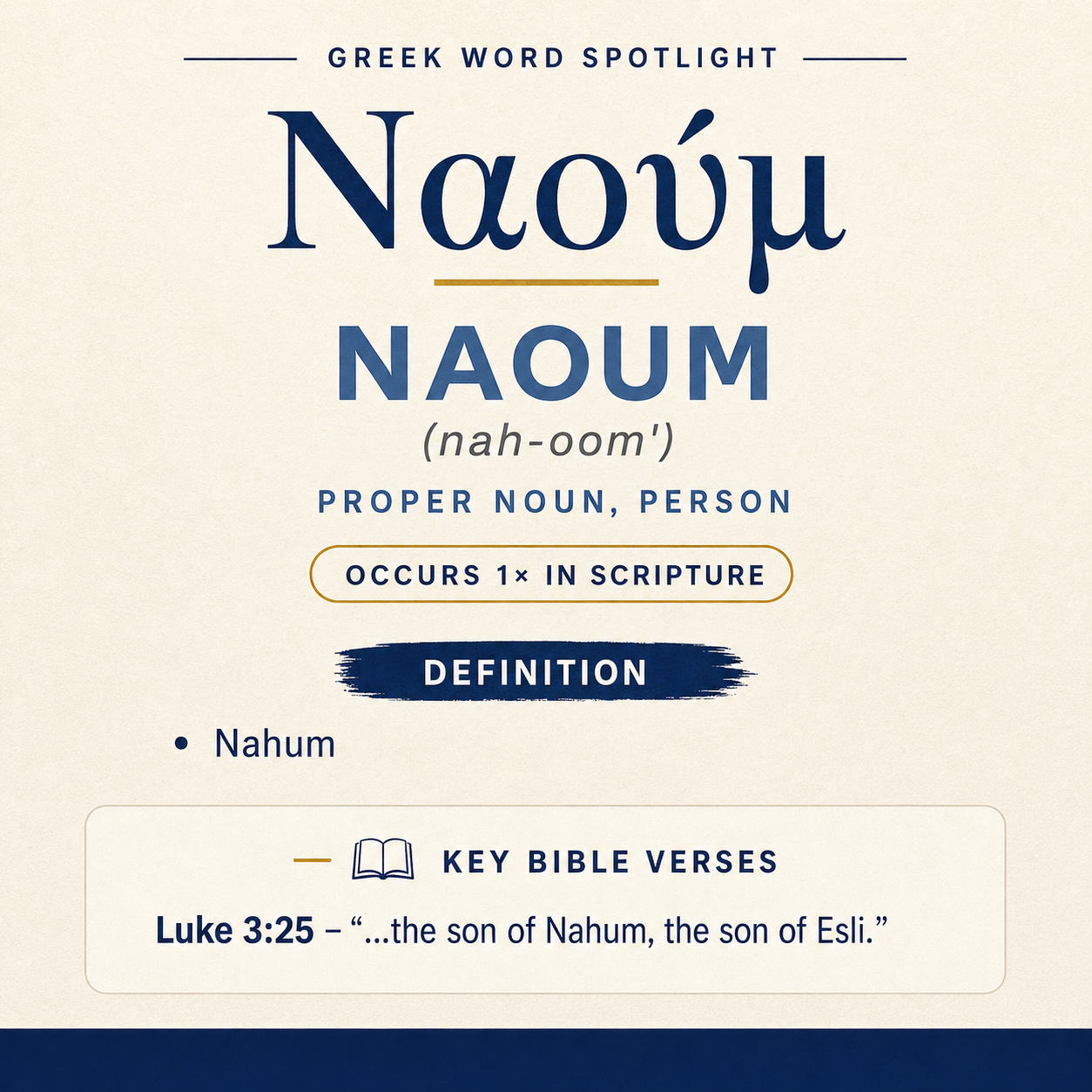
Ναούμ means “Nahum” and appears once in Scripture in Luke 3:25.
Context in Luke
In Luke 3:25, Nahum is listed in a genealogy. He is named as the son of Esli.
Learn More →Naoum is the personal name “Nahum,” appearing within the ancestral list in Luke’s Gospel. In that setting it functions as one link in a chain of descent, locating an individual within a remembered family line.
Occurrences
“the son of Mattathias, the son of Amos, the son of Nahum, the son of Esli, the son of Naggai,” (Luke 3:25)
Here Naoum designates a particular ancestor named Nahum inside a tightly structured sequence of “the son of …” relationships. The verse does not present Nahum’s actions, location, or speech; instead, the name serves a genealogical purpose, marking a specific node between Amos and Esli. By placing Nahum in the middle of a series, the text uses the name to maintain continuity—each named person connects two others and keeps the lineage intelligible as a line rather than a loose collection of names.
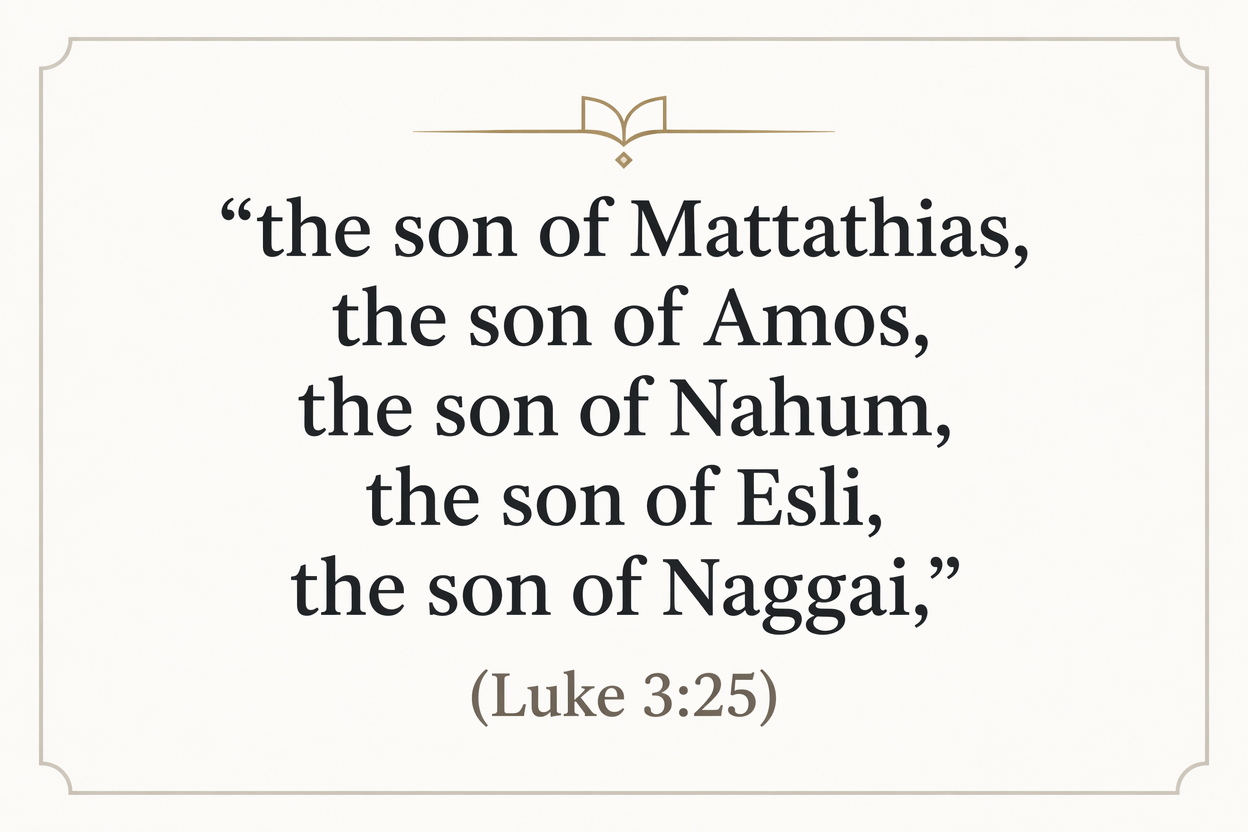
The immediate surroundings within the quotation make clear what Naoum contributes: it provides an identifying label for the father in one generational step (“the son of Amos, the son of Nahum, the son of Esli”). The repeated pattern creates a rhythmic, almost ledger-like presentation, and the presence of Nahum participates in that pattern without interruption. In this form of writing, a name is not merely a label but a relational marker; it signals that the person is known in the tradition chiefly through ancestry and descent, and that the claim being advanced by the genealogy depends on each link being stated plainly.

Sense and Usage
As used in Luke 3:25, Naoum functions as a straightforward personal name, “Nahum,” with no descriptive modifiers attached. Its semantic force lies not in additional attributes but in its role as a unique identifier. In a genealogy, a name like Nahum carries its weight by establishing relationships: the individual is defined, in the narrative’s immediate presentation, by being someone’s son and someone else’s father. The text’s emphasis is on lineage expressed through succession, and Naoum contributes by allowing one segment of that succession to be articulated precisely.
Because the verse presents a chain of descent rather than a narrative episode, the name’s usage is constrained and highly formal. It does not invite the reader to infer character traits or events; it anchors memory and identity in family structure. This is typical of genealogical discourse: the meaning of a name in context is carried by its placement and connections. Nahum’s placement between Amos and Esli prevents ambiguity in the line, ensuring that the descent moves from Mattathias to Amos to Nahum to Esli to Naggai in an orderly progression. The repetition of “the son of” also means that the name is inseparable from its relational function; it is heard and read as part of a formula that links generations.
Within this single attestation, Naoum also illustrates how proper names operate differently from common nouns in Scripture. A proper name in a genealogy does not primarily describe; it distinguishes. Luke’s listing is concerned with identification across generations, so each name, including Nahum, becomes a point of continuity that supports the broader claim of familial connection. Even without further elaboration, the name provides specificity: it is not “someone” in the line, but Nahum, a named person occupying a definite place in the succession.
Genealogical Imagery
Luke 3:25 presents Nahum as part of a long chain, and that chain imagery is the passage’s dominant effect: one link joined to another through repeated phrasing. In such a setting, Naoum evokes the concrete picture of lineage as a sequence—names laid out in order, each one bridging what comes before and after. Nahum’s appearance contributes to that sense of ordered continuity, where identity is traced through named generations rather than told through a single scene.
Sources: Lexical data from Strong’s Exhaustive Concordance and the Translators Brief Lexicon of Extended Strongs for Greek (STEPBible, CC BY). Occurrence data from the Translators Amalgamated Greek New Testament (STEPBible, CC BY). Scripture quotations from the World English Bible (public domain).




