Exploring the Meaning of Musia in Greek
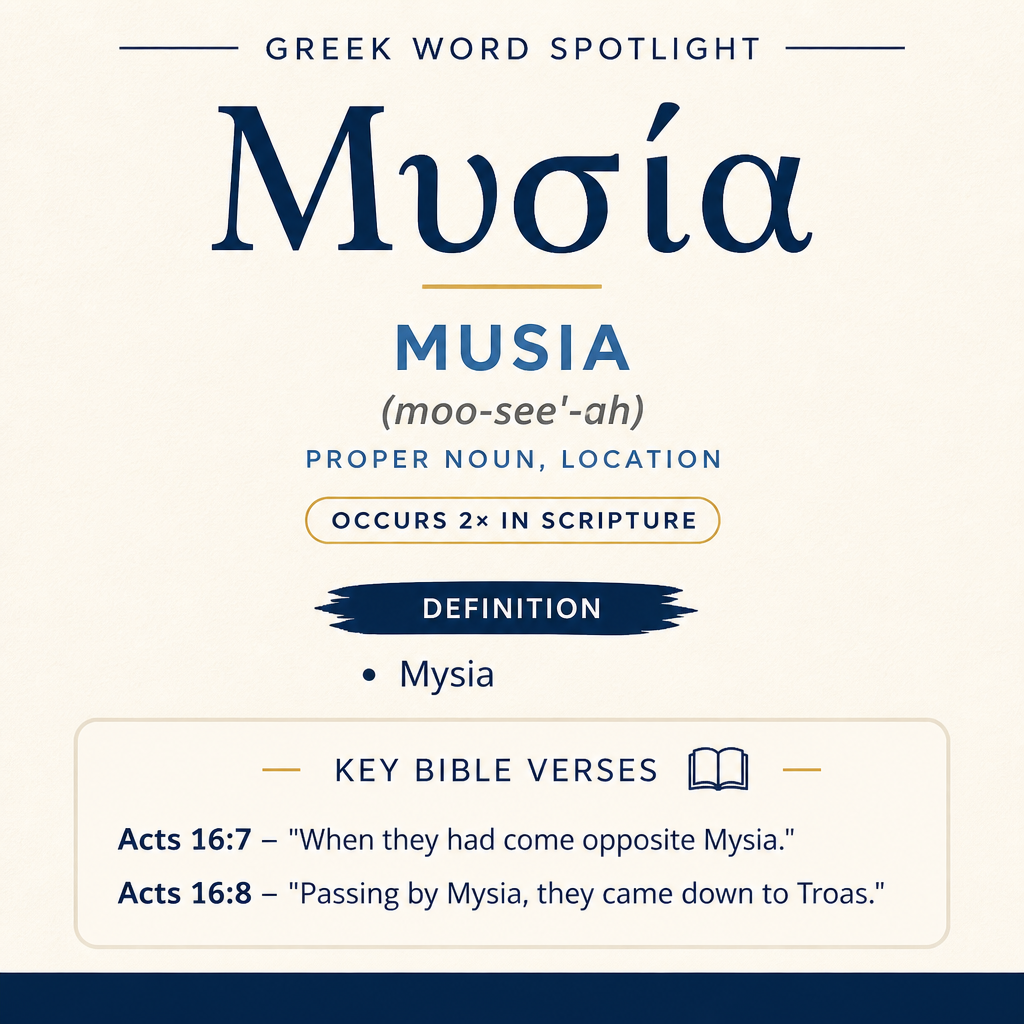
Μυσία (Musia) means “Mysia” and appears twice in Scripture, in Acts 16:7–8.
Acts Narrative
In Acts 16:7, they came opposite Mysia and tried to go into Bithynia, but the Spirit didn’t allow them. In Acts 16:8, passing by Mysia, they came down to Troas.
Learn More →Μυσία refers to Mysia and appears in Acts 16:7–8 as a geographic marker within a travel narrative. In these two verses the name functions to locate movement, intention, and redirection along a route.
Occurrences
“When they had come opposite Mysia, they tried to go into Bithynia, but the Spirit didn’t allow them.” (Acts 16:7)
Here Μυσία names the region that the travelers have reached in relation to their next intended destination. The phrasing “come opposite Mysia” uses the place name as a point of orientation: they are positioned with reference to Mysia as they attempt to proceed “into Bithynia.” Mysia therefore anchors the reader in the geography of the journey at the moment when a planned movement is blocked—“the Spirit didn’t allow them.” The effect is that Mysia marks the threshold of a decision point: it is not merely where they are, but the backdrop against which their intention (“they tried to go”) is contrasted with restraint (“didn’t allow”). In the verse’s logic, Mysia supplies the location from which the attempted advance toward another region is made, making the redirection concrete and mappable rather than abstract.
“Passing by Mysia, they came down to Troas.” (Acts 16:8)
In the next verse Μυσία appears again, now within an explicit movement description: “Passing by Mysia.” The place name is part of the route statement, conveying that Mysia is traversed or skirted in the course of continuing travel. The action then resolves in a new arrival point: “they came down to Troas.” Mysia thus functions as the intermediate geographic reference between the earlier attempted direction and the eventual destination named here. The narrative pace is brisk: “passing by” presents Mysia as a segment of the journey rather than a place of extended stay, and it links the prior constraint to a new path by depicting movement that continues despite the earlier prevention. In this way Mysia helps the reader visualize a changed itinerary, with the journey flowing onward to Troas.

Sense and Usage
As a proper place name, Μυσία serves primarily as a locator in space, but in these two closely connected sentences it also becomes a hinge for the story’s movement. The first mention places the travelers “opposite Mysia” at the time they “tried to go into Bithynia.” That construction uses Mysia as a geographic reference point for intention: it situates the attempted plan at a specific stage of travel. The second mention uses the same place name to narrate the revised route—“Passing by Mysia”—and so the name participates in the transition from a blocked direction to a continuing journey toward Troas.
Across both occurrences, Mysia is not described in itself; it is named as part of the narrative’s connective tissue: opposite it, passing by it, moving on from it. The repeated use within consecutive verses gives the name a clarifying function, keeping the travel account coherent by tying together where the travelers are positioned (Acts 16:7) and how they proceed afterward (Acts 16:8). Because the verses coordinate three region/place names in short order—Mysia, Bithynia, Troas—Μυσία helps form a small chain of place references. In Acts 16:7 it frames a thwarted attempt to enter Bithynia; in Acts 16:8 it frames the alternate movement that results in reaching Troas. The name therefore contributes to the narrative’s sense of direction and constraint: the journey’s course is narrated in relation to real locations, and the change in course is expressed through the relationship between those locations.
The two uses also show how a place name can function with different kinds of motion language. “Come opposite” presents Mysia as something approached and used to describe position relative to it; “passing by” presents it as something along the way, a region that is adjacent to the path taken or encountered en route. In both cases, Mysia is integrated into verbs of travel and orientation, emphasizing movement through space and progression from one named point to another.
Travel Imagery
In Acts 16:7–8, the imagery carried by Μυσία is the imagery of a route: approaching a region, attempting to turn toward another, then moving past and arriving elsewhere. Mysia stands in the text as a visible waypoint in a constrained journey—first as the place opposite which an intended path is closed (“the Spirit didn’t allow them”), and then as the place passed by as they “came down to Troas.” The name evokes the concrete feel of travel decisions made on the road, where direction is narrated by reference to the places one nears, passes, and reaches.
Sources: Lexical data from Strong’s Exhaustive Concordance and the Translators Brief Lexicon of Extended Strongs for Greek (STEPBible, CC BY). Occurrence data from the Translators Amalgamated Greek New Testament (STEPBible, CC BY). Scripture quotations from the World English Bible (public domain).