
Exploring the Meaning of Murizo in Greek
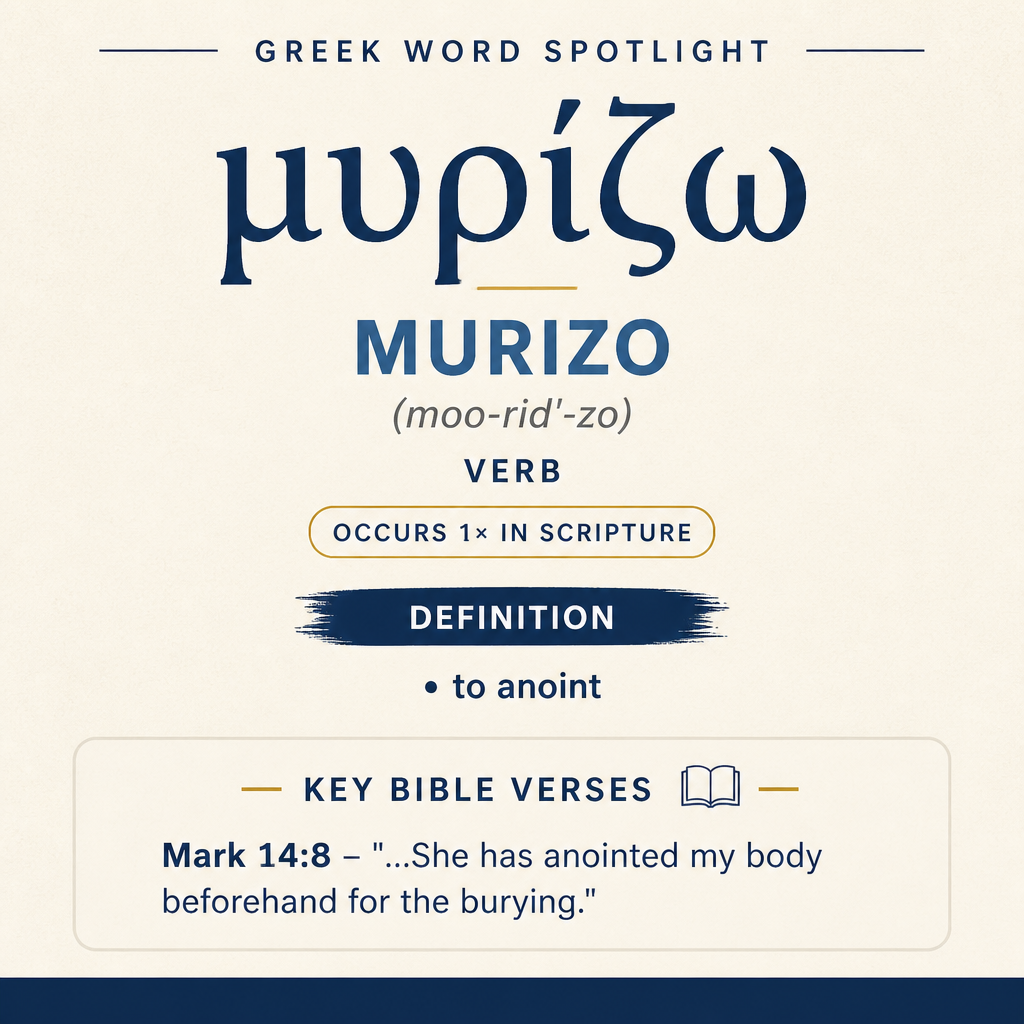
μυρίζω means “to anoint” and appears once in Scripture, in Mark 14:8.
Mark 14:8 Context
In Mark 14:8, it describes anointing Jesus’ body beforehand for the burying.
Learn More →μυρίζω means “to anoint,” and it appears in the Passion narrative where Jesus interprets a woman’s act as preparation for his burial. In its single New Testament occurrence, the verb frames a completed action whose significance is explained by Jesus himself.
Root and Related Words
μυρίζω derives from the noun Muron (μύρον), “ointment” (Strong’s G3464). The verb thus presents the action associated with ointment as an intentional deed performed upon a person’s body.

Occurrences
“She has done what she could. She has anointed my body beforehand for the burying.” (Mark 14:8)
In Mark 14:8, μυρίζω stands in Jesus’ assessment of a woman’s action: “She has done what she could.” The verb is used in a perfective way in English (“has anointed”), portraying the anointing as a completed act with continuing relevance to the moment of speaking. The direct object clarifies the physical and personal focus of the deed: “my body.” The anointing is not described in abstract terms; it is an act directed toward Jesus’ embodied presence, and it is treated as something already accomplished before Jesus interprets it.

The temporal marker “beforehand” is crucial to how μυρίζω functions in this line. The anointing is located prior to a coming event (“for the burying”), so the verb carries forward-looking weight: the act is performed now, but it is understood in relation to what is about to happen. In the sentence, the anointing is not merely a gesture of courtesy; it is explicitly connected to burial. Jesus supplies the interpretive frame, making the verb the hinge between a tangible action (anointing his body) and a looming reality (his burial). The word thus contributes both concreteness (ointment applied to a body) and solemnity (an act aligned with burial preparation).
The clause “for the burying” also shows that the anointing is not presented as open-ended in purpose. The verb is embedded in a statement of intent and meaning: the woman’s action is explained as oriented toward burial, whether or not she grasped that full significance. Within the quoted verse, μυρίζω is the centerpiece of Jesus’ commendation—an action that represents her doing “what she could,” and an action interpreted as timely, even urgent, because it comes “beforehand.”
Sense and Usage
The sense “to anoint” in Mark 14:8 is expressed as a deliberate, bodily act that carries interpretive force within the narrative. The verb is not used here simply to report that ointment was present; it depicts the purposeful application of ointment to Jesus’ body. Because Jesus himself states what the anointing signifies (“for the burying”), the verb operates at two levels at once: it names a physical act and it marks that act as meaningful within the unfolding events.
The wording “my body” keeps the action personal and concrete. μυρίζω, in this context, is not about an object in isolation, but about caring for a person’s body in a way that is suited to death and burial. The verb therefore sits near the border between ordinary human attentiveness and ritual or customary preparation, without requiring the reader to supply additional details beyond what the sentence already states. The anointing is pictured as something that can be done—something within the woman’s capacity (“what she could”)—and at the same time as something whose full significance is larger than the immediate setting, because it anticipates burial.
The adverb “beforehand” also shapes the usage. Anointing could be imagined as something done after death, but here it is performed in advance. That temporal placement makes the verb serve as a kind of anticipatory preparation: the action is carried out while Jesus is still present to speak about it, and its meaning is fixed by his explanation. The verb thus contributes a sense of readiness and forethought to the scene: the anointing is timely precisely because it precedes the burial it pertains to.
Because this is the only occurrence, the word’s New Testament profile is concentrated: it is attached to a single, narrated action and to a single, explicit interpretive statement by Jesus. The meaning is therefore not built by comparison across multiple settings; instead, it is anchored by the narrative’s own explanation. The one usage presents anointing as an act that can be evaluated (“She has done what she could”) and as an act whose value is connected to what it prepares for (“for the burying”).
Imagery
The imagery carried by μυρίζω in Mark 14:8 is intimate and weighty: a body is anointed, and the anointing is bound to burial. The verse places the reader at the intersection of care and mortality—care expressed through a concrete act upon “my body,” and mortality signaled by the explicit mention of “the burying.” Within that single sentence, the verb evokes the scent, touch, and nearness implied by applying ointment, while the purpose clause directs those sensory associations toward the sobering horizon of death.
Sources: Lexical data from Strong’s Exhaustive Concordance and the Translators Brief Lexicon of Extended Strongs for Greek (STEPBible, CC BY). Occurrence data from the Translators Amalgamated Greek New Testament (STEPBible, CC BY). Scripture quotations from the World English Bible (public domain).





