
Exploring the Meaning of Mousikos in Greek
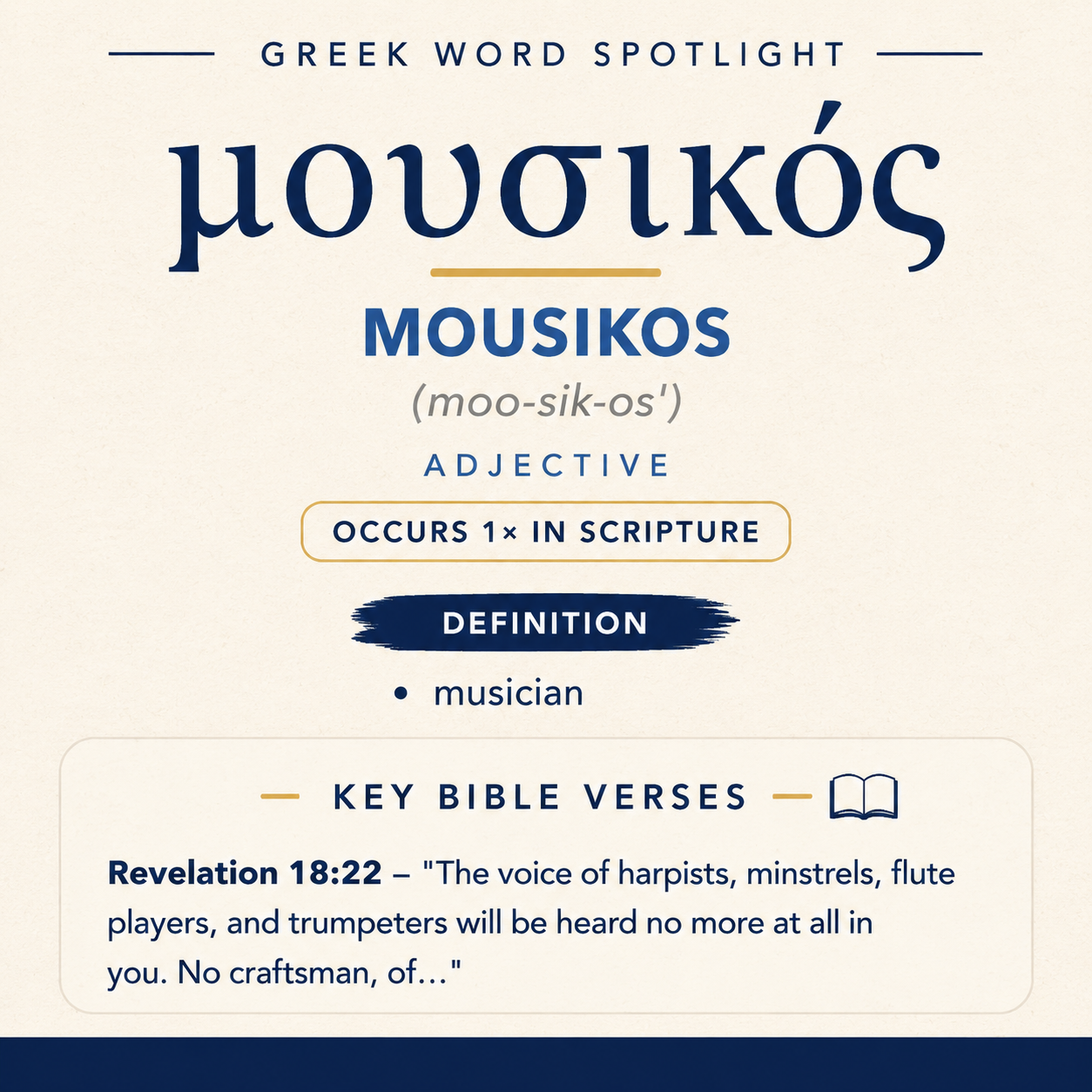
μουσικός means “musician” and appears once in Scripture in Revelation 18:22.
Context Note
Revelation 18:22 speaks of the voice of harpists, minstrels, flute players, and trumpeters being heard no more.
Learn More →μουσικός means “musician” and appears in a single New Testament passage describing what will no longer be heard in a fallen city. In that scene it belongs to a catalog of sounds and trades that are depicted as coming to a complete end.
Occurrences
Revelation 18:22: “The voice of harpists, minstrels, flute players, and trumpeters will be heard no more at all in you. No craftsman, of whatever craft, will be found any more at all in you. The sound of a mill will be heard no more at all in you.”
In Revelation 18:22, μουσικός contributes to a dense auditory picture of a place emptied of ordinary human activity. The verse frames the loss in terms of “voice” and “sound”: “The voice of harpists, minstrels, flute players, and trumpeters will be heard no more at all in you.” The musician is presented not as an isolated figure but as one member of a group whose collective presence once filled the city with organized, recognizably human sound. The wording places emphasis on the medium—what is “heard”—so the musician’s significance is tied to audible life within the city’s space (“in you”).
The line’s structure gathers a range of performers and instruments into a single statement of cessation. Harpists, minstrels, flute players, and trumpeters represent varied kinds of musical output: stringed music, sung or performed music, wind instruments, and brass-like instruments. Within that list, μουσικός is tied to the idea of skilled performance that can be named, categorized, and recognized by its sound. The musician here is part of the city’s soundscape—one of the normal, expected contributors to public celebration, cultural activity, or entertainment—now removed so completely that the voice “will be heard no more at all.”
The verse then widens from sound to labor: “No craftsman, of whatever craft, will be found any more at all in you.” This second sentence parallels the first, shifting from what can be heard to who can be found. In that parallelism, the musician sits close to the “craftsman” as another kind of skilled worker whose work affects the shared life of a community. The musician is not described abstractly; the musician is implied through those who produce a “voice” that others hear. The effect is to treat musical performance as a public, social craft that belongs to the city’s functioning identity.
Finally, the imagery returns to sound with a more domestic, workaday noise: “The sound of a mill will be heard no more at all in you.” This completes a threefold picture: music (the voice of performers), work (craftsmen present and active), and daily provision (the mill’s sound). Against that backdrop, μουσικός helps anchor the first line in a specific category of human sound: not the accidental noises of a crowd but the intentional sound made by musicians. The musician’s “voice” stands at the head of the sequence, so the silencing of musicians functions as the initial marker of a city emptied of both celebration and routine life.

Sense and Usage
As an adjective used for “musician,” μουσικός marks a person by their role in producing music—someone identified with musical performance as a defining characteristic. In Revelation 18:22, the word’s force is relational and communal: the musician exists in relation to listeners (“will be heard”) and in relation to the place addressed (“in you”). The scene does not describe technique, style, or repertoire; it focuses on the presence or absence of the musician as a source of sound that once belonged to the city’s audible identity.
The verse places musicians alongside several other named performers (“harpists, minstrels, flute players, and trumpeters”), which shows how the category “musician” can be expressed by specifying types of performers. The list creates a layered depiction of music as something that can be distinguished by instrument and by the kind of performer. In ordinary experience, those distinctions matter because different musicians contribute different tones, volumes, and functions; the verse harnesses that everyday recognizability to underline the totality of the loss. The city will not merely lose one kind of music; it will lose the whole range of musicians whose voices once represented festivity, artistry, and public sound.
Within the immediate context, the musician is one example of skilled human presence that makes a city feel inhabited. The adjacent statement about “No craftsman, of whatever craft” supports that reading by moving from a particular set of skilled voices (musicians) to skilled hands (craftsmen). The result is that μουσικός participates in a broader portrayal of societal collapse: the disappearance of professions, arts, and the ordinary activities that signal a living economy and a living neighborhood. The musician is not treated as peripheral decoration; the musician’s absence is part of the city’s ruin, because the city is imagined as a place where people once made music and others heard it.
The repetition of “no more at all” shapes how the sense of “musician” lands. The phrase presses the reader to feel finality: not a temporary quiet, but the end of music’s public presence in that place. Because musicians are defined by producing sound, the prophecy of silence is, in effect, the removal of the musician’s social function. What is lost is not only entertainment, but the audible proof of human congregation and shared life—the kind of proof that comes when there are performers and there is an audience to hear them.
The sequence of sounds also suggests that music belongs to the upper range of a city’s audible spectrum: voices and instruments that can carry through streets and public spaces. The mill’s sound, by contrast, evokes daily work and sustenance. By setting these side by side, the verse places musical life and practical life under the same judgment of absence. In that arrangement, μουσικός functions as a marker of cultural vitality: where there are musicians, there is public sound, celebration, and artistry; where they are gone, the city is reduced to silence.
The wording “The voice of harpists, minstrels, flute players, and trumpeters” frames musicians primarily as voices—sources of sound rather than visual performers. This keeps the focus on what the city emits and what others can perceive. The soundscape becomes a diagnostic of the city’s condition: music heard in its streets would signal thriving life; music absent signals desolation. In this way, the term “musician” serves as a concrete index of communal presence. The verse does not analyze why music ceases; it simply declares that the musician’s audible place in the city’s life is ended.
Imagery
Revelation 18:22 uses μουσικός to paint silence as a form of judgment. The city that once held “the voice of harpists, minstrels, flute players, and trumpeters” is portrayed as having no such voice within it, no craftsmen found within it, and not even “the sound of a mill” within it. The musician’s missing voice thus becomes one stroke in a stark portrait: a city without music, without work, and without the ordinary sounds that make a place feel lived in.
Sources: Lexical data from Strong’s Exhaustive Concordance and the Translators Brief Lexicon of Extended Strongs for Greek (STEPBible, CC BY). Occurrence data from the Translators Amalgamated Greek New Testament (STEPBible, CC BY). Scripture quotations from the World English Bible (public domain).




