
Exploring the Meaning of Morphosis in Greek
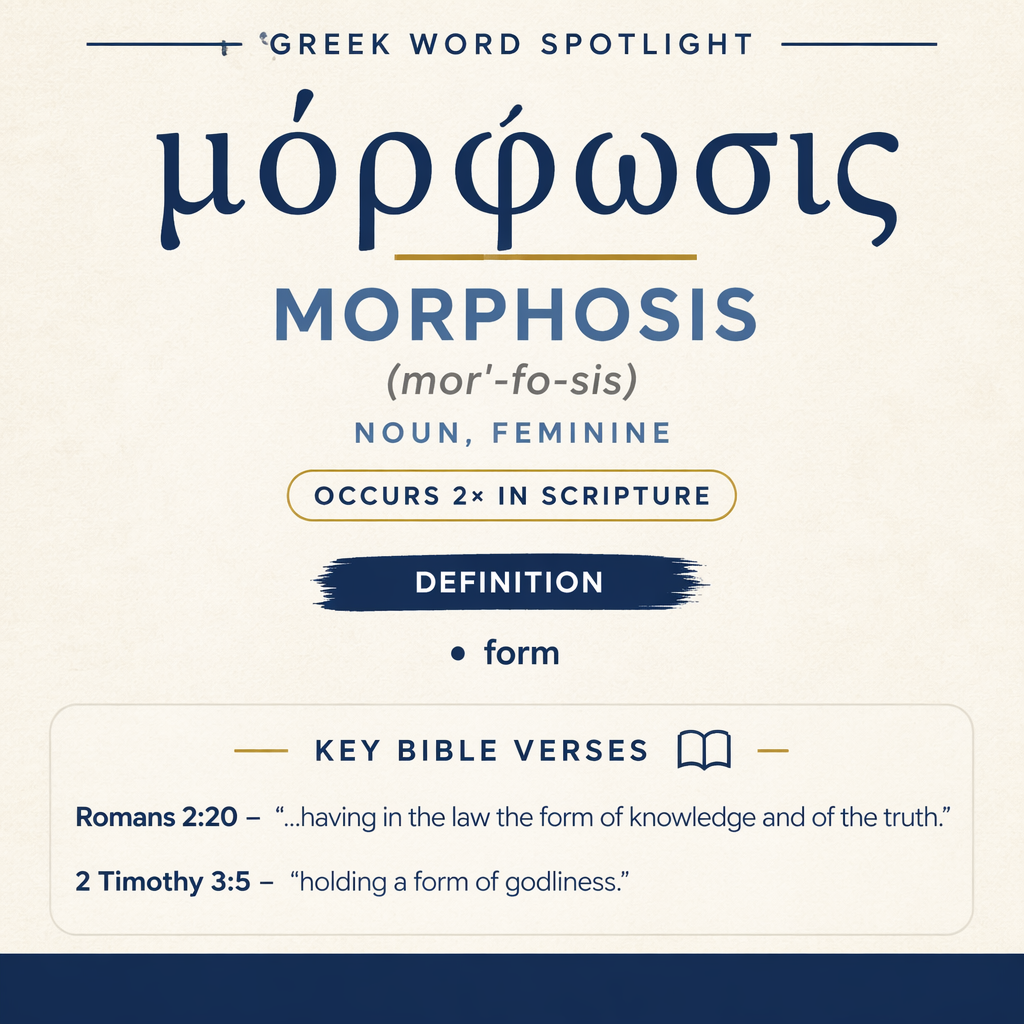
μόρφωσις means “form” and appears twice in Scripture, in Romans 2:20 and 2 Timothy 3:5.
Scripture Occurrences
It occurs two times in Scripture: Romans 2:20 and 2 Timothy 3:5.
Learn More →Context Highlights
Romans 2:20 speaks of “the form of knowledge and of the truth” in the law. 2 Timothy 3:5 describes “a form of godliness” while denying its power.
Learn More →μόρφωσις speaks of “form,” a way something is shaped or presented. It appears in Romans 2:20 with reference to “the law” and in 2 Timothy 3:5 with reference to “godliness.”
Root and Related Words
μόρφωσις relates to the verb morphoo (μορφόω), “to form” (Strong’s G3445). The noun expresses the result or recognizable shape that corresponds to what has been “formed.”

Occurrences
Romans 2:20 — “a corrector of the foolish, a teacher of babies, having in the law the form of knowledge and of the truth.”
Here μόρφωσις is tied to “the law” as the locus in which a “form” of “knowledge and of the truth” is possessed. The surrounding phrases (“a corrector of the foolish, a teacher of babies”) describe roles that assume competence and authority to instruct others. Within that setting, “having in the law the form of knowledge and of the truth” characterizes what is held: not merely an interest in knowledge and truth, but a defined shape of them as located “in the law.” The word “form” contributes the idea of an identifiable configuration—something that can be had, carried, and appealed to—suitable for supporting the identity of someone who corrects and teaches. In the sentence’s movement, μόρφωσις functions as what undergirds the speaker’s confidence: the law is presented as containing a discernible pattern that can be treated as “knowledge” and “truth,” and the one addressed is portrayed as possessing that pattern.

The phrase “the form of knowledge and of the truth” also sets up an important relationship within the line itself: “knowledge” and “truth” are not floating abstractions here, but are presented as something that takes a “form” within a concrete referent (“the law”). μόρφωσις thus helps the line speak about the law not only as a source but as a structured embodiment—knowledge and truth as they are shaped in that particular sphere. This shaping is what makes instruction and correction imaginable: teachers typically work not with formless impressions but with something they regard as stable and communicable.
2 Timothy 3:5 — “holding a form of godliness, but having denied its power. Turn away from these, also.”
In this occurrence μόρφωσις stands in sharp contrast with “power.” The people in view are described as “holding a form of godliness,” and immediately qualified: they are also “having denied its power.” The word “form” therefore marks what remains when something is retained at the level of recognizable appearance or structure while what is described as its “power” is repudiated. The verb “holding” gives μόρφωσις a tactile, possessive feel: the “form” is something one can keep in hand, maintain, and display. Yet the parallel clause exposes a disconnect within the same subject—one can be in possession of this “form” and yet be characterized by denial in relation to “power.”
Because the verse ends with “Turn away from these, also,” the “form” is not treated as neutral. The instruction to avoid such people implies that the mere possession of μόρφωσις—when paired with denial of “power”—is an insufficient or even misleading condition. In this line, μόρφωσις contributes to the portrayal of a religious profile that can be outwardly recognizable (“godliness” in “form”) and still be fundamentally compromised by what it negates. The noun allows the writer to name the external or structured side of “godliness” as a thing that can be maintained independently from what the writer calls its effective force.
Sense and Usage
Across these two passages, “form” functions as a category for what can be possessed and pointed to: a shaped, organized expression associated with something valued (“knowledge and of the truth” in Romans; “godliness” in 2 Timothy). In both contexts μόρφωσις is attached to a larger reality—knowledge/truth, godliness—and the sentences press the reader to consider the relation between that larger reality and its “form.” The word is useful precisely because it can sit between the intangible and the concrete: it allows “knowledge,” “truth,” and “godliness” to be spoken of as having a definable shape that people can “have” or “hold.”
Yet the two uses also create a tension. In Romans 2:20, μόρφωσις is presented as something located “in the law,” and it is integrated into a self-description that involves teaching and correcting. The “form” there is connected with claims to competence: it is the shape of “knowledge and of the truth” as expressed in a known reference point. In 2 Timothy 3:5, μόρφωσις is connected with a contradiction inside the same people: the shape of “godliness” is retained while its “power” is denied. In that setting “form” helps the writer name the possibility of an externally maintained configuration that does not guarantee what should correspond to it.
Because μόρφωσις can describe something that is recognizable and retainable, it naturally fits contexts involving instruction and evaluation. Teachers work with forms: patterns of content that can be transmitted to “babies” (Romans 2:20) and standards by which conduct can be assessed (“holding a form of godliness” in 2 Timothy 3:5). The word’s value is that it describes a kind of structured representation—something that can be possessed, exhibited, and used as a basis for roles and judgments. At the same time, these passages show that the presence of “form” invites scrutiny of what accompanies it: in Romans the “form” is linked with “knowledge and of the truth” as grounded in “the law,” while in 2 Timothy the “form” is set beside a denial that undermines what the “form” might lead others to expect.
In both verses μόρφωσις is modified by a genitive (“of knowledge and of the truth,” “of godliness”), which frames the “form” as belonging to and expressing something else. That relationship matters for how the noun works: μόρφωσις is not presented as an independent object but as the shaped profile of a larger concept. This makes it a pointed term for discussing the difference between a thing as structured and the thing as truly operative. The Romans line emphasizes having the structured expression within a recognized source; the Timothy line warns that the structured expression can be retained even while something essential (“power”) is repudiated.
Imagery
The word’s imagery in these passages is the difference between what can be held and what can be lived. Romans 2:20 pictures “the law” as containing a graspable configuration of “knowledge and of the truth,” something a “teacher” might claim to possess. 2 Timothy 3:5 pictures “godliness” as capable of being reduced to a maintainable outline—something people can “hold”—even as a deeper reality is denied, making the “form” a signal that calls for discernment and separation: “Turn away from these, also.”
Sources: Lexical data from Strong’s Exhaustive Concordance and the Translators Brief Lexicon of Extended Strongs for Greek (STEPBible, CC BY). Occurrence data from the Translators Amalgamated Greek New Testament (STEPBible, CC BY). Scripture quotations from the World English Bible (public domain).




