
Exploring the Meaning of Mochthos in Greek
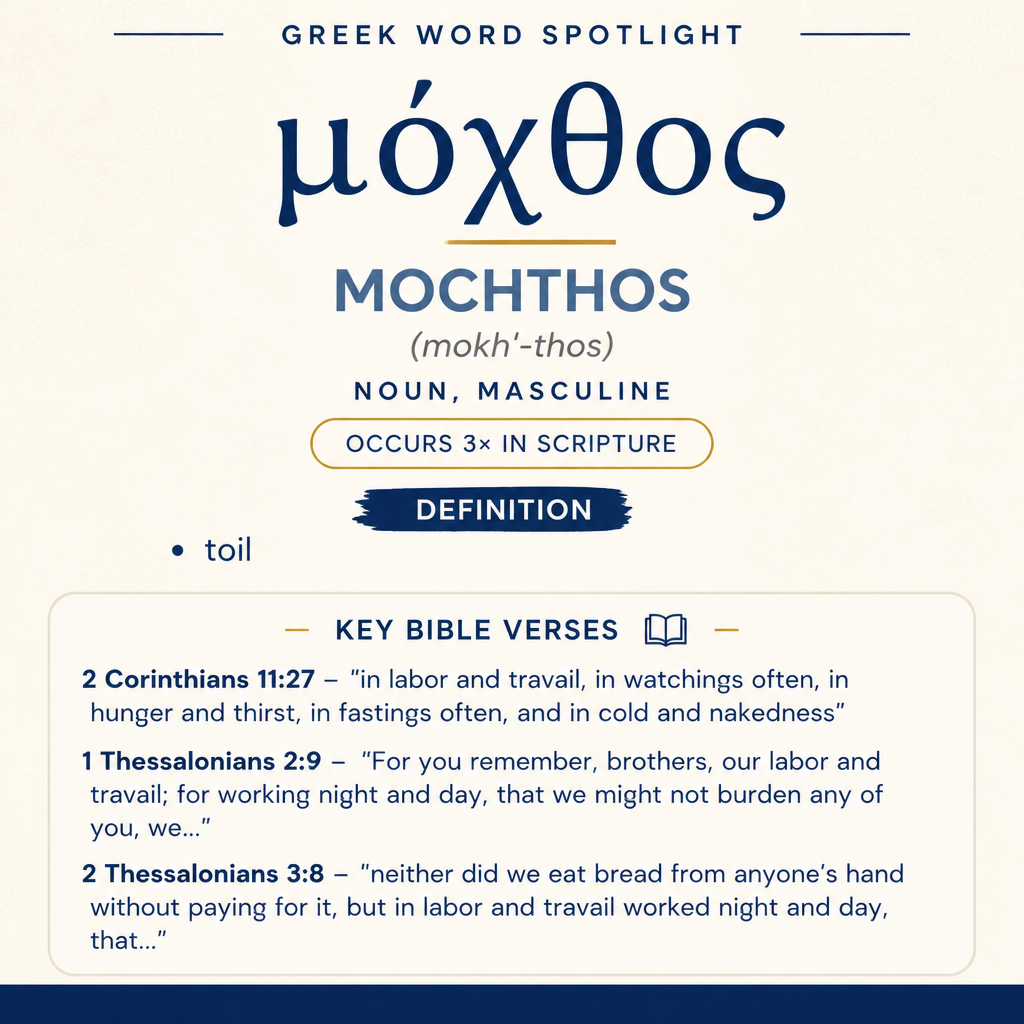
μόχθος means “toil” and appears three times in Scripture: 2 Corinthians 11:27, 1 Thessalonians 2:9, and 2 Thessalonians 3:8.
Pauline Contexts
In 2 Corinthians 11:27 it appears in a list of hardships including hunger, thirst, cold, and nakedness.
Learn More →Night and Day Work
In 1 Thessalonians 2:9 and 2 Thessalonians 3:8 it is paired with “travail” and linked to working night and day.
Learn More →μόχθος names “toil” and appears in three Pauline contexts where strenuous work is set alongside other hardships. In each passage it helps characterize a pattern of effort carried through demanding circumstances.
Root and Related Words
μόχθος (Mochthos) is linked with μόγις (mogis), meaning “hardly” (Strong’s G3425), identified as the word from which it derives.

Occurrences
“in labor and travail, in watchings often, in hunger and thirst, in fastings often, and in cold and nakedness.” (2 Corinthians 11:27)
Here μόχθος stands within a compact chain of pressures. The line moves from “labor and travail” into repeated “watchings,” then bodily deprivation (“hunger and thirst,” “fastings often”), and finally exposure (“cold and nakedness”). In that setting, μόχθος contributes the idea of toil as a real, costly exertion that belongs with sleeplessness and want, not as a separate theme but as part of a single portrait of hardship. The pairing “labor and travail” places toil alongside another term of strain, giving the opening of the list a heavy, work-worn tone before the verse turns to the other dimensions of suffering named in the series.
“For you remember, brothers, our labor and travail; for working night and day, that we might not burden any of you, we preached to you the Good News of God.” (1 Thessalonians 2:9)
In this recollection, μόχθος helps frame the apostolic presence among the Thessalonians as costly work remembered by the community: “you remember… our labor and travail.” The verse then explains the shape that toil took—“working night and day”—and gives its purpose: “that we might not burden any of you.” Toil here is not an abstract description of difficulty; it is linked to a sustained schedule (“night and day”) and to a deliberate choice about material impact on others (“not burden any of you”). Within the same sentence, preaching (“we preached to you the Good News of God”) sits alongside the work described, so μόχθος belongs to the practical exertion that accompanied their proclamation and supported their aim of avoiding financial weight on the believers addressed as “brothers.”
“neither did we eat bread from anyone’s hand without paying for it, but in labor and travail worked night and day, that we might not burden any of you,” (2 Thessalonians 3:8)
This occurrence places μόχθος inside a defense of conduct regarding provision. The verse begins with the concrete picture of receiving food: “neither did we eat bread from anyone’s hand without paying for it.” Against any notion of taking support freely, the speaker contrasts a different pattern: “but in labor and travail worked night and day.” Toil is thus tied to self-supporting effort and to the same stated aim found in the earlier letter: “that we might not burden any of you.” The repetition of “worked night and day” again makes μόχθος visible as sustained, demanding exertion, and the mention of “bread” and “paying for it” shows toil as the means by which they avoided indebting themselves to the community or imposing on it.
Sense and Usage
Across these three passages, μόχθος functions as a concrete descriptor of strenuous exertion, not merely a feeling of weariness. In 2 Corinthians 11:27 it is embedded in a list of hardships where toil stands among sleeplessness, hunger, thirst, fasting, cold, and nakedness; the word belongs to an inventory of life conditions that press upon the body and daily existence. In 1 Thessalonians 2:9 and 2 Thessalonians 3:8, the word is attached to a remembered and exemplary pattern of work: “working night and day” or “worked night and day.” That repeated temporal frame shows toil as extended effort rather than a brief surge of activity.
The two Thessalonian uses also show toil as purposive. Both verses explicitly connect it to an intention: “that we might not burden any of you.” In other words, μόχθος is portrayed as effort taken on willingly to spare others a load. The same lines also place toil in close proximity to ordinary necessities: “bread,” “paying for it,” and the risk of being a “burden.” This ties the word’s sense to the realm of provision and responsibility. The congregation’s memory (“you remember”) in 1 Thessalonians 2:9 indicates that μόχθος is something observable and communal—work that left a trace in the lived experience of those who watched it.
In all three occurrences μόχθος appears in the set phrase “labor and travail.” The repeated pairing suggests that the word is used where the writer wants an emphatic, weighty description of effort—effort that can be counted among hardships (2 Corinthians) and also among choices of conduct meant to avoid imposing on others (both Thessalonian letters). The surrounding language keeps μόχθος anchored to visible actions (“working,” “worked”) and tangible needs (“bread”), so the word carries a down-to-earth force: toil that costs time, strength, and comfort.
Imagery
Read together, these verses give μόχθος a landscape of long hours and thin margins: “working night and day” while guarding against becoming a “burden,” and enduring conditions marked by “hunger and thirst” and even “cold and nakedness.” The word’s imagery in these contexts is not heroic abstraction but gritty persistence—effort that continues through lack of sleep and lack of ease, and that aims to protect others from added weight.
Sources: Lexical data from Strong’s Exhaustive Concordance and the Translators Brief Lexicon of Extended Strongs for Greek (STEPBible, CC BY). Occurrence data from the Translators Amalgamated Greek New Testament (STEPBible, CC BY). Scripture quotations from the World English Bible (public domain).





