
Exploring the Meaning of Misthapodosia in Greek
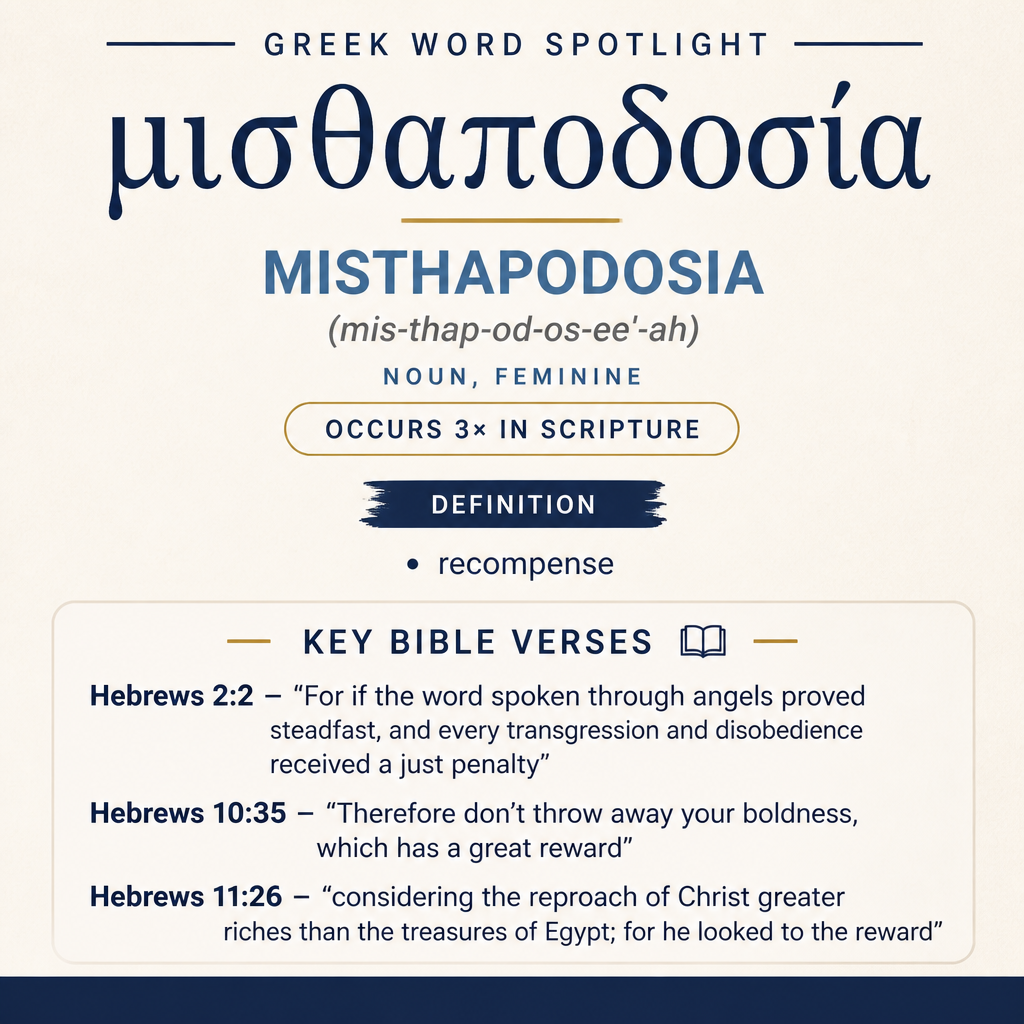
μισθαποδοσία means “recompense” and appears three times in Scripture: Hebrews 2:2; 10:35; 11:26.
Hebrews Contexts
In Hebrews 2:2 it is linked with a just penalty received for transgression and disobedience. In Hebrews 10:35 it refers to a great reward connected with boldness.
Learn More →Moses’ Focus
In Hebrews 11:26 Moses looked to the reward, valuing the reproach of Christ above Egypt’s treasures.
Learn More →μισθαποδοσία refers to “recompense,” appearing three times in Hebrews in contexts of accountability, perseverance, and forward-looking valuation. In these passages it marks what is received as the fitting outcome of actions and commitments.
Root and Related Words
Misthapodosia is related to misthapodotes (μισθαποδότης), “rewarder” (Strong’s G3406), identified as the word from which it derives.

Occurrences
Hebrews 2:2: “For if the word spoken through angels proved steadfast, and every transgression and disobedience received a just penalty,”
Here misthapodosia stands in a juridical frame: the “word spoken through angels” is described as “steadfast,” and the result is that “every transgression and disobedience received a just penalty.” The term functions as the named outcome that corresponds to wrongdoing—what is received is not random but characterized as “just.” In this setting, recompense is presented as measured response, tied to the firmness of the prior word and to concrete categories of violation (“transgression and disobedience”). The sentence sets recompense within moral order: actions have outcomes, and the outcomes carry an evaluative quality (“just”).

Hebrews 10:35: “Therefore don’t throw away your boldness, which has a great reward.”
In this exhortation, misthapodosia is attached not to wrongdoing but to steadfast courage: “don’t throw away your boldness.” The recompense is described as something boldness “has,” and it is explicitly “great.” The term supports the practical force of the command: boldness is not presented as empty bravado or merely a present posture; it is linked to an anticipated outcome that makes perseverance reasonable. The logic of the sentence treats recompense as a motivating reality—something that can be forfeited (“throw away”) in tandem with the boldness itself, and therefore something worth protecting by continuing in courage.
Hebrews 11:26: “considering the reproach of Christ greater riches than the treasures of Egypt; for he looked to the reward.”
Here misthapodosia is the object of a deliberate gaze: “he looked to the reward.” The verse frames a comparison of values—“the reproach of Christ” is counted “greater riches than the treasures of Egypt.” Within that valuation, recompense functions as the future-oriented reference point that explains the choice. The term helps articulate how present loss or shame (“reproach”) can be weighed as “greater riches” than visible wealth (“treasures”), because the perspective is oriented toward what will be received. Recompense, in this setting, is not merely an abstract idea; it is the aim that governs evaluation, the reason a costly identification can be considered wealthier than tangible treasure.
Sense and Usage
Across these occurrences, “recompense” operates as a received outcome, and the passages highlight different sides of that reality. Hebrews 2:2 places recompense in the sphere of moral accountability: transgression and disobedience meet with a “just penalty,” presenting recompense as a fitting return in response to violation. Hebrews 10:35 places it alongside perseverance: boldness is to be held fast because it is connected with a “great” recompense, portraying recompense as a promised outcome that gives weight to continued courage. Hebrews 11:26 places recompense within a calculus of value: the choice of “reproach” over “treasures” is explained by looking toward recompense, so recompense serves as the horizon against which present riches and present shame are assessed.
The three texts also show how recompense can be spoken of with differing emphases while remaining the same kind of reality: in 2:2 it is described by its justice (“just penalty”), in 10:35 by its magnitude (“great reward”), and in 11:26 by its directing power (“he looked to the reward”). Taken together, these uses present recompense as something that can be received in response to conduct, something that can anchor exhortation, and something that can shape what a person counts as wealth.
Imagery
The word carries the imagery of a settled outcome that follows a path already taken. In Hebrews 2:2 the picture is of a case with a verdict—transgression and disobedience meeting a “just penalty.” In Hebrews 10:35 recompense stands like a promised return attached to “boldness,” urging the reader not to discard what is linked to such a return. In Hebrews 11:26 recompense appears as a distant point of focus, enabling a person to regard “reproach” as “greater riches” than “treasures” because the eye is set on what will be received.
Sources: Lexical data from Strong’s Exhaustive Concordance and the Translators Brief Lexicon of Extended Strongs for Greek (STEPBible, CC BY). Occurrence data from the Translators Amalgamated Greek New Testament (STEPBible, CC BY). Scripture quotations from the World English Bible (public domain).





