Exploring the Meaning of Methusko in Greek
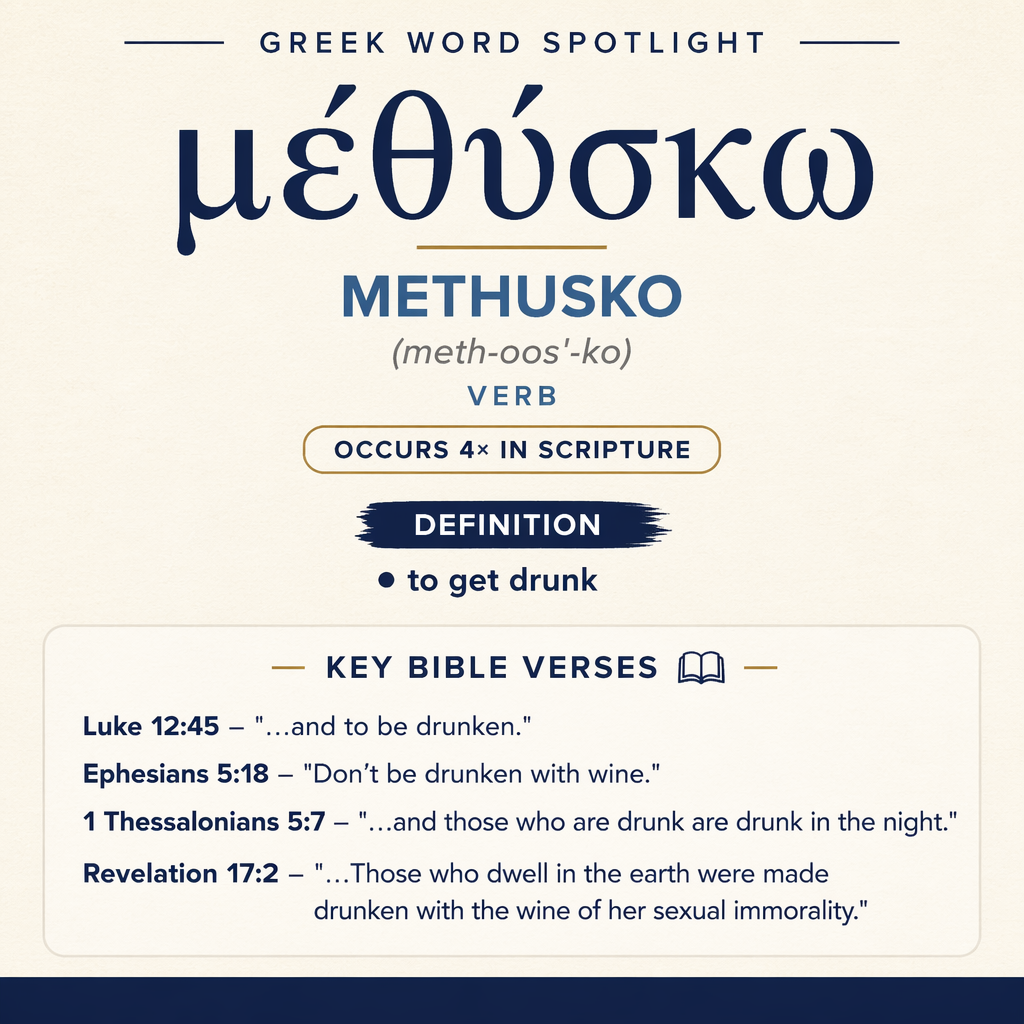
μεθύσκω means “to get drunk” and appears 4 times in Scripture: Luke 12:45; Ephesians 5:18; 1 Thessalonians 5:7; Revelation 17:2.
Core Meaning
μεθύσκω means “to get drunk.” It is used of becoming intoxicated, including with wine.
Learn More →Scripture Occurrences
μεθύσκω occurs four times: Luke 12:45; Ephesians 5:18; 1 Thessalonians 5:7; Revelation 17:2.
Learn More →Context Snapshots
Ephesians 5:18 warns against being drunken with wine. Revelation 17:2 describes earth-dwellers made drunken.
Learn More →μεθύσκω describes the act of becoming drunk. It appears in a parable about a servant’s misconduct, in apostolic instruction about wine and Spirit-filling, in a contrast between night and day, and in apocalyptic imagery where peoples are made drunk by immoral influence.
Root and Related Words
μεθύσκω (Methusko) derives from the verb μεθύω (methyo), “to get drunk” (Strong’s G3184).

Occurrences
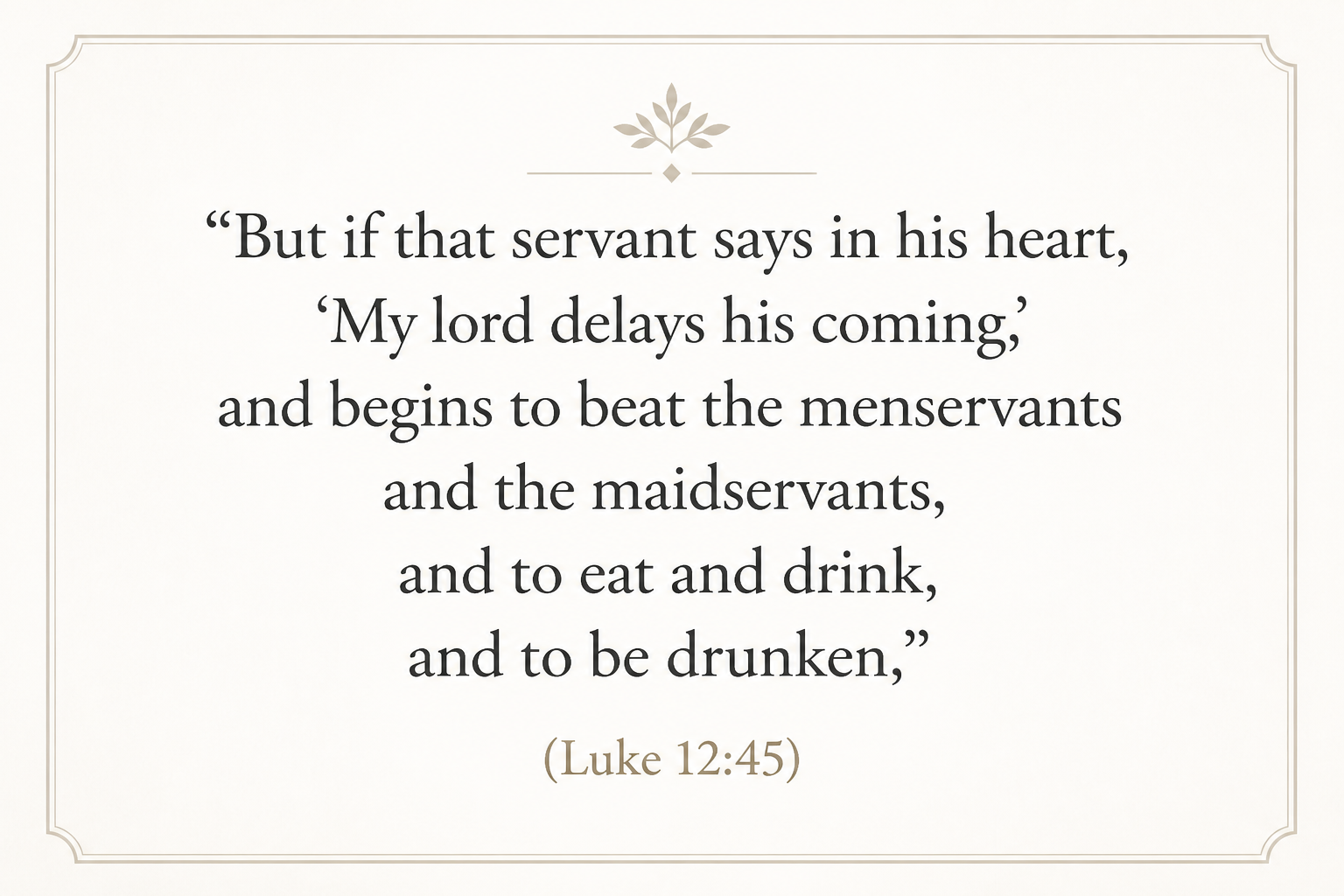
“But if that servant says in his heart, ‘My lord delays his coming,’ and begins to beat the menservants and the maidservants, and to eat and drink, and to be drunken,” (Luke 12:45)
Here μεθύσκω is part of a chain of actions that mark the servant’s collapse into self-indulgence and abuse. The servant’s inner reasoning (“My lord delays his coming”) sets the stage for outward behaviors: violence toward fellow servants, unchecked appetite (“to eat and drink”), and finally “to be drunken.” In this scene drunkenness is not an isolated lapse but the culmination of a pattern—an escalation from attitude to conduct. The word helps portray a servant who acts as though accountability is postponed, and so treats both people and pleasures as if he were answerable to no one.
“Don’t be drunken with wine, in which is dissipation, but be filled with the Spirit,” (Ephesians 5:18)
In this instruction, μεθύσκω is framed as a condition brought about “with wine,” and it is set in deliberate contrast with another kind of fullness: “be filled with the Spirit.” The clause “in which is dissipation” places drunkenness within a broader moral outcome; the state of being drunk is presented as a doorway into wasteful, uncontrolled living. The word thus functions as a boundary-marker: it names a bodily condition that can shape one’s direction and behavior, and it is explicitly rejected in favor of a different governing influence.
“For those who sleep, sleep in the night; and those who are drunk are drunk in the night.” (1 Thessalonians 5:7)
Here μεθύσκω is placed alongside sleep as a typical nighttime activity: “those who sleep… in the night,” “those who are drunk… in the night.” The verse uses the regularity of night patterns to make a point by association. Drunkenness is pictured as belonging to the realm of darkness and ordinary concealment—the time when people withdraw, lose alertness, or surrender to stupor. The repetition (“are drunk are drunk”) reinforces the idea of a settled condition characteristic of that time. The word contributes a social and temporal coloring: it is not merely an action but a recognizable state that fits a certain setting.
“with whom the kings of the earth committed sexual immorality. Those who dwell in the earth were made drunken with the wine of her sexual immorality.” (Revelation 17:2)
In this apocalyptic statement, μεθύσκω is used in the passive idea “were made drunken,” describing an effect inflicted upon “Those who dwell in the earth.” The intoxication is tied to “the wine of her sexual immorality,” so drunkenness becomes a metaphorical way of describing how pervasive and overpowering that immoral influence is. The word’s contribution is to depict moral corruption as something that does not merely entice but alters condition and perception—an induced stupor that spreads outward from “her” to the earth-dwellers, while “the kings of the earth” are already described as participating in immorality. Drunkenness here paints the reach and force of the corruption in the imagery of drink and its effects.
Sense and Usage
Across these passages μεθύσκω consistently denotes becoming drunk, but its rhetorical role shifts with context. In Luke 12:45 it functions as evidence of a servant’s abandonment of faithful restraint: drunkenness sits beside cruelty and unchecked consumption, helping portray a life unmoored from expectation of the master’s return. In Ephesians 5:18 the word anchors a moral prohibition: drunkenness is presented as a wine-caused state that leads into “dissipation,” and it is contrasted with a different kind of fullness that is to govern the believer’s life. In 1 Thessalonians 5:7 it serves as a marker of “night” existence, aligned with sleep as part of a picture of diminished alertness and ordinary darkness-bound habits. In Revelation 17:2 it is applied to a wider population, where being made drunk communicates the power of seductive immorality to sway and overwhelm, described in the language of “wine.”
Two features stand out in these uses. First, the word readily attaches to a cause (“with wine”; “with the wine of her sexual immorality”), making drunkenness something that happens through an agent or instrument. Second, it can function both literally and figuratively without changing the core idea of intoxication: Luke and Ephesians speak straightforwardly about wine and drunken conduct, while Revelation uses drunkenness to express the effect of immoral influence, still framed as “wine.” The shared thread is a movement into a state that shapes actions and judgment—whether that state manifests in abusive behavior, moral dissipation, nighttime unwatchfulness, or susceptibility to corrupting allure.
Imagery
The passages repeatedly pair drunkenness with motifs of loss of control and altered condition. Luke 12:45 places it at the end of a descent into violent and indulgent living. Ephesians 5:18 sets it against Spirit-filled life, presenting two competing forms of “fullness.” 1 Thessalonians 5:7 associates it with night, when people sleep and when drunkenness belongs to the ordinary darkness. Revelation 17:2 intensifies the imagery: intoxication becomes a way to picture whole peoples being swept up by “the wine of her sexual immorality,” as though corruption can be imbibed and spread like a drink that masters its consumers.
Sources: Lexical data from Strong’s Exhaustive Concordance and the Translators Brief Lexicon of Extended Strongs for Greek (STEPBible, CC BY). Occurrence data from the Translators Amalgamated Greek New Testament (STEPBible, CC BY). Scripture quotations from the World English Bible (public domain).