
Exploring the Meaning of Metaxu in Greek
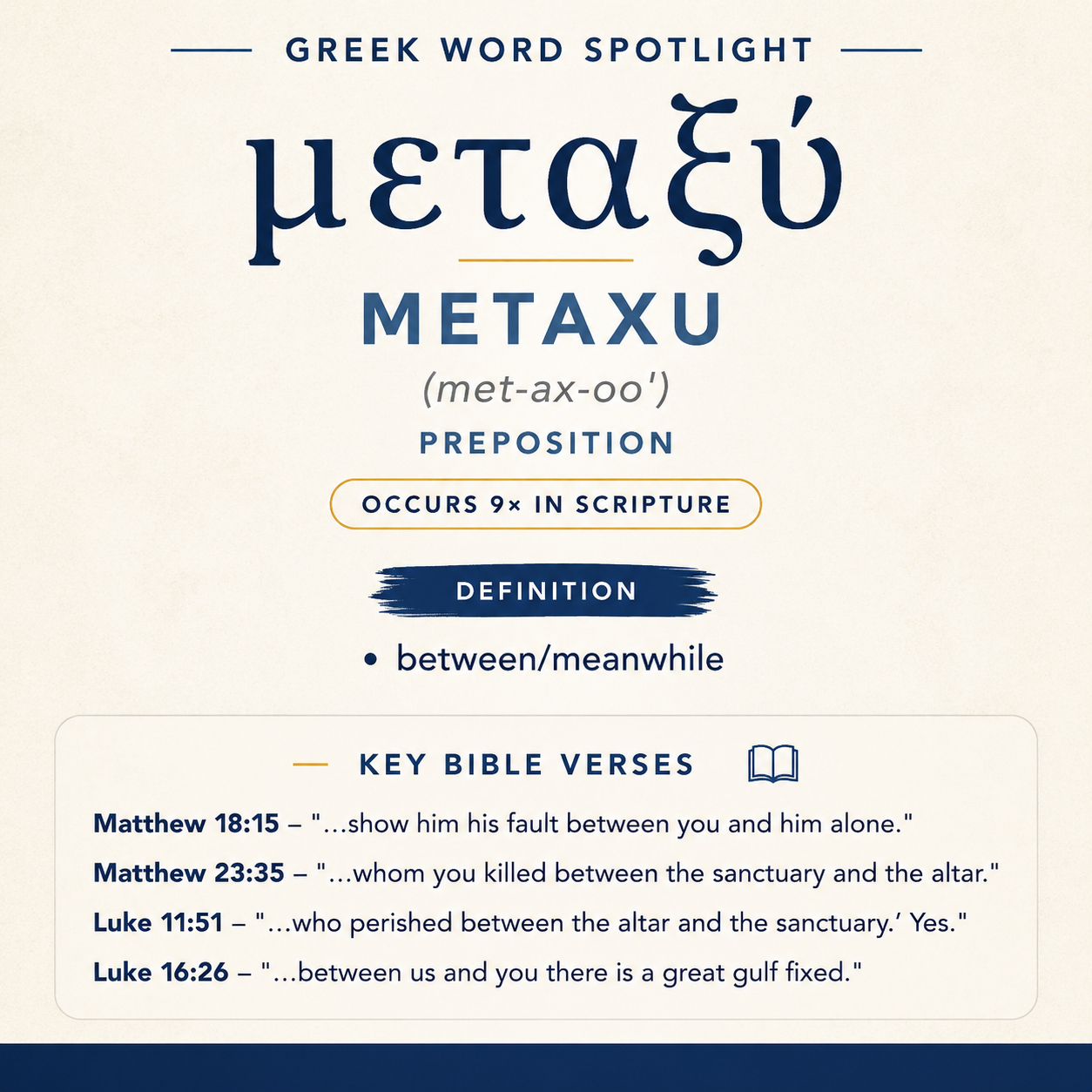
μεταξύ means “between/meanwhile” and appears 9 times in Scripture, including Matthew 18:15, Luke 16:26, John 4:31, and Acts 12:6.
Core Meaning
μεταξύ expresses location or relation “between,” and also can mean “meanwhile.”
Learn More →Between People
In Matthew 18:15 it describes addressing a brother’s fault “between you and him alone.” Acts 15:9 uses it for “between us and them.”
Learn More →Between Places
It marks separation in Luke 16:26: “between us and you there is a great gulf fixed.” It also appears spatially in Acts 12:6, with Peter sleeping “between two soldiers.”
Learn More →μεταξύ expresses relational placement or interval: something stands “between” parties, places, or groups, and it can also mark an intervening time (“meanwhile”). In the New Testament it appears in settings ranging from private reconciliation and temple space to imprisonment, a fixed chasm, and the inner forum of conscience.
Occurrences
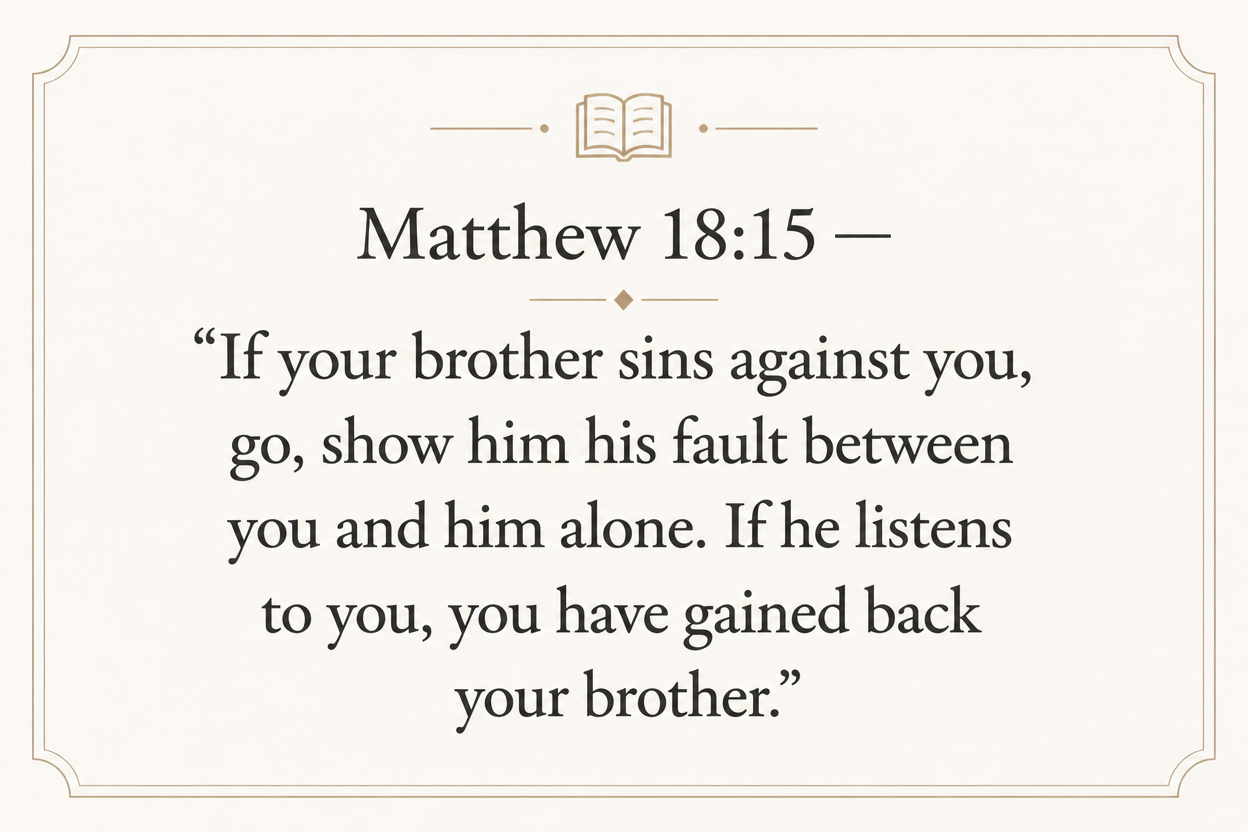
Matthew 18:15 — “If your brother sins against you, go, show him his fault between you and him alone. If he listens to you, you have gained back your brother.”
Here μεταξύ marks a narrow relational space: the confrontation is to happen in the restricted sphere “between you and him alone.” The phrase frames the action as contained within two persons, excluding additional witnesses or public exposure. The word’s force is not merely spatial but social—defining the boundaries of who is present in the exchange.
Matthew 23:35 — “that on you may come all the righteous blood shed on the earth, from the blood of righteous Abel to the blood of Zachariah son of Barachiah, whom you killed between the sanctuary and the altar.”
In this accusation, μεταξύ locates a killing within a defined sacred precinct: “between the sanctuary and the altar.” The term contributes a concrete spatial interval, drawing attention to the specific zone separating two cultic landmarks. The violence is situated not vaguely “in the temple,” but in a measured in-between place, sharpening the scene by its exact placement.
Luke 11:51 — “from the blood of Abel to the blood of Zachariah, who perished between the altar and the sanctuary.’ Yes, I tell you, it will be required of this generation.”
The Lucan wording parallels the Matthean spatial interval but reverses the paired nouns: “between the altar and the sanctuary.” μεταξύ again fixes the event in a liminal temple corridor—an area defined by two points. By naming the interval, the saying evokes a boundary-space within worship, intensifying the moral weight of the death that occurred there.
Luke 16:26 — “Besides all this, between us and you there is a great gulf fixed, that those who want to pass from here to you are not able, and that no one may cross over from there to us.’”
μεταξύ here describes separation between two groups: “between us and you there is a great gulf fixed.” The word establishes not just distance but a dividing interval that functions as an impassable barrier, reinforced by the explanation that passage is impossible in either direction. The “between” becomes a fixed boundary that controls movement and relationship.
John 4:31 — “In the meanwhile, the disciples urged him, saying, “Rabbi, eat.””
In this narrative aside, μεταξύ shifts from spatial to temporal interval: “In the meanwhile.” It marks what is happening during an intervening period, while another action or conversation is in view. The term creates a sense of concurrent time—an in-between moment in which the disciples press Jesus to eat.
Acts 12:6 — “The same night when Herod was about to bring him out, Peter was sleeping between two soldiers, bound with two chains. Guards in front of the door kept the prison.”
μεταξύ portrays a tightly controlled physical position: Peter is “sleeping between two soldiers.” The word defines him as located in the middle of a guarded arrangement, emphasized by “bound with two chains” and the additional guards at the door. The interval is not open space but a constrained “between,” a human barrier on both sides.
Acts 13:42 — “So when the Jews went out of the synagogue, the Gentiles begged that these words might be preached to them the next Sabbath.”
In this verse μεταξύ is not represented in the English wording quoted, yet the scene itself is framed by movement and interval: one group exits (“the Jews went out of the synagogue”) and another group requests a future hearing (“the next Sabbath”). Read within the flow of the sentence, the action unfolds in a transitional moment after departure and before the next gathering, an implicit in-between time where request and anticipation arise.
Acts 15:9 — “He made no distinction between us and them, cleansing their hearts by faith.”
μεταξύ marks comparison and separation—or, here, the denial of separation—between two sets of people: “between us and them.” The statement depends on the idea of an interval that could have been maintained (a dividing line), but it is explicitly removed: “He made no distinction.” The word supplies the relational axis on which “no distinction” is declared.
Romans 2:15 — “in that they show the work of the law written in their hearts, their conscience testifying with them, and their thoughts among themselves accusing or else excusing them)”
In this description of inner moral experience, μεταξύ (rendered here as “among themselves”) locates activity within an internal interpersonal-like arena: “their thoughts among themselves accusing or else excusing them.” The word frames a mental interval where competing assessments arise and interact. The “between/among” space is not geographical but the structured relation of thoughts engaging one another in accusation or defense.

Sense and Usage
Across these passages, μεταξύ consistently establishes an interval defined by two poles, whether people, places, groups, or moments. In relational settings it specifies the limits of an interaction: Matthew 18:15 places correction within the confines of two persons, while Acts 15:9 uses the same between-language to speak about the potential dividing line between “us and them,” only to insist that such a line is not operative.
In spatial descriptions, μεταξύ can be vivid and measurable. Matthew 23:35 and Luke 11:51 anchor an event in the space separating “the sanctuary” and “the altar,” and Acts 12:6 places Peter in the narrow middle position “between two soldiers.” In each case the interval is not empty; it is charged with what occurs there—violence in the temple precinct, restraint in a prison cell. Luke 16:26 intensifies the spatial sense by combining “between” with the idea of a “great gulf fixed,” turning the interval into a permanent barrier that determines what is possible (“not able,” “no one may cross over”).
μεταξύ also functions in temporal narration. John 4:31 uses it to mark concurrent time—what the disciples are doing during an intervening moment. In narrative flow, such a “meanwhile” can hold together adjacent scenes by highlighting what runs alongside the main line of action. Acts 13:42, with its exit from the synagogue and request for “the next Sabbath,” likewise depicts a transition in which one group leaves and another presses for continuation; the interval between gatherings becomes the moment for desire and request to surface.
Finally, Romans 2:15 shows that the notion of “between” can extend to the inner life. The interval is conceptual: thoughts stand in relation to one another “among themselves,” forming a kind of internal forum where accusation and excuse alternate. Even here, the word keeps its core contribution: it maps a structured space of relation in which more than one party (or mental movement) is set in reference to the other.
Imagery
The occurrences of μεταξύ frequently bring the reader’s attention to thresholds and middle spaces. Temple architecture (“between the sanctuary and the altar”), custody (“between two soldiers”), and the unbridgeable divide (“between us and you there is a great gulf fixed”) all use “between” to make the in-between itself significant—sometimes as the place where something happens, sometimes as the barrier that prevents anything from happening across it. Even in quieter uses—private conversation “between you and him alone,” or an internal exchange “among themselves”—the word highlights how much depends on what is placed in the middle, and on the boundaries that define that middle.
Sources: Lexical data from Strong’s Exhaustive Concordance and the Translators Brief Lexicon of Extended Strongs for Greek (STEPBible, CC BY). Occurrence data from the Translators Amalgamated Greek New Testament (STEPBible, CC BY). Scripture quotations from the World English Bible (public domain).




