Exploring the Meaning of Metalambano in Greek
μεταλαμβάνω means “to partake” and occurs 7 times in Scripture, including Acts, 2 Timothy, and Hebrews.
Core Meaning
μεταλαμβάνω is defined as “to partake.” In its occurrences, it describes sharing in something received or enjoyed.
Learn More →Acts Usage
In Acts 2:46, it appears with taking food while breaking bread at home. In Acts 27:33–34, Paul urges others to take some food.
Learn More →Other Occurrences
It appears in 2 Timothy 2:6 about getting a share of the crops. In Hebrews 12:10 it refers to being partakers of profit, and Hebrews 6:7 uses it of land drinking rain.
Learn More →μεταλαμβάνω expresses the act of taking part in something—of partaking. In the passages where it appears, it is tied to ordinary eating, to receiving a share from labor, and to participation in what benefits and shapes a person.

Occurrences
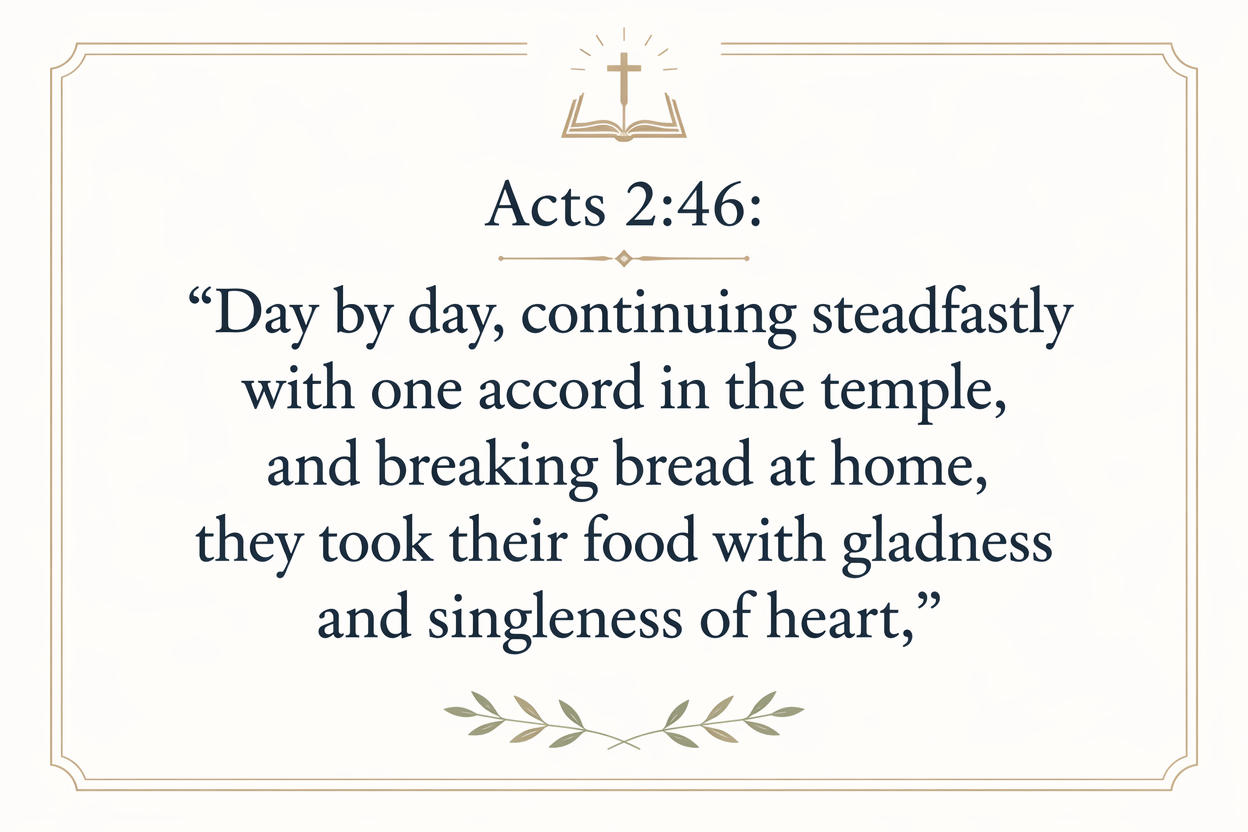
Acts 2:46: “Day by day, continuing steadfastly with one accord in the temple, and breaking bread at home, they took their food with gladness and singleness of heart,”
Here the word belongs to a rhythm of shared life marked by constancy (“Day by day”), unity (“with one accord”), and two settings: public worship (“in the temple”) and household fellowship (“at home”). The action is simple—taking food—but it is described with an inner quality: “gladness and singleness of heart.” The idea of partaking is not bare consumption; it is a communal, glad participation in daily provision that fits a whole pattern of steadfastness.
Acts 24:25: “As he reasoned about righteousness, self-control, and the judgment to come, Felix was terrified, and answered, “Go your way for this time, and when it is convenient for me, I will summon you.””
In this scene the surrounding content is a moral and judicial triad—“righteousness, self-control, and the judgment to come”—and the reaction is fear (“Felix was terrified”). The word’s contribution is to frame Felix’s response as a postponement rather than a participation: he sends the speaker away and defers engagement to a later, “convenient” time. Against the urgency implied by “judgment to come,” the notion of partaking sits in tension with delay—whether one will enter into what is being set before him or hold back from it.
Acts 27:33: “While the day was coming on, Paul begged them all to take some food, saying, “Today is the fourteenth day that you wait and continue fasting, having taken nothing.”
The setting is crisis at sea, where time and weakness matter: “the fourteenth day” of waiting, with ongoing deprivation (“continue fasting”), and the stark summary “having taken nothing.” The word is pressed into the concrete need of sustenance: Paul urges them to partake of food as daylight approaches. The act of partaking is portrayed as a necessary step out of prolonged withholding, a practical turning point in endurance.
Acts 27:34: “Therefore I beg you to take some food; for this is for your safety; for not a hair will perish from any of your heads.”
This repeats the urging but adds an explicit purpose: “for your safety.” Partaking is linked to preservation of life and strength in the immediate ordeal. The reassurance “not a hair will perish from any of your heads” places the act of taking food within a larger expectation of deliverance; yet the appeal remains physical and direct. Partaking becomes an act aligned with staying alive and being fit to reach safety.
2 Timothy 2:6: “The farmer who labors must be the first to get a share of the crops.”
Here the scene shifts from emergency to ordinary work. The proverb-like statement ties partaking to effort: the one “who labors” has a rightful priority “to get a share of the crops.” The word emphasizes participation in the yield that results from toil. Partaking is not accidental but structured by the moral logic of work and reward—the laborer’s first enjoyment of the produce corresponds to his exertion in bringing it about.
Hebrews 6:7: “For the land which has drunk the rain that comes often on it and produces a crop suitable for them for whose sake it is also tilled, receives blessing from God;”
The imagery is agricultural and receptive: land “has drunk the rain that comes often on it.” That receptive taking-in leads to fruitfulness (“produces a crop suitable”) and culminates in “receives blessing from God.” In this chain, the word contributes the notion of partaking as reception—land partakes of rain; in response it yields what fits the purpose of cultivation (“for whose sake it is also tilled”). The action of receiving is portrayed as repeated (“often”) and consequential: what is taken in shapes what is brought forth and what is received in return.
Hebrews 12:10: “For they indeed, for a few days, punished us as seemed good to them; but he for our profit, that we may be partakers of his holiness.”
This usage places partaking in the sphere of formation and outcome. A contrast is drawn between human discipline (“for a few days,” “as seemed good to them”) and a divine purpose (“for our profit”). The stated aim is participation: “that we may be partakers of his holiness.” Here partaking is relational and transformative—something shared in, not merely received externally. The word marks the goal of discipline as entry into a quality described as “his holiness,” with profit understood not as gain detached from character, but as participation in what belongs to him.

Sense and Usage
Across these passages, μεταλαμβάνω gathers around the concrete act of taking in or taking part, and the contexts show what kind of participation is in view. In Acts it most visibly attaches to eating: “they took their food” in daily fellowship (Acts 2:46), and sailors are urged twice to “take some food” in the name of endurance and “safety” (Acts 27:33–34). In both settings, partaking is more than private nourishment. In Acts 2 it is tied to shared life, gladness, and unity; in Acts 27 it is a communal act urged for the group’s survival, coordinated by a voice of leadership (“Paul begged them all”). These scenes underline how partaking can be both ordinary and urgent: the same basic action—taking food—can express settled joy or emergency necessity.
Other occurrences widen the angle without leaving the central idea. In 2 Timothy 2:6, partaking is framed as “get a share” of what labor produces. The farmer’s participation in the crop is portrayed as fitting and ordered: the one who has borne the work participates first in the yield. The movement is from exertion to participation, making partaking the appropriate enjoyment of results rather than an entitlement detached from labor.
Hebrews extends the idea into figurative and moral terrain. Hebrews 6:7 depicts land that “has drunk the rain” and thereby produces a suitable crop and “receives blessing.” Partaking is pictured as receptive intake that leads to fruitfulness: what the land takes in shapes what it gives out. Hebrews 12:10 then places partaking at the end of discipline: a purposeful process aims “that we may be partakers of his holiness.” Here participation is not in food, crops, or rain, but in a quality belonging to God, and it is presented as the intended benefit (“for our profit”). The varied contexts—table fellowship, survival rations, agricultural reward, fruitful land, and disciplined formation—show the word’s flexibility: participation may be immediate and physical, or it may be the long-range outcome of a shaping process, but in each case it is an entering into and receiving of something set before the person or community.
Acts 24:25 stands out for placing the word in a scene of moral reasoning and deferral. The response—“Go your way for this time… when it is convenient for me”—sets postponement against the weight of the topics discussed. In that frame, partaking is implicitly a matter of timely engagement: a summons to share in what is being presented can be met with delay. The narrative tension is that the moment of hearing can become a moment of refusal to participate, not by overt contradiction but by putting off the encounter.
Imagery
The word’s imagery in these texts is strikingly tangible: bread broken “at home” and food taken “with gladness” (Acts 2:46), a hungry company urged to eat for “safety” (Acts 27:34), a laborer taking the first share of harvest (2 Timothy 2:6), and soil drinking frequent rain and receiving blessing (Hebrews 6:7). Even when the object of participation is “his holiness” (Hebrews 12:10), the language stays in the register of sharing and receiving—participation that is as real as nourishment and as purposive as cultivation.
Sources: Lexical data from Strong’s Exhaustive Concordance and the Translators Brief Lexicon of Extended Strongs for Greek (STEPBible, CC BY). Occurrence data from the Translators Amalgamated Greek New Testament (STEPBible, CC BY). Scripture quotations from the World English Bible (public domain).