Exploring the Meaning of Metakineo in Greek
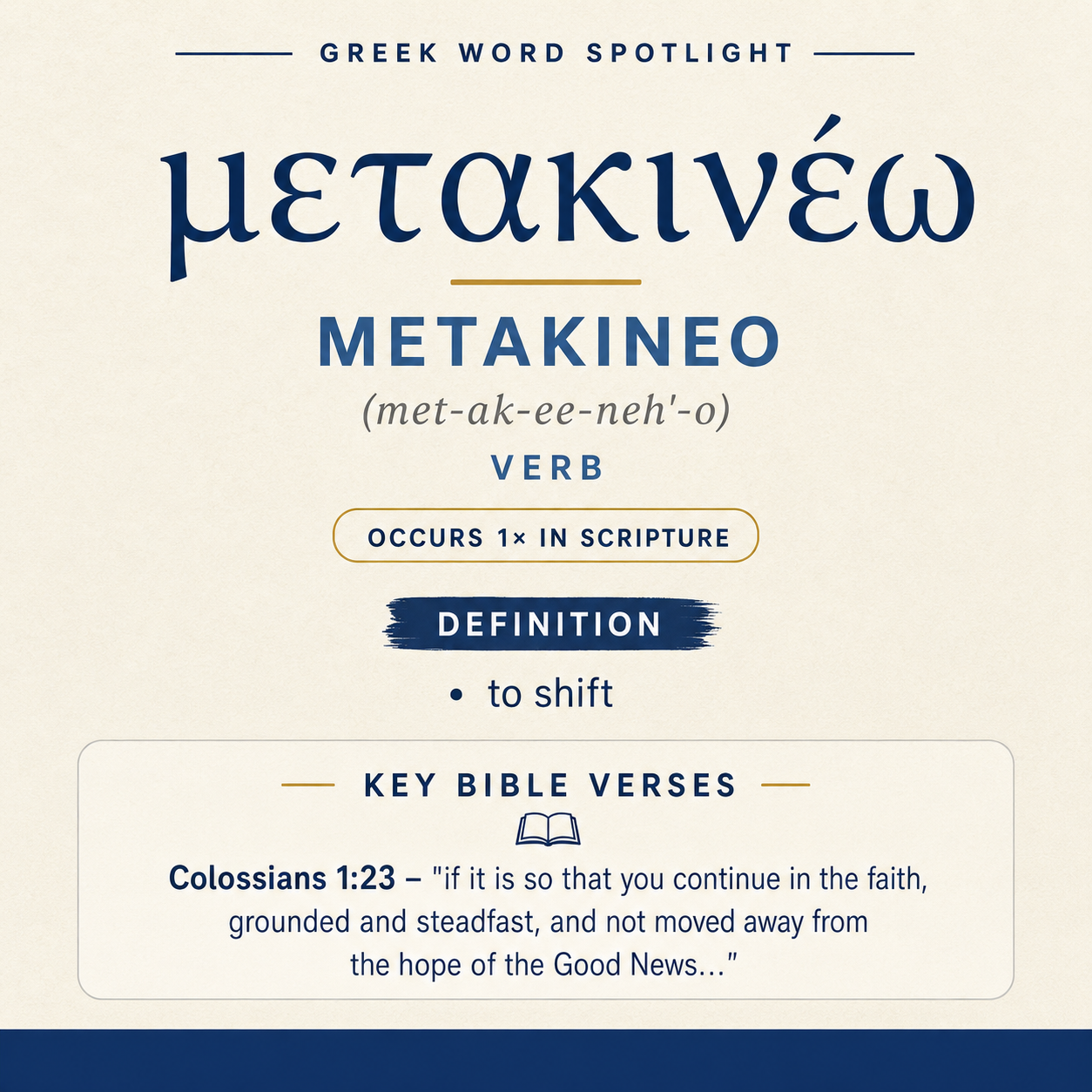
μετακινέω means “to shift” and appears once in Scripture, in Colossians 1:23.
Scripture Occurrence
This verb occurs 1 time in Scripture. Its single occurrence is in Colossians 1:23.
Learn More →Context in Colossians
In Colossians 1:23 it appears in the phrase “not moved away from the hope of the Good News.”
Learn More →Metakineo means “to shift,” and it appears once in the New Testament, in Paul’s exhortation in Colossians. In that setting it names a danger that threatens endurance and stability in the life shaped by the good news.
Root and Related Words
Metakineo is formed from meta (μετά), “with/after,” and kineo (κινέω), “to move.”

Occurrences
“if it is so that you continue in the faith, grounded and steadfast, and not moved away from the hope of the Good News which you heard, which is being proclaimed in all creation under heaven, of which I, Paul, was made a servant.” (Colossians 1:23)
In this sentence, the verb stands in direct contrast to two images of stability: “grounded” and “steadfast.” The line is shaped as a conditional exhortation (“if it is so that you continue”), and the warning is expressed negatively: “and not moved away from the hope of the Good News.” In this context, metakineo marks a shift away from a defined center—“the hope of the Good News which you heard.” The movement envisioned is not a neutral change of place; it is a displacement that would break continuity (“continue in the faith”) and disturb what is pictured as fixed and settled (“grounded and steadfast”).
The phrase “moved away from the hope” frames the shift as relational and directional: the hope is the point from which one can be shifted, and remaining is tied to perseverance in faith. The clause that follows (“which is being proclaimed in all creation under heaven”) places that hope within a broad proclamation, but the verb keeps the focus on the readers’ stability in relation to what they “heard.” Paul’s final self-reference (“of which I, Paul, was made a servant”) situates the warning within apostolic ministry: his service supports their continuing, and the threatened “shift” would be a departure from the very message that created their hope.
Sense and Usage
Within its lone New Testament use, metakineo (“to shift”) functions as a vivid verb for destabilization. It belongs to a field of imagery where faith is pictured as something that can be continued in, like a settled stance, and hope is pictured as something from which a person can be displaced. The surrounding adjectives help specify the kind of shifting in view. To be “grounded” suggests something set on a firm base, and to be “steadfast” suggests firmness under pressure; metakineo names what would undermine that firmness by moving someone away from the hope anchored in the good news.
The verb’s placement after “continue in the faith” links shifting with failing to persist. Continuance is portrayed as the intended trajectory, and the negative phrase “not moved away” describes a condition necessary for that trajectory to hold. Metakineo thus captures the idea of a shift that changes one’s position relative to the gospel’s hope: a movement away rather than a deepening within. The object from which the movement occurs is not an abstract optimism but “the hope of the Good News which you heard.” The wording ties hope tightly to the preached message and to the initial reception of that message (“which you heard”), so the shift is away from a heard and proclaimed reality rather than away from a private feeling.
Because the sentence also speaks of the gospel “being proclaimed in all creation under heaven,” metakineo implicitly contrasts a message that is broadcast widely with the individual’s need to remain fixed in relation to it. The proclamation is expansive; the danger addressed is not the message’s disappearance but the listener’s displacement from hope. In this way the verb serves Paul’s pastoral aim: the readers are urged to maintain a stable orientation to the gospel’s hope even as the message spreads outward.
Imagery
Colossians 1:23 pairs metakineo with building-and-foundation language (“grounded”) and with the posture of firmness (“steadfast”). Against that backdrop, “shift” evokes the picture of something set in place that is being forced out of alignment. The hope connected to the good news is treated as a fixed reference point; the exhortation is to remain where that hope holds, rather than being shifted away from it.
Sources: Lexical data from Strong’s Exhaustive Concordance and the Translators Brief Lexicon of Extended Strongs for Greek (STEPBible, CC BY). Occurrence data from the Translators Amalgamated Greek New Testament (STEPBible, CC BY). Scripture quotations from the World English Bible (public domain).