Exploring the Meaning of Mastos in Greek
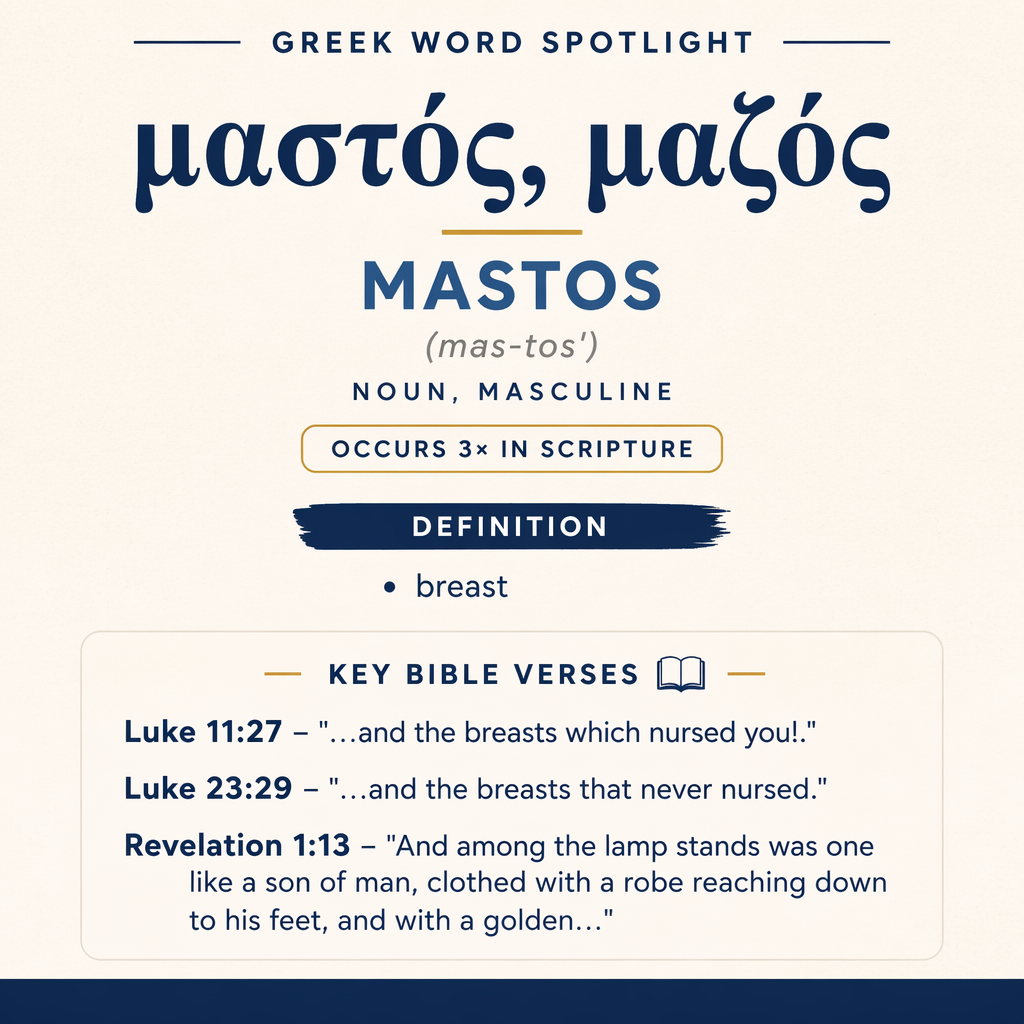
μαστός / μαζός (Mastos) means “breast” and occurs three times in Scripture: Luke 11:27; Luke 23:29; Revelation 1:13.
Scripture Occurrences
This word appears 3 times in Scripture. The references listed are Luke 11:27, Luke 23:29, and Revelation 1:13.
Learn More →Verse Contexts
In Luke 11:27 and Luke 23:29 it appears in sayings that include “Blessed …” language. In Revelation 1:13 it appears in a vision scene describing one “like a son of man.”
Learn More →μαστός, μαζός denotes a “breast.” It appears in two sayings in Luke that speak of nursing and childbearing, and once in Revelation in a description that locates a golden sash “around his chest.”
Root and Related Words
Strong’s connects μαστός/μαζός with the verb massaomai (μασσάομαι), “to gnaw” (Strong’s G3145), giving a lexical association that fits the nursing context where an infant feeds.

Occurrences
“It came to pass, as he said these things, a certain woman out of the multitude lifted up her voice, and said to him, “Blessed is the womb that bore you, and the breasts which nursed you!”” (Luke 11:27)
Here the word stands in a pair with “the womb that bore you,” so that bearing and nursing are held together as bodily realities of motherhood. The breasts are specified not simply as anatomy but as the means by which the child was sustained: “the breasts which nursed you.” In the woman’s exclamation, this is praise expressed through the concrete image of nurture—first carried in the womb, then fed at the breast—placing the emphasis on the intimate, life-giving relationship implied by nursing.
“For behold, the days are coming in which they will say, ‘Blessed are the barren, the wombs that never bore, and the breasts that never nursed.’” (Luke 23:29)
In this saying the word is again linked to wombs, but now by negation: “the wombs that never bore, and the breasts that never nursed.” The breasts are described by their unrealized function—nursing that does not take place—so the image is of withheld or absent nurture rather than its presence. The line’s force depends on the ordinary expectation that wombs bear and breasts nurse; the statement reverses that expectation by pronouncing “blessed” those for whom these maternal experiences never occur. The word therefore carries a tone shaped by contrast with Luke 11:27: what was once a ground for blessing through fulfilled nurture becomes a ground for blessing through the avoidance of that same maternal role.
“And among the lamp stands was one like a son of man, clothed with a robe reaching down to his feet, and with a golden sash around his chest.” (Revelation 1:13)
This occurrence uses the word in a descriptive scene rather than a maternal saying. The reference is to the location of a “golden sash,” placed “around his chest.” The term marks the upper torso as the point where the sash is fastened, contributing to the careful, visual detailing of clothing: a long robe and a sash positioned high on the body. Unlike the Lukan uses, there is no mention of nursing or motherhood in the wording; the word functions here as a spatial marker in an apparition-like description “among the lamp stands,” helping the reader picture how the figure is dressed and how the garment lies on the body.
Sense and Usage
Across these passages, “breast” moves between two main kinds of reference: (1) the breast as the bodily source of nourishment for a child, and (2) the breast/chest as a region of the body where something is worn. Luke’s two sayings anchor the word in the lived experience of nursing, making the breast significant not merely as a body part but as an instrument of care. In Luke 11:27, the breasts are remembered for what they did—“which nursed you”—so the image is active and relational, pointing to feeding and the bond between mother and child. In Luke 23:29, the breasts are described as “never nursed,” which keeps the same basic idea in view but frames it as absence; the wording draws attention to what is ordinarily expected and then speaks of a time when the lack of that experience is called “blessed.” In both, the word is closely paired with “womb,” creating a compact picture of motherhood from conception and birth to nourishment and early life.
Revelation 1:13 shows the term’s ability to serve straightforward description. The phrase “around his chest” is part of a coordinated depiction—robe length, sash material, and sash placement—so that the breast/chest area becomes a point of visual structure in the scene. Because the sash is “golden” and positioned “around his chest,” the body region has a role in how the figure’s presence is perceived: it is not incidental, but part of the arranged, observable details of the vision. This use demonstrates that the same concrete noun can be employed either to evoke nurture (nursing breasts) or to locate an object on the body (a sash at the chest), with the immediate context determining which aspect comes forward.
Imagery
The word’s imagery in Luke is domestic and bodily, centering on the intimate act of nursing and on the blessing language attached to motherhood—either celebrated (“the breasts which nursed you”) or deliberately inverted (“the breasts that never nursed”). In Revelation the imagery is formal and visual: clothing and adornment, with a golden sash drawn tight “around his chest” as the figure stands “among the lamp stands.” Together, these passages show how a single concrete term can carry the warmth of nurture in one setting and the measured detail of a visionary description in another.
Sources: Lexical data from Strong’s Exhaustive Concordance and the Translators Brief Lexicon of Extended Strongs for Greek (STEPBible, CC BY). Occurrence data from the Translators Amalgamated Greek New Testament (STEPBible, CC BY). Scripture quotations from the World English Bible (public domain).