Exploring the Meaning of Maraino in Greek
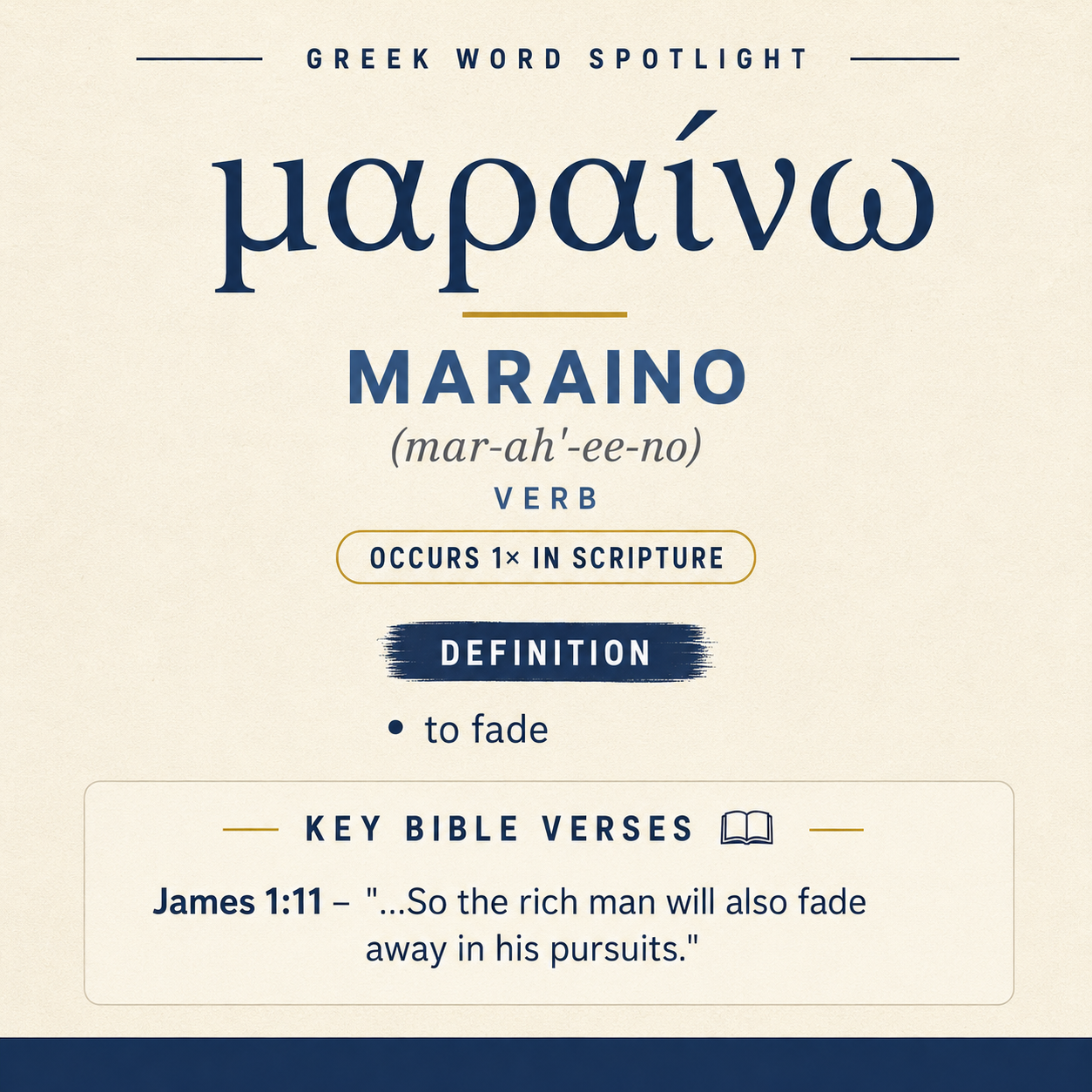
μαραίνω means “to fade” and appears once in Scripture, in James 1:11.
Biblical Occurrence
This word occurs 1 time in Scripture. The occurrence is in James 1:11.
Learn More →James 1:11 Context
In James 1:11, it is used in imagery where the sun rises with scorching wind and the flower’s beauty fades.
Learn More →μαραίνω expresses the idea of “to fade,” and it appears once in the New Testament, in James 1:11. In that verse it is set within a chain of natural images—sun, scorching wind, grass, flower, and perishing beauty—to describe what happens to the rich man in the course of his pursuits.
Occurrences
“For the sun arises with the scorching wind and withers the grass, and the flower in it falls, and the beauty of its appearance perishes. So the rich man will also fade away in his pursuits.” (James 1:11)
Here μαραίνω stands at the end of a tightly linked sequence of events. The verse first presents a scene in the natural world: the sun rises, a scorching wind comes, the grass withers, the flower falls, and the visible “beauty of its appearance” perishes. Each clause narrows from the larger setting (sun and wind) to the plant itself (grass) and then to what is most delicate and admired (the flower and its beauty). The verb “fade away” is then applied to “the rich man,” drawing a comparison between the swift loss in the landscape and the rich man’s own outcome.
In this setting, “fade away” is not an isolated comment but a concluding statement that gathers the imagery into a single verdict. The earlier descriptions (“withers,” “falls,” “perishes”) form a movement from vitality to diminished state and then to loss. Against that backdrop, μαραίνω portrays the rich man’s decline as something that happens in the same moral universe as the scorching wind’s effect on grass: it is real, it is observable in its results, and it belongs to the course of ordinary events. The rich man’s fading is also located “in his pursuits,” which frames the fading as occurring amid activity and intent rather than only after all activity has ceased; the verse’s comparison implies that the very sphere in which he is occupied does not shield him from the kind of diminishment pictured in the plant.
The placement of μαραίνω after the natural illustration gives it rhetorical weight. The verse does not merely say that the rich man ends; it says that he “will also fade away,” with “also” explicitly tying his fate to the plant’s fate. The word therefore functions as the human-side counterpart to the earlier scene’s deterioration: as the flower’s beauty does not endure under the sun and scorching wind, so the rich man does not endure in the forward motion of his plans.

Sense and Usage
The single attestation of μαραίνω in James 1:11 anchors its sense in the imagery of brief flourishing followed by rapid diminishment. “To fade” in this context works as the final step in a comparison that begins with something living and visually appealing and ends with its loss of vitality and attractiveness. The verse’s progression—sun and wind acting upon grass, flower, and beauty—shows fading as the kind of change that can be described in terms of visible decline, a lessening that follows exposure to harsh conditions. Within the logic of the sentence, fading is not presented as accidental or rare; it is presented as the expected outcome once the scorching forces have done their work.
Because the comparison is made explicitly (“So the rich man will also fade away”), the verb carries over the atmosphere of the illustration into the moral point. The fading of the rich man is not described in terms of geography or social standing but in terms of a process analogous to what happens to vegetation under intense heat and drying wind. The illustration does more than decorate the statement; it defines the kind of fading meant. The rich man’s fading is pictured as something that can be swift, something that follows a season of apparent life and beauty, and something that leaves no lasting claim to the earlier appearance. In this way, the word’s sense is sharpened by the immediate co-text: it is the rich man’s diminishment when measured against the transitory character of what looks impressive for a time.
The phrase “in his pursuits” further shapes how “fade away” is heard. The fading is not placed outside the rich man’s projects as though his pursuits continued untouched while only his person faded at the end. Rather, the pursuits are the arena in which the fading occurs. This keeps the verb from being merely a distant future outcome detached from present life. The clause suggests that fading is compatible with busyness and ambition; it is possible for someone to be actively pursuing aims while nonetheless moving toward the kind of decline the verse has just illustrated. The earlier lines about grass and flower likewise show change happening within the ongoing cycle of nature: the sun “arises,” the wind blows, and the plant’s condition shifts as those actions unfold. The verbal choice therefore supports a view of fading as a process that can take place alongside ordinary movement and activity.
Even within one verse, James 1:11 provides a small semantic field around μαραίνω by clustering it near verbs and images of deterioration: “withers,” “falls,” and “perishes” appear immediately before “fade away.” Without adding new meanings, these neighboring terms clarify how the fading is imagined. It is aligned with withering—loss of freshness or vitality; it is aligned with falling—collapse of what was elevated or blooming; and it is aligned with perishing—loss of what was regarded as beautiful. The richness of the comparison lies in the layered description: fading is the capstone term that transfers the entire botanical picture onto the rich man’s situation.
In James 1:11, then, μαραίνω operates as a verdict on the durability of a certain kind of human security. The verse does not argue by abstract definition; it argues by showing what the sun and scorching wind do to what seems stable and lovely, and then applying that same logic to the rich man. Within that argument, “to fade” names the outcome: the rich man does not remain at the height suggested by his wealth and pursuits, but undergoes a reduction analogous to the visible decline of vegetation under harsh heat.
Imagery
The imagery carried by μαραίνω in James 1:11 is deliberately concrete. The verse invites the reader to picture a landscape where the day’s heat and a scorching wind quickly change what was green and attractive: grass dries, a flower drops, and beauty vanishes. When the same verb is applied to the rich man, the effect is to make human status feel as exposed as a wild plant in open air. The word “fade away” thus evokes the quiet, relentless change from bloom to loss, and it places that change “in his pursuits,” as though the fading accompanies the very course of life in which confidence might otherwise be placed.
Sources: Lexical data from Strong’s Exhaustive Concordance and the Translators Brief Lexicon of Extended Strongs for Greek (STEPBible, CC BY). Occurrence data from the Translators Amalgamated Greek New Testament (STEPBible, CC BY). Scripture quotations from the World English Bible (public domain).