
Exploring the Meaning of Manna in Greek
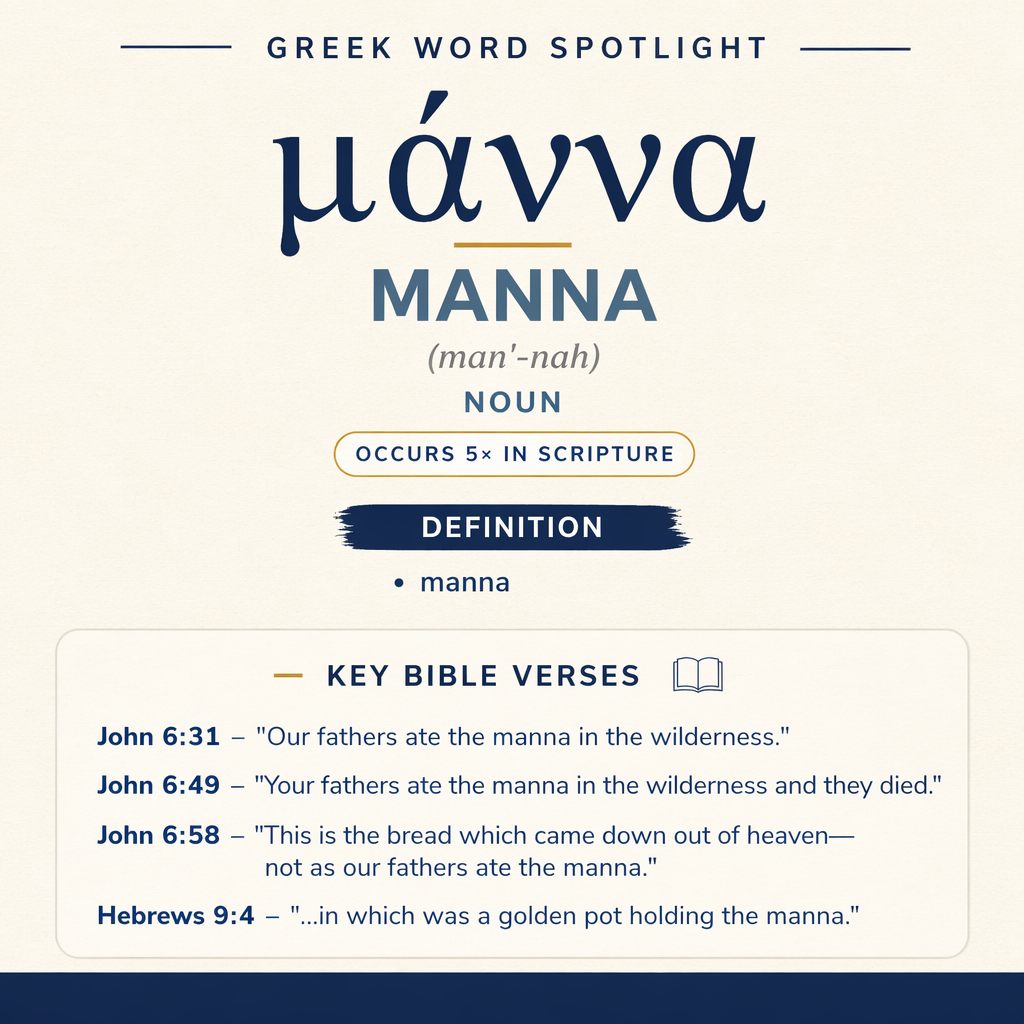
μάννα means “manna” and appears five times in Scripture: John 6:31, 6:49, 6:58; Hebrews 9:4; Revelation 2:17.
Gospel Usage
In John 6:31, 6:49, and 6:58 it refers to the manna eaten by the fathers in the wilderness.
Learn More →Other Contexts
Hebrews 9:4 mentions a golden pot associated with the ark of the covenant. Revelation 2:17 promises giving of the manna to the one who overcomes.
Learn More →μάννα means “manna,” a concrete food associated with God’s provision and remembered in Israel’s story. In the New Testament it appears in a cluster of sayings in John 6, in a description of sacred objects in Hebrews 9, and in a promise to the conqueror in Revelation 2.
Occurrences
John 6:31 — “Our fathers ate the manna in the wilderness. As it is written, ‘He gave them bread out of heaven to eat.’ ”
Here μάννα names the food eaten by “our fathers” during “the wilderness,” presented as a shared ancestral memory. The sentence places the noun inside a brief narrative summary (“ate the manna”) and then sets it alongside the citation about “bread out of heaven.” Within the verse’s own wording, μάννα functions as the remembered instance of “bread” given from above: a specific kind of bread whose origin is traced to heaven. The effect is to anchor the discussion in a recognizable event—an episode of eating that was repeated enough to define a generation (“our fathers”).

John 6:49 — “Your fathers ate the manna in the wilderness and they died.”
In this later statement, μάννα is again the object of the fathers’ eating, but the emphasis shifts to the outcome: “and they died.” The noun is placed in a stark contrast between provision and mortality. By joining “ate the manna” with “and they died,” the verse uses μάννα to mark something genuinely sustaining (it was eaten as food) yet limited in what it achieved for those who received it. The wilderness setting remains, keeping the memory tied to a journey context where survival depended on provision.
John 6:58 — “This is the bread which came down out of heaven—not as our fathers ate the manna, and died. He who eats this bread will live forever.”
Here μάννα is embedded in an explicit comparison. The verse speaks of “the bread which came down out of heaven” and then adds a negation: “not as our fathers ate the manna, and died.” In the logic of the sentence, μάννα represents a prior “bread from heaven” experience, but one whose eaters still “died.” That memory sets the baseline for what follows: “He who eats this bread will live forever.” μάννα thus serves as the historical reference point that makes the claim about the new bread’s effect intelligible; it is the known heavenly food whose benefits, in this framing, did not extend to everlasting life.
Hebrews 9:4 — “having a golden altar of incense, and the ark of the covenant overlaid on all sides with gold, in which was a golden pot holding the manna, Aaron’s rod that budded, and the tablets of the covenant;”
In this description of cultic furnishings, μάννα appears not as something eaten but as something stored: “a golden pot holding the manna.” The noun is treated as a tangible item that could be kept in a container and placed “in” the ark area described. Its placement among “Aaron’s rod that budded, and the tablets of the covenant” frames it as a preserved witness alongside other concrete objects connected with covenant memory. The phrase “holding the manna” makes μάννα a substance with physical presence—something that can be contained, carried, and safeguarded as part of sacred inventory.
Revelation 2:17 — “He who has an ear, let him hear what the Spirit says to the assemblies. To him who overcomes, to him I will give of the hidden manna, and I will give him a white stone, and on the stone a new name written, which no one knows but he who receives it.”
In this promise, μάννα is modified by “hidden,” forming the gift “the hidden manna.” The noun retains its identity as food, but now it is presented as something granted by the speaker (“I will give”) to “him who overcomes.” The pairing with “a white stone” and “a new name written” places μάννα within a cluster of personal gifts received by an individual. The adjective “hidden” adds a dimension of reserved access: μάννα is not portrayed as public or common in this context, but as something kept and then bestowed. The verse’s emphasis is not on eating in a wilderness scene, but on receiving a promised provision tied to overcoming and to a message addressed to “the assemblies.”

Sense and Usage
Across these passages, μάννα consistently denotes manna itself, yet its narrative roles differ. In John 6 it functions as a remembered food that a whole generation “ate” in the wilderness, a shared point of reference introduced with “Our fathers” and “Your fathers.” Within those sayings, μάννα is closely associated with “bread out of heaven” and is repeatedly linked to the action of eating. At the same time, the repeated clause “and they died” assigns μάννα a particular argumentative value: it exemplifies a genuine heavenly provision that did not prevent the mortality of those who received it. The word is therefore used not merely to evoke past nourishment, but to establish a contrast between the effects associated with two kinds of “bread” mentioned in the discourse.
Hebrews 9:4 uses μάννα in a different register. The word appears within a list of sancta and is treated as an item preserved in a “golden pot.” This setting does not develop the theme of eating at all; instead it presents μάννα as an artifact-like remnant. The phrase “holding the manna” depicts the substance as storable, able to be contained as part of the sacred complex described. In that context μάννα is connected to the physicality of worship space and to objects that carry covenant associations (as the verse lists them), so the word contributes to a picture of tangible memorials connected with Israel’s sacred history.
Revelation 2:17 extends the noun’s imagery into a promise. By speaking of “the hidden manna,” the verse draws on μάννα’s identity as a provision, but re-frames it as a gift reserved and later given to a particular recipient: “To him who overcomes, to him I will give.” The manna is “hidden,” suggesting guardedness and selective bestowal within the verse’s own terms, and it is grouped with other individualized gifts (“a white stone,” “a new name written”). In this way μάννα can evoke provision and sustenance while also functioning as a symbolic gift in a message meant to be heard and received. Even here, however, it remains manna—something given, not earned, and something received in response to overcoming, not merely recollected as an ancestral event.
Considered together, these occurrences show μάννα moving through three primary frames: communal memory of wilderness eating (John), sacred preservation in a vessel (Hebrews), and eschatological-style promise language of a gift to the conqueror (Revelation). The word’s concreteness holds these frames together: it is always a “thing,” spoken of as eaten, held in a pot, or given. That concreteness allows it to carry both historical recollection (“our fathers”) and present promise (“I will give”) without shifting into abstraction.
Imagery
The passages pair μάννα with strong spatial language. John places it “in the wilderness” and links it with “bread out of heaven,” setting vertical origin against a harsh earthly setting. Hebrews locates it inside a “golden pot” within the sacred furnishings, moving the image from open wilderness to enclosed holiness. Revelation calls it “hidden,” turning the image inward again: manna is not scattered for general gathering, but reserved as a gift disclosed to the one who receives it. Across these scenes, μάννα gathers associations of provision, memory, and guarded treasure, each shaped by the immediate wording of its context.
Sources: Lexical data from Strong’s Exhaustive Concordance and the Translators Brief Lexicon of Extended Strongs for Greek (STEPBible, CC BY). Occurrence data from the Translators Amalgamated Greek New Testament (STEPBible, CC BY). Scripture quotations from the World English Bible (public domain).




