Exploring the Meaning of Makrothumia in Greek
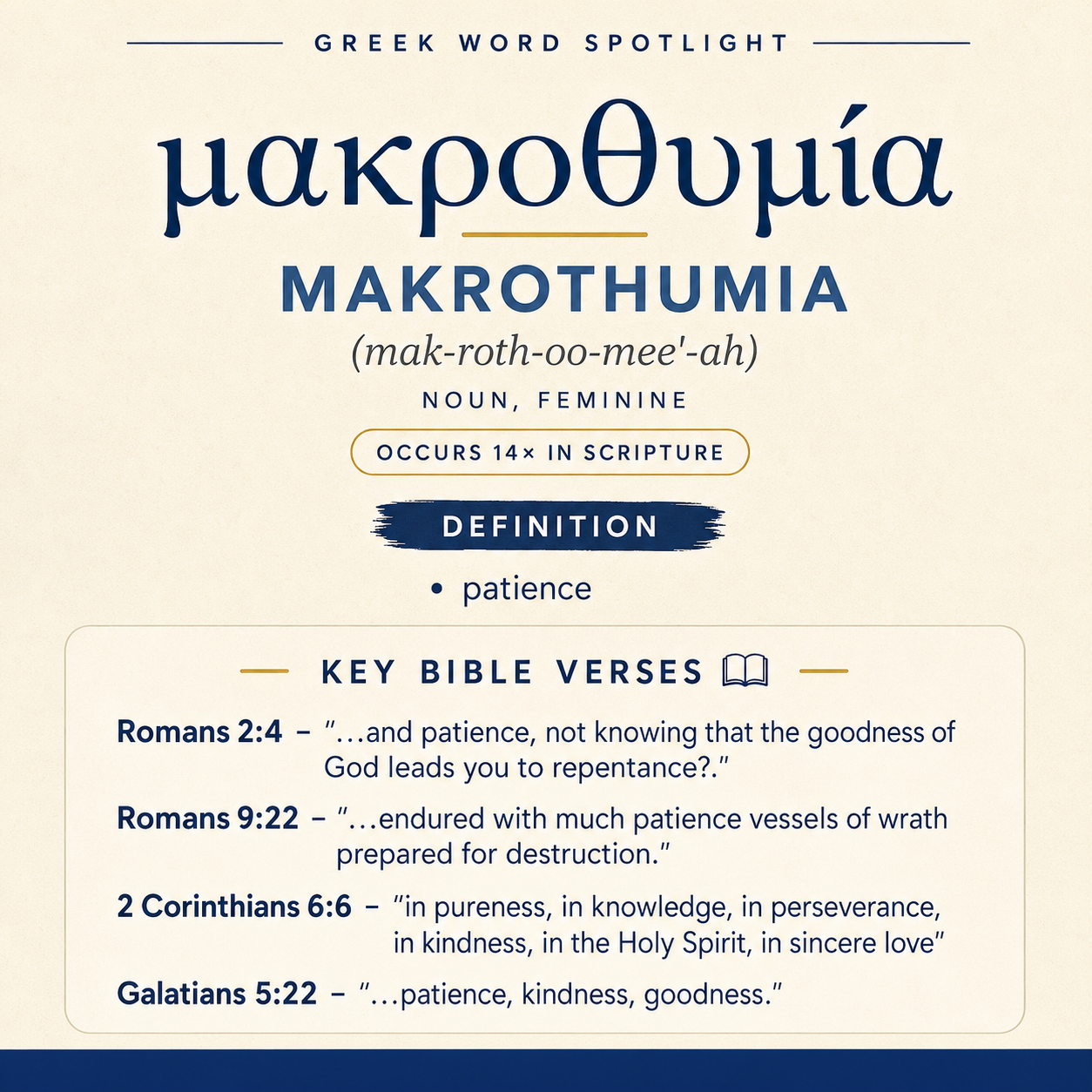
μακροθυμία means “patience” and occurs 14 times in Scripture, including Romans, Corinthians, Galatians, Ephesians, Colossians, and 1 Timothy.
Biblical Usage
It appears in lists of virtues and Spirit-produced qualities in passages like Galatians 5:22 and Ephesians 4:2.
Learn More →God’s Patience
Romans 2:4 and Romans 9:22 use μακροθυμία to speak of God’s patience and endurance.
Learn More →μακροθυμία means “patience.” In the passages where it appears, it names a divine quality, a Spirit-produced fruit, a posture required for life together, and a needed manner for ministry and teaching.
Occurrences
Or do you despise the riches of his goodness, forbearance, and patience, not knowing that the goodness of God leads you to repentance? (Romans 2:4)
Here μακροθυμία is placed alongside “goodness” and “forbearance” as part of God’s “riches.” The verse frames this patience as something that can be “despise[d]” when it is misconstrued, and it situates it within a moral appeal: God’s goodness leads to repentance. Patience, in this sentence, belongs to the way God deals with people over time rather than responding immediately in a way the hearer might expect.

What if God, willing to show his wrath and to make his power known, endured with much patience vessels of wrath prepared for destruction, (Romans 9:22)
In this conditional question, μακροθυμία describes God’s enduring. The patience is intensified (“with much patience”) and is connected to the tension between God’s willingness “to show his wrath” and the fact that he “endured.” The term contributes the notion of restraint within endurance: the scene is not passive, but a deliberate bearing with a situation while other divine purposes (“to make his power known”) are in view.
in pureness, in knowledge, in perseverance, in kindness, in the Holy Spirit, in sincere love, (2 Corinthians 6:6)
Within a chain of qualities, μακροθυμία appears as one item among virtues and ministry markers (“pureness,” “knowledge,” “kindness,” “the Holy Spirit,” “sincere love”). Its contribution is to name a steady disposition that belongs with moral integrity and Spirit-shaped service. The surrounding terms suggest that patience is not isolated; it sits among traits that collectively describe the kind of life and conduct being commended.
But the fruit of the Spirit is love, joy, peace, patience, kindness, goodness, faith, (Galatians 5:22)
Here μακροθυμία is explicitly “the fruit of the Spirit.” The verse makes patience a product of the Spirit’s work rather than merely a natural temperament. Set among relational and moral goods (“love… peace… kindness”), patience functions as a sustaining quality that accompanies a Spirit-formed life and helps characterize what that life looks like in practice.
with all lowliness and humility, with patience, bearing with one another in love, (Ephesians 4:2)
In this instruction, μακροθυμία is paired with “lowliness and humility” and directly tied to community life: “bearing with one another in love.” Patience here is the interior strength that makes ongoing forbearance possible. The verse depicts it as a manner (“with patience”) that shapes how believers carry the weight of imperfect relationships, and it keeps that bearing explicitly anchored “in love.”
strengthened with all power, according to the might of his glory, for all endurance and perseverance with joy, (Colossians 1:11)
Within a prayer-like description of divine strengthening, μακροθυμία belongs to the purpose clause: being strengthened results in “all endurance and perseverance with joy.” Patience is not portrayed as weakness; it is something for which believers are empowered “with all power” according to divine “might.” The verse also adds emotional texture—this perseverance is “with joy”—so the patience in view can coexist with gladness rather than mere grim survival.
Put on therefore, as God’s chosen ones, holy and beloved, a heart of compassion, kindness, lowliness, humility, and perseverance; (Colossians 3:12)
Here μακροθυμία is part of what is to be “put on,” pictured as a garment-like set of virtues. It is linked with identity (“God’s chosen ones, holy and beloved”) and with a “heart” shaped by compassion and humility. Patience functions as an intentional, worn habit of life—something taken up and practiced—rather than a momentary reaction.
However, for this cause I obtained mercy, that in me first, Jesus Christ might display all his patience for an example of those who were going to believe in him for eternal life. (1 Timothy 1:16)
In this testimony, μακροθυμία is something Christ “display[s].” The patience is comprehensive (“all his patience”) and is made visible in a particular person’s receiving “mercy.” The verse explicitly assigns a demonstrative purpose: this patience becomes “an example” for future believers. Patience, then, is not only endured privately; it is shown in a way that teaches and reassures others about Christ’s manner toward those who come to faith.
But you followed my teaching, conduct, purpose, faith, patience, love, steadfastness, (2 Timothy 3:10)
In this personal appeal, μακροθυμία is part of a list of observable features that someone has “followed”—it stands alongside “teaching,” “conduct,” and “purpose.” This places patience within the realm of lived discipleship: it is a trait that can be tracked across time, seen in how one carries out a calling. In the company of “love” and “steadfastness,” patience contributes the idea of remaining consistent and measured under pressure.
preach the word; be urgent in season and out of season; reprove, rebuke, and exhort with all patience and teaching. (2 Timothy 4:2)
Here μακροθυμία directly qualifies ministry speech. The tasks are forceful (“reprove, rebuke, and exhort”), yet they are to be carried out “with all patience and teaching.” Patience in this verse governs tone and method: urgency is not permission for harshness. The phrase “with all patience” suggests that even corrective and challenging words should be accompanied by a measured steadiness that makes room for instruction (“teaching”) rather than only confrontation.
that you won’t be sluggish, but imitators of those who through faith and perseverance inherited the promises. (Hebrews 6:12)
In this exhortation, μακροθυμία is linked to perseverance as a trait of exemplary people. The opposite of the desired posture is “sluggish” inactivity; instead, the readers are urged to imitate those who persist “through faith and perseverance.” Patience here belongs to the long view—continuing in a course of faith until the promises are inherited—so it functions as the steady companion of faith over a span of waiting.
Take, brothers, for an example of suffering and of perseverance, the prophets who spoke in the name of the Lord. (James 5:10)
Here μακροθυμία is placed in the setting of “suffering” and is attached to the example of “the prophets who spoke in the name of the Lord.” Patience is thus tied to endurance under hardship and to faithful speech in God’s name. The term contributes the stance of continuing steadfastly in one’s calling even when that calling is costly.

Sense and Usage
Across these verses, μακροθυμία consistently functions as patience that has to do with time, pressure, and relational strain. In Romans 2:4 and Romans 9:22, the word names patience as a divine manner: it belongs to God’s “riches” and to God’s choice to “endure” even in contexts where wrath and power are in view. The emphasis is not on mere delay for its own sake, but on patience as a purposeful bearing that creates space for what God is doing—whether leading to repentance or enduring amid a larger divine purpose.
In the congregational and ethical texts, patience becomes both gift and garment. Galatians 5:22 identifies it as “the fruit of the Spirit,” locating it in spiritual formation. Colossians 3:12 casts it as something to “put on,” suggesting intentional adoption and daily practice. Ephesians 4:2 gives a concrete social expression: patience enables “bearing with one another in love,” and it is reinforced by “lowliness and humility.” These passages together show patience as a stabilizing quality for community, especially where differences and burdens require ongoing forbearance rather than quick judgment.
Other occurrences highlight how patience operates under demanding conditions. Colossians 1:11 links patience with divine strengthening and adds “joy,” indicating that perseverance can be sustained with an inner gladness when empowered by God’s might. Hebrews 6:12 and James 5:10 attach patience to models—those who inherit promises through persistence, and prophets who endure suffering—so the word gains a forward-looking dimension: it is the refusal to become “sluggish” when outcomes are not immediate. Finally, the Pastoral Epistles connect patience to leadership and instruction: Christ “display[s]” patience as a pattern for believers (1 Timothy 1:16), patience is part of a life others can “follow” (2 Timothy 3:10), and patience must shape proclamation that includes correction (2 Timothy 4:2). In these settings, patience is not the absence of conviction; it is the manner in which conviction is carried, taught, and embodied.
Imagery
The passages give patience a set of recurring pictures: God “endured with much patience” (Romans 9:22), believers are “strengthened with all power” for persevering joy (Colossians 1:11), and Christian community involves “bearing with one another in love” (Ephesians 4:2). Patience is thus portrayed not as inactivity, but as durable strength—displayed by Christ, worn like clothing, practiced in relationships, and exercised in teaching that remains steady even when it must “reprove” and “rebuke” (2 Timothy 4:2).
Sources: Lexical data from Strong’s Exhaustive Concordance and the Translators Brief Lexicon of Extended Strongs for Greek (STEPBible, CC BY). Occurrence data from the Translators Amalgamated Greek New Testament (STEPBible, CC BY). Scripture quotations from the World English Bible (public domain).