Exploring the Meaning of Lutroo in Greek
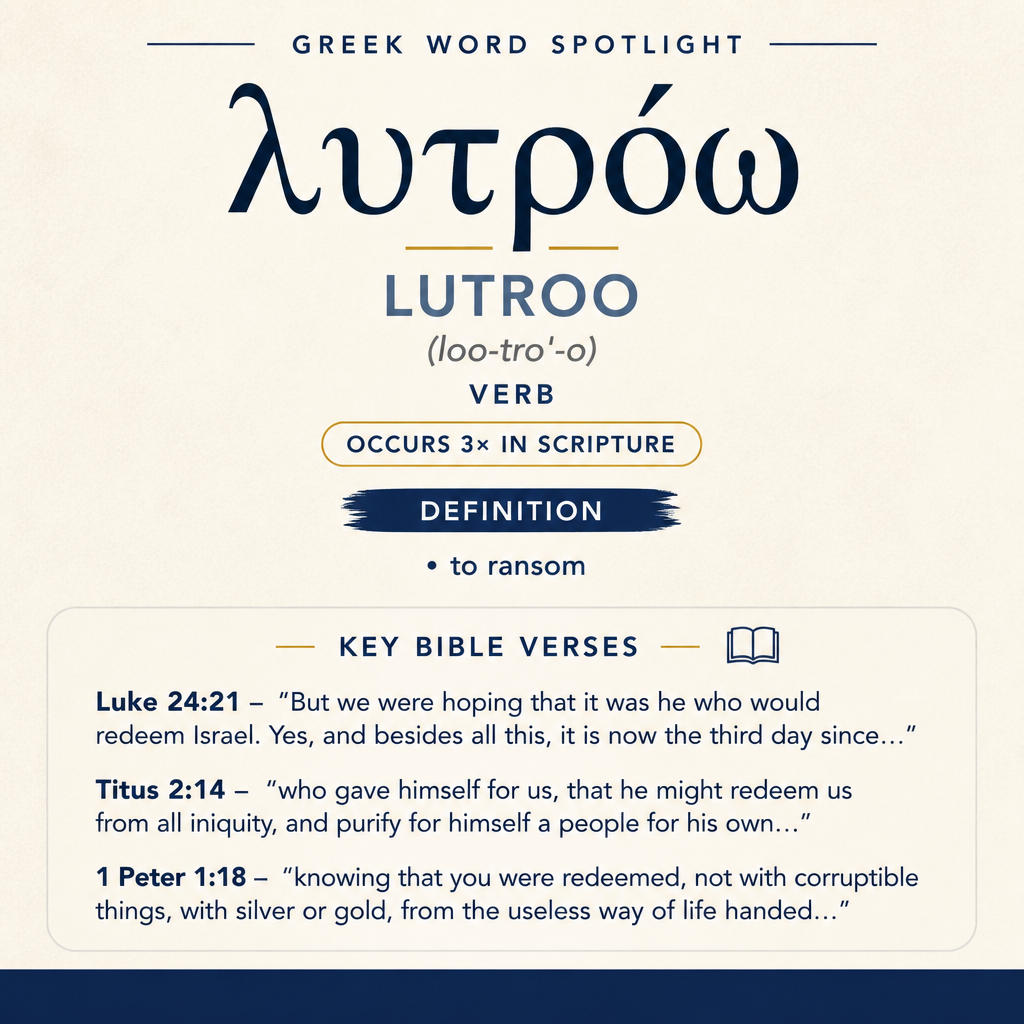
λυτρόω means “to ransom” and occurs three times in Scripture: Luke 24:21, Titus 2:14, and 1 Peter 1:18.
Core Meaning
λυτρόω means “to ransom.” In its three occurrences, it is translated with the idea of redeeming.
Learn More →Scripture Occurrences
This verb appears in Luke 24:21; Titus 2:14; and 1 Peter 1:18. Each passage uses it in a redemption context.
Learn More →Redemption Focus
Luke 24:21 speaks of redeeming Israel. Titus 2:14 and 1 Peter 1:18 speak of believers being redeemed.
Learn More →λυτρόω means “to ransom” and appears in three New Testament contexts: a disappointed hope for Israel’s deliverance, a description of Christ’s self-giving, and an explanation of what believers have been brought out of. In each passage the word frames rescue as a costly act that results in a changed status.
Root and Related Words
λυτρόω is related to λύτρον (lytron), “ransom” (Strong’s G3083). The connection ties the verb to the language of a ransom-price: an act of ransoming that corresponds to a “ransom” as its conceptual counterpart.

Occurrences
Luke 24:21 — “But we were hoping that it was he who would redeem Israel. Yes, and besides all this, it is now the third day since these things happened.”
Here the word sits inside a sentence of dashed expectation: “we were hoping” points to a hope that has not yet been realized in the way the speakers anticipated. The object of the hoped-for ransoming is “Israel,” and the time marker—“it is now the third day since these things happened”—casts the hope against recent events that have produced confusion and disappointment. In this scene, “redeem” functions as the name of the outcome they associated with Jesus: a decisive act benefiting the people as a whole. The verb gives their hope a concrete direction: not merely comfort or instruction, but a ransoming of Israel that would have been recognizable as deliverance.

Titus 2:14 — “who gave himself for us, that he might redeem us from all iniquity, and purify for himself a people for his own possession, zealous for good works.”
This occurrence places the act of ransoming in a purpose statement: “who gave himself for us, that he might redeem us…” The verse links the ransoming directly to self-giving (“gave himself”) and specifies what the ransoming accomplishes: it is “from all iniquity.” The ransoming is not left as an isolated transaction; it has a stated aim and ongoing effect, paired with “and purify for himself a people for his own possession.” In this sentence, ransoming is portrayed as a transfer out of a condition (“all iniquity”) and into a new identity (“a people for his own possession”). The final phrase, “zealous for good works,” shows the social and ethical shape of the result: the ransomed community is marked by eagerness for deeds that fit their new standing.
1 Peter 1:18 — “knowing that you were redeemed, not with corruptible things, with silver or gold, from the useless way of life handed down from your fathers,”
In 1 Peter, the verb is used as a settled fact: “you were redeemed.” The sentence adds two clarifying contrasts that fill out the imagery of ransoming. First, it denies that the ransoming was carried out “with corruptible things, with silver or gold,” naming familiar forms of payment only to set them aside. Second, it describes what the ransoming brought them out of: “from the useless way of life handed down from your fathers.” The word therefore carries a double emphasis here: it implies a ransoming that cannot be explained in terms of ordinary, perishable payment, and it defines the previous condition not as a single act but as a “way of life,” received by tradition and characterized as “useless.” The verb contributes the idea of a decisive rescue that breaks continuity with an inherited pattern.
Sense and Usage
Across these three passages, “to ransom” is consistently transitive: it takes an object (“Israel,” “us,” “you”) and is oriented toward a change in condition. In Luke 24:21 it is the hoped-for act itself—the anticipated ransoming that would answer the situation of Israel. In Titus 2:14 it is framed as the intended outcome of Christ’s self-giving, and it is immediately given direction: it brings people out “from all iniquity” and is joined to purification and the formation of a people who belong to him. In 1 Peter 1:18 the ransoming is treated as a known reality, and the verse tightens the concept by rejecting the categories of perishable payment (“silver or gold”) and by naming the prior state as an inherited way of life.
These uses together show how the verb’s basic sense can be applied at different scales and to different kinds of need. Luke presents ransoming as a public hope attached to the destiny of “Israel.” Titus and 1 Peter apply the verb directly to the audience (“us,” “you”), describing the ransoming as deliverance from moral disorder (“all iniquity”) and from an entrenched pattern (“the useless way of life”). Without changing its core idea, the word can thus point either to a collective redemption longed for, or to a personal and communal liberation that reshapes belonging and behavior. The passages also pair ransoming with purpose and result: in Titus it leads into being a purified people “for his own possession,” and in 1 Peter it is something the readers are to “know,” grounding their understanding of their changed state.
Imagery
The imagery evoked by these texts is the movement from one ownership or condition to another, expressed through the language of ransoming. Luke’s mournful “we were hoping” gives the word the feel of an awaited liberation. Titus links the act to “gave himself,” casting ransoming in terms of costly self-donation that yields a purified people. Peter’s contrast—“not with corruptible things, with silver or gold”—reinforces that the ransoming is not an ordinary purchase, even while the language remains recognizably drawn from the world of payment and release, and it sets the endpoint as freedom from an inherited “way of life.”
Sources: Lexical data from Strong’s Exhaustive Concordance and the Translators Brief Lexicon of Extended Strongs for Greek (STEPBible, CC BY). Occurrence data from the Translators Amalgamated Greek New Testament (STEPBible, CC BY). Scripture quotations from the World English Bible (public domain).