Exploring the Meaning of Lithostrotos in Greek
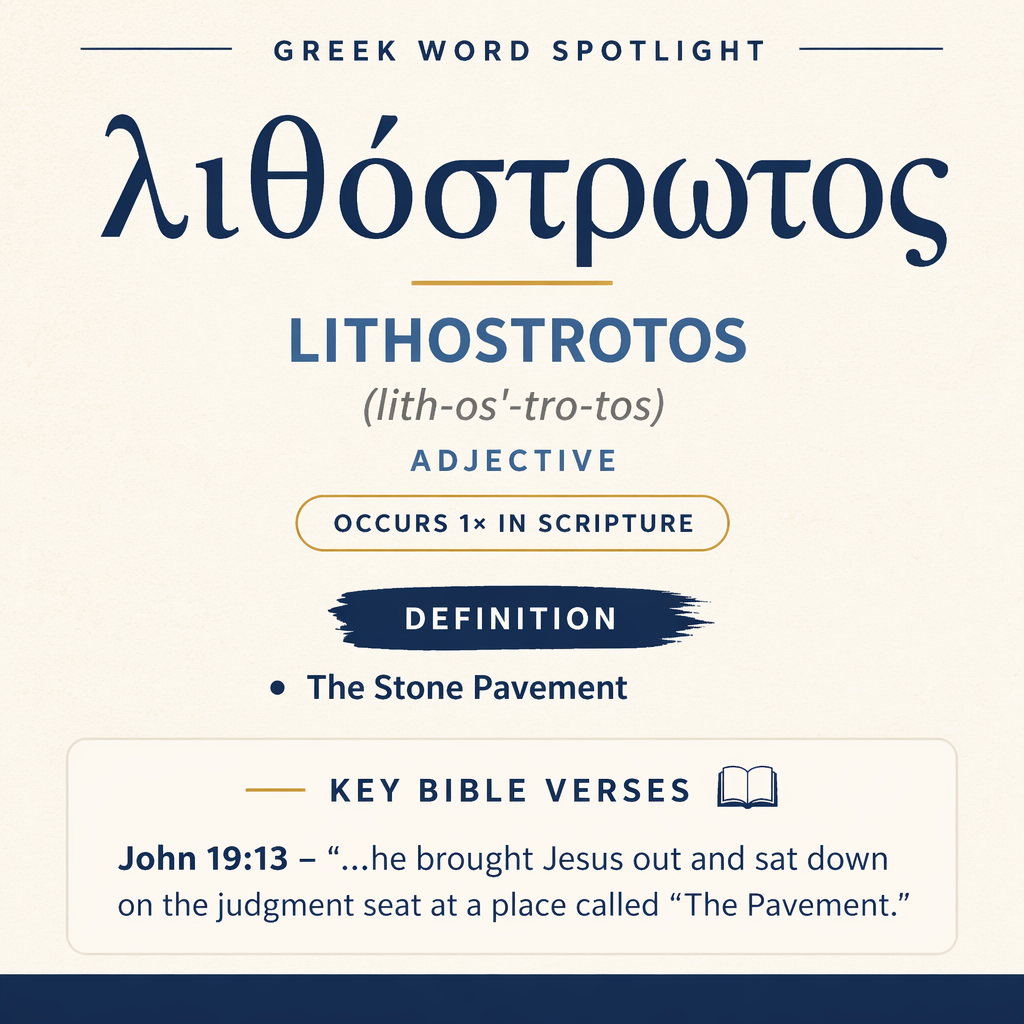
λιθόστρωτος means “The Stone Pavement” and appears once in Scripture in John 19:13.
John 19:13 Context
In John 19:13, Pilate brings Jesus out and sits down on the judgment seat at a place called “The Stone Pavement.”
Learn More →Lithostrotos means “The Stone Pavement” and appears in the Passion narrative in John, naming the place where Pilate sat to render judgment. In that single scene it functions as a concrete location marker with a formal, public feel.
Root and Related Words
Lithostrotos is connected with lithos (λίθος), “stone” (Strong’s G3037), and stronnymi (στρώννυμι), “to spread” (Strong’s G4766). Together these related words point to the idea of stone as a surface laid out or spread as a pavement.

Occurrences
“When Pilate therefore heard these words, he brought Jesus out and sat down on the judgment seat at a place called “The Pavement”, but in Hebrew, “Gabbatha.”” (John 19:13)
Here Lithostrotos identifies the setting for Pilate’s public action: he “brought Jesus out” and “sat down on the judgment seat.” The place-name “The Pavement” anchors the moment in a specific, tangible space rather than leaving it as an undefined courtroom or private chamber. By naming the site where the judgment seat is set, the word emphasizes that the proceeding is official and visible—Pilate’s decision is staged in a recognized place suited for formal pronouncement.
John 19:13 also places “The Pavement” alongside another designation: “in Hebrew, ‘Gabbatha.’” This pairing presents the location as known by more than one name, while keeping the focus on a real place that can be pointed to. Within the verse, Lithostrotos helps the reader picture a hard, fixed surface appropriate for the governor’s seat and for the act of bringing the accused “out” before others.
Sense and Usage
The sense “The Stone Pavement” is realized in John 19:13 as more than a bare geographical note. The narrative uses a named surface to frame a pivotal judicial moment: Pilate sits, Jesus is brought out, and the judgment seat is set in a particular place. The choice to specify a pavement highlights the physical setting that matches the legal posture of the scene—something established, durable, and suited to official business.
Because the word names a place rather than describing a fleeting action, it contributes stability and concreteness to the account. The reader is not only told what Pilate did but where he did it, and the location is remembered by a descriptive title, “The Pavement.” In this way Lithostrotos functions as a narrative hinge: it fixes the transition from hearing “these words” to taking a public seat of authority in a designated venue.
Imagery
In John 19:13 the image carried by Lithostrotos is a stone-laid surface associated with the judgment seat. The hard pavement underlines the solemnity of the moment: an accused man is brought out, and a ruler takes his seat to decide the case in a place defined by its very ground.
Sources: Lexical data from Strong’s Exhaustive Concordance and the Translators Brief Lexicon of Extended Strongs for Greek (STEPBible, CC BY). Occurrence data from the Translators Amalgamated Greek New Testament (STEPBible, CC BY). Scripture quotations from the World English Bible (public domain).