
Exploring the Meaning of Lithazo in Greek
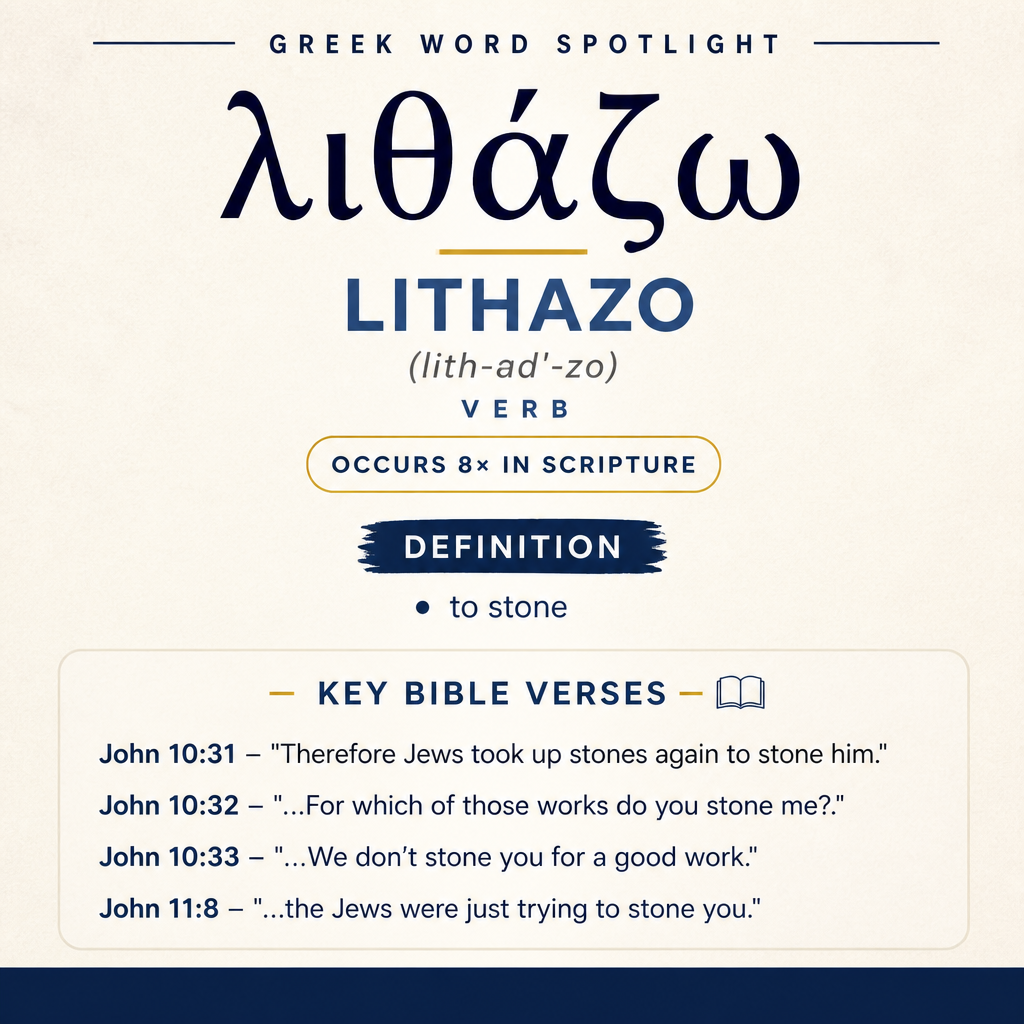
λιθάζω means “to stone” and occurs 8 times in Scripture, including John 10–11; Acts 5 and 14; 2 Corinthians 11; Hebrews 11.
Gospel Scenes
In John 10:31–33, the Jews take up stones to stone Jesus and explain their accusation of blasphemy. In John 11:8, the disciples recall an earlier attempt to stone Him.
Learn More →Later Witness
Acts 14:19 reports Paul being stoned, and 2 Corinthians 11:25 notes, “Once I was stoned.” Hebrews 11:37 includes, “They were stoned.”
Learn More →λιθάζω means “to stone,” describing the act or threat of killing someone by throwing stones. In the New Testament it appears in scenes of attempted violence against Jesus, fears of mob justice, the actual stoning of Paul, and a retrospective catalog of suffering and persecution.
Occurrences
John 10:31 — “Therefore Jews took up stones again to stone him.”
Here λιθάζω names the immediate intent behind a concrete action: stones are gathered in hand for a specific purpose. The verb supplies the reason the stones are “taken up”—not for display or building, but as weapons. The word also frames the moment as a renewed attempt (“again”), presenting stoning as an already familiar form of hostility in this setting.
John 10:32 — “Jesus answered them, “I have shown you many good works from my Father. For which of those works do you stone me?””
In Jesus’ question, λιθάζω is placed in direct contrast with “many good works.” The verb names the violence he is facing, and the question forces the crowd to articulate a rationale for a punishment that is already underway in their actions. By asking “For which,” the scene treats stoning as a response that claims moral justification; the verb is the hinge that exposes the gap between the “good works” shown and the attack being threatened.
John 10:33 — “The Jews answered him, “We don’t stone you for a good work, but for blasphemy: because you, being a man, make yourself God.””
This reply uses λιθάζω to clarify motive. The crowd denies that their planned stoning is a reaction to benevolent deeds and instead ties the act to a stated charge (“blasphemy”). The verb thus functions as the chosen penalty in their reasoning: it is not random violence, but violence presented as a deliberate response to perceived sacrilege.
John 11:8 — “The disciples asked him, “Rabbi, the Jews were just trying to stone you. Are you going there again?””
λιθάζω here is recollected as a near and recent danger: “were just trying.” The disciples’ concern depends on the verb’s concrete sense—returning to the same area implies returning to the same threat. Stoning is treated as a foreseeable, repeatable outcome of his presence, giving the disciples’ question a practical edge: “Are you going there again?” in light of that specific attempted violence.
Acts 5:26 — “Then the captain went with the officers, and brought them without violence, for they were afraid that the people might stone them.”
In this narrative, λιθάζω expresses what the authorities fear the crowd could do. The captain’s restraint (“without violence”) is motivated by the potential that the people might stone the officers. The verb therefore marks stoning as a known form of public, collective violence capable of erupting quickly; it shapes the tactical choice to avoid provoking a mob.
Acts 14:19 — “But some Jews from Antioch and Iconium came there, and having persuaded the multitudes, they stoned Paul, and dragged him out of the city, supposing that he was dead.”
This occurrence shows λιθάζω as an accomplished act rather than a threat. The verse links it to persuasion and crowd movement: outsiders arrive, “persuaded the multitudes,” and then the stoning happens. The aftermath—Paul is “dragged…out of the city” and thought dead—shows the intended severity of the action. The verb anchors the sequence as a public, communal assault whose expected result is death.
2 Corinthians 11:25 — “Three times I was beaten with rods. Once I was stoned. Three times I suffered shipwreck. I have been a night and a day in the deep.”
Here λιθάζω appears in Paul’s first-person summary of hardships. The verb is set among other forms of bodily danger (“beaten with rods,” “shipwreck”), making stoning one item in a larger pattern of life-threatening experiences. “Once I was stoned” compresses the event into a stark count, emphasizing the reality of the act without narrating details: stoning is memorable enough to be tallied as a distinct episode of violence endured.
Hebrews 11:37 — “They were stoned. They were sawn apart. They were tempted. They were slain with the sword. They went around in sheep skins and in goat skins; being destitute, afflicted, ill-treated—”
In Hebrews, λιθάζω is used in a generalized, plural description: “They were stoned.” The verb stands at the head of a series of passive sufferings and killings, portraying stoning as one mode of persecution experienced by the faithful. Its placement alongside other brutal outcomes gives it rhetorical weight: stoning is part of a spectrum of severe mistreatment, not an isolated anomaly.

Sense and Usage
Across these passages, λιθάζω consistently denotes stoning as a form of violent attack carried out (or contemplated) by a group, often in a charged public setting. In John, the verb appears on the lips and in the hands of “the Jews” in a conflict over Jesus’ identity. There, it functions as a proposed response to speech and deeds: Jesus’ “many good works” provoke no plausible case for stoning (John 10:32), and so the crowd supplies an explicit accusation—“blasphemy”—to frame the act as warranted (John 10:33). The verb therefore marks not only impending violence but also the attempt to justify that violence with a stated reason.
In Acts, the word highlights how quickly crowds can become instruments of punishment. Acts 5:26 portrays the mere possibility of stoning as enough to constrain official behavior: the captain chooses a nonviolent approach precisely because stoning by the people is a credible risk. Acts 14:19 then depicts the act itself as something catalyzed by persuasion and the mobilization of “the multitudes.” The verb belongs to the public sphere; stoning is not described as a private assault but as a communal action that can be initiated through agitation and carried through with lethal expectation (“supposing that he was dead”).
In 2 Corinthians 11:25 and Hebrews 11:37, λιθάζω is detached from immediate narrative and used as a compact descriptor of suffering. Paul’s “Once I was stoned” treats the act as a discrete, countable event alongside other dangers, making it part of a catalogue rather than a scene. Hebrews uses the passive plural—“They were stoned”—to represent stoning as a recurring pattern within the broader experience of being “destitute, afflicted, ill-treated.” In these summary uses, the verb gains a representative quality: it stands for a kind of violent opposition that can characterize the plight of God’s people across time and circumstances.
Although the verb’s meaning remains stable, the passages show distinct communicative roles: an imminent threat (John 10:31; John 11:8), a contested justification (John 10:32–33), a crowd-driven hazard shaping decisions (Acts 5:26), an enacted attempt to kill with a public aftermath (Acts 14:19), and retrospective testimony or communal memory (2 Corinthians 11:25; Hebrews 11:37). In each role, λιθάζω keeps the focus on the act of stoning itself—an act that can be attempted, feared, carried out, and remembered.
Imagery
The word carries a harsh physical imagery: stones picked up, hurled, and left behind as evidence of communal violence. John 10:31 visualizes the moment before impact—stones in hand and intent declared—while Acts 14:19 presses the image to its end, where stoning is followed by the body being “dragged…out of the city,” the crowd assuming death. Even when no stones are described, the verb evokes that same scene of public, forceful attack, whether as a looming threat (Acts 5:26) or as a remembered wound (2 Corinthians 11:25) within a broader history of affliction (Hebrews 11:37).
Sources: Lexical data from Strong’s Exhaustive Concordance and the Translators Brief Lexicon of Extended Strongs for Greek (STEPBible, CC BY). Occurrence data from the Translators Amalgamated Greek New Testament (STEPBible, CC BY). Scripture quotations from the World English Bible (public domain).





