
Exploring the Meaning of Lian in Greek
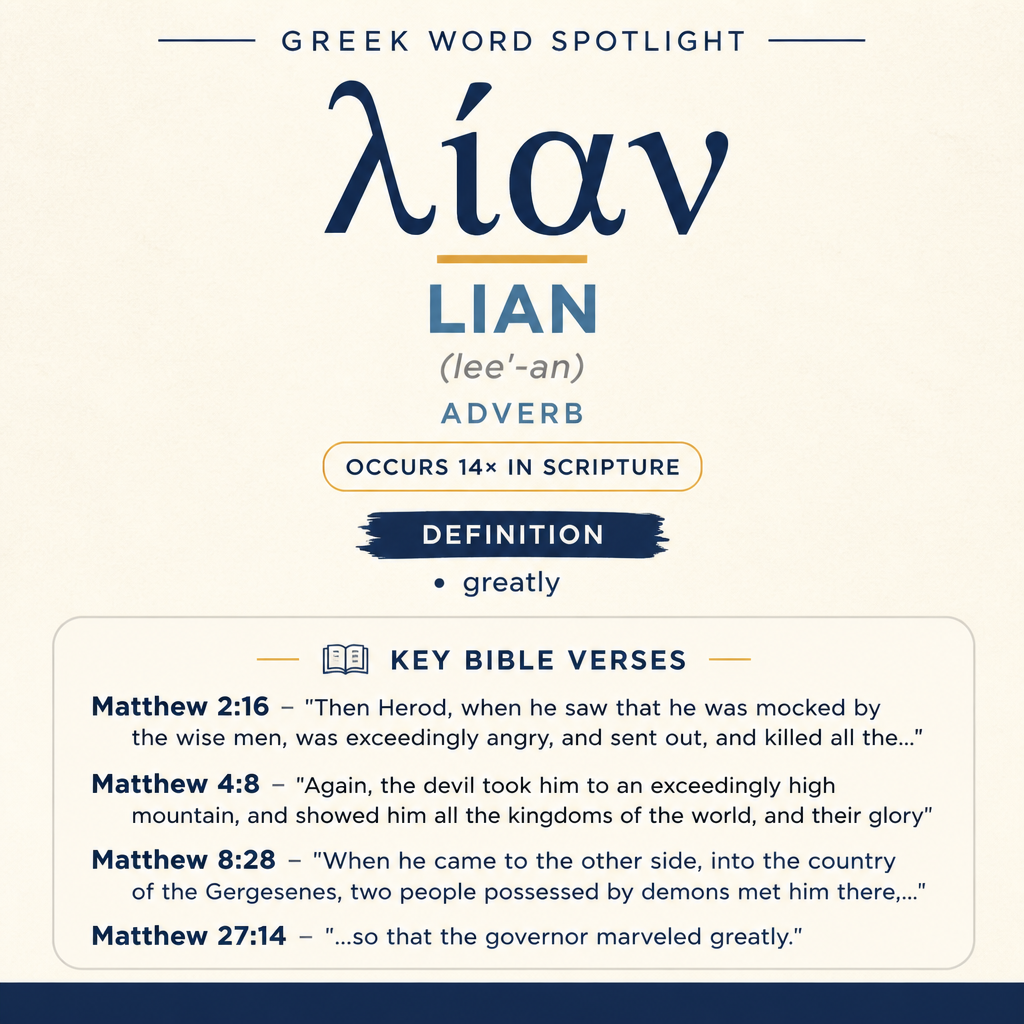
λίαν means “greatly” and appears 14 times in Scripture, including Matthew 2:16 and Mark 9:3.
Core Meaning
λίαν functions as an intensifier meaning “greatly.” It strengthens descriptions of actions, qualities, and reactions in its contexts.
Learn More →Matthew Examples
In Matthew it intensifies anger (“exceedingly angry,” 2:16), height (“an exceedingly high mountain,” 4:8), and amazement (“marveled greatly,” 27:14).
Learn More →Mark Examples
In Mark it intensifies amazement (“very amazed,” 6:51) and whiteness (“exceedingly white,” 9:3), and also appears in time references (“Very early,” 16:2).
Learn More →λίαν expresses intensity: something is done or experienced “greatly.” In the passages where it appears, it heightens emotion, amplifies description, or marks an unusually strong degree of time, place, or reaction.
Occurrences
“Then Herod, when he saw that he was mocked by the wise men, was exceedingly angry, and sent out, and killed all the male children who were in Bethlehem and in all the surrounding countryside, from two years old and under, according to the exact time which he had learned from the wise men.” (Matthew 2:16)
Here λίαν intensifies Herod’s anger: it is not a mild irritation but an anger presented as extreme. That heightened emotion frames the severity of his response in the same sentence—sending out and killing the male children—so the adverb underlines the disproportion and force of the reaction described.
“Again, the devil took him to an exceedingly high mountain, and showed him all the kingdoms of the world, and their glory.” (Matthew 4:8)
λίαν strengthens the description of the mountain’s height. The scene aims at a vantage point suitable for the sweeping display that follows (“all the kingdoms of the world, and their glory”); the adverb makes the mountain’s height stand out as remarkable within the narrative’s staging.
“When he came to the other side, into the country of the Gergesenes, two people possessed by demons met him there, coming out of the tombs, exceedingly fierce, so that nobody could pass that way.” (Matthew 8:28)
In this encounter, λίαν heightens the menace of the two demon-possessed men: they are described as “exceedingly fierce.” The result clause (“so that nobody could pass that way”) matches the intensified description; the adverb helps explain why the area is effectively blocked to ordinary travelers.
“He gave him no answer, not even one word, so that the governor marveled greatly.” (Matthew 27:14)
λίαν amplifies the governor’s astonishment. The marvel arises from Jesus’ complete silence (“no answer, not even one word”), and the adverb signals that the governor’s reaction is unusually strong—surprise pushed into the realm of profound wonder.
“Early in the morning, while it was still dark, he rose up and went out, and departed into a deserted place, and prayed there.” (Mark 1:35)
Here λίαν sharpens the time reference: the action happens not merely in the morning, but at a very early point (“while it was still dark”). The adverb contributes to the picture of deliberate, unhurried privacy: the setting is early, dark, and “a deserted place,” fitting the purpose of prayer.
“He got into the boat with them; and the wind ceased, and they were very amazed among themselves, and marveled;” (Mark 6:51)
λίαν increases the intensity of the disciples’ amazement. The immediate trigger in the verse is the wind’s sudden cessation as Jesus enters the boat. The adverb portrays their internal response (“among themselves”) as strongly elevated beyond ordinary surprise.
“His clothing became glistening, exceedingly white, like snow, such as no launderer on earth can whiten them.” (Mark 9:3)
In this descriptive line, λίαν heightens the whiteness of Jesus’ clothing. The verse already presses language toward the limits of ordinary comparison (“like snow,” and beyond any human whitening), and the adverb drives the description further: the whiteness is presented as extreme, dazzling.
“Very early on the first day of the week, they came to the tomb when the sun had risen.” (Mark 16:2)
λίαν again intensifies a time marker. The women’s arrival is framed as strikingly early, and the clause “when the sun had risen” anchors that “very early” moment at daybreak, lending urgency and immediacy to the visit to the tomb.
“Now when Herod saw Jesus, he was exceedingly glad, for he had wanted to see him for a long time, because he had heard many things about him. He hoped to see some miracle done by him.” (Luke 23:8)
Here λίαν strengthens the portrayal of Herod’s gladness. The verse explains the gladness with motives and expectations: a long-standing desire to see Jesus, reports he has heard, and hope for a miracle. The adverb portrays that gladness as intense—an eager excitement rather than a polite welcome.
“For I reckon that I am not at all behind the very best apostles.” (2 Corinthians 11:5)
In Paul’s comparison, λίαν functions to intensify a superlative claim: “the very best apostles.” The adverb raises the rhetorical bar—Paul is not measuring himself against average figures, but against those presented as the highest tier in the discussion.
“I have become foolish in boasting. You compelled me, for I ought to have been commended by you, for I am in no way inferior to the very best apostles, though I am nothing.” (2 Corinthians 12:11)
λίαν again intensifies the phrase “the very best apostles,” now inside a paragraph of reluctant self-defense. The adverb contributes to the tension in the sentence: Paul denies inferiority to the topmost comparators while simultaneously adding the humbling concession “though I am nothing.”
“of whom you also must beware; for he greatly opposed our words.” (2 Timothy 4:15)
Here λίαν heightens the force of opposition. The warning (“you also must beware”) is grounded in the manner of resistance: the person in view did not merely disagree; he “greatly opposed our words,” an intensified antagonism that justifies caution.

Sense and Usage
Across these contexts, λίαν consistently operates as a degree-marker that pushes a description toward an extreme. It attaches to emotions (“exceedingly angry,” “exceedingly glad”), perceptions and reactions (“marveled greatly,” “very amazed”), and qualities that shape a scene’s physical or temporal setting (“exceedingly high mountain,” “exceedingly white,” “very early”). The adverb thus acts as a narrative amplifier: it heightens what the reader is meant to feel, see, or recognize as exceptional in the moment.
Several patterns emerge in the way intensity is used. First, λίαν can explain behavior by intensifying an inner state: Herod’s “exceedingly angry” temper in Matthew 2:16 is set right beside a catastrophic action, so the heightened emotion frames the gravity of the decision described. Similarly, Herod’s “exceedingly glad” reaction in Luke 23:8 is immediately explained by longing, rumor, and expectation; the adverb helps the reader grasp the strength of the anticipation driving his interest.
Second, λίαν can sharpen the staging of a scene by intensifying spatial or visual description. The “exceedingly high mountain” in Matthew 4:8 presents an elevated place suitable for a panoramic showing of “all the kingdoms of the world, and their glory.” In Mark 9:3, “exceedingly white” clothing is paired with analogies (“like snow”) and a limit statement (“such as no launderer on earth can whiten them”), so λίαν functions as one component of a layered strategy to press the description beyond everyday categories.
Third, λίαν can intensify time to communicate purposeful timing or urgency. Mark 1:35 places prayer in the darkness of “Early in the morning,” and λίαν strengthens that earlyness so the reader senses deliberate choice in leaving for “a deserted place.” Mark 16:2 similarly portrays movement toward the tomb at the earliest edge of day, with “when the sun had risen” anchoring the “Very early” phrase in a concrete moment.
Finally, λίαν can heighten comparison and conflict. In 2 Corinthians 11:5 and 12:11, it intensifies the descriptor “the very best apostles,” tightening the rhetorical claim by choosing the strongest conceivable comparison group within the argument. In 2 Timothy 4:15, it intensifies opposition to words, supporting a practical warning; the adverb signals that the resistance was pronounced and therefore consequential.
Imagery
The passages give λίαν a vivid profile: it is heard in extremes—rage that spills into violence, gladness fueled by long desire, fearsome danger that blocks a road, and wonder provoked by silence or by sudden calm. It also sits on the edge of the day (“while it was still dark,” “Very early”) and on the edge of description (“exceedingly high,” “exceedingly white”), where ordinary measurements feel insufficient and language must be intensified to match what the narrative puts before the reader.
Sources: Lexical data from Strong’s Exhaustive Concordance and the Translators Brief Lexicon of Extended Strongs for Greek (STEPBible, CC BY). Occurrence data from the Translators Amalgamated Greek New Testament (STEPBible, CC BY). Scripture quotations from the World English Bible (public domain).




