
Exploring the Meaning of Lethe in Greek
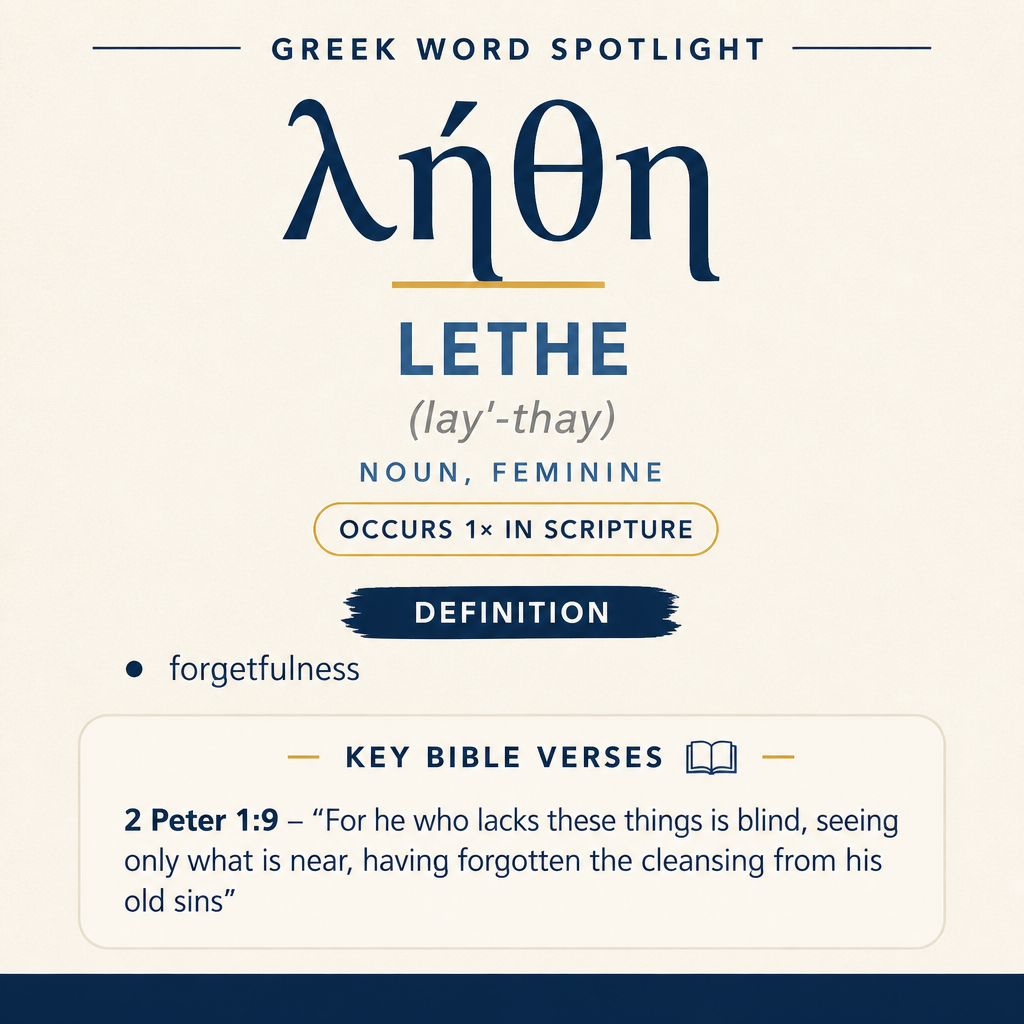
λήθη means “forgetfulness” and appears once in Scripture in 2 Peter 1:9.
Verse Context
In 2 Peter 1:9, it describes having forgotten the cleansing from old sins.
Learn More →λήθη denotes “forgetfulness” and appears once in the New Testament, in 2 Peter 1:9. In that setting it describes a moral and spiritual lapse: a failure to keep in view what has already been received.
Root and Related Words
λήθη is related to lanthanō (λανθάνω), “be hidden” (Strong’s G2990). The relationship points to forgetfulness as a condition in which something does not remain in view—something becomes, in effect, obscured from awareness.

Occurrences
“For he who lacks these things is blind, seeing only what is near, having forgotten the cleansing from his old sins.” (2 Peter 1:9)
In 2 Peter 1:9, λήθη is set within a compact description of a person whose inner and outer life has narrowed. The verse begins with lack—“he who lacks these things”—and immediately names the result as a kind of impairment: “is blind, seeing only what is near.” Forgetfulness functions here as more than a neutral lapse of memory; it belongs to a chain of spiritual conditions that affect perception and direction.
The line “seeing only what is near” paints a picture of limited range. Within that same portrait, “having forgotten the cleansing from his old sins” identifies what has slipped from view. The object of the forgetfulness is not a trivial detail but “the cleansing,” framed as something already received and connected to a former way of life (“old sins”). λήθη, therefore, explains how someone can be “blind” in the sense described: the person’s moral vision contracts because the reality of cleansing no longer stands in the foreground of consciousness.
The grammar of the sentence also matters for how λήθη contributes to the scene. The verse strings descriptions together, moving from lack (“lacks these things”) to condition (“is blind”), to perspective (“seeing only what is near”), and then to the internal failure (“having forgotten…”). Forgetfulness is presented as part of the present diagnosis. The person is not said merely to have once forgotten; rather, forgetfulness characterizes the person in the moment being described, shaping how he sees and how he lives.
Finally, the phrase “the cleansing from his old sins” sets forgetfulness against a concrete moral reality. The verse does not treat cleansing as a vague optimism or a general religious idea. It is cleansing from something (“old sins”), and forgetfulness is the failure to keep that cleansing in mind. The effect is that a person can live as though the decisive break with “old sins” has faded into the background, even while that cleansing stands as a defining feature of the person’s story.
Sense and Usage
As used here, “forgetfulness” depicts a loss of conscious hold on a past act of cleansing, with direct consequences for present spiritual perception. The verse ties forgetfulness to shortsightedness: “seeing only what is near.” In this picture, forgetfulness is not merely the absence of information but a narrowing of attention and remembrance that reshapes one’s field of vision. What should remain central—the cleansing that addresses “old sins”—is treated as though it were no longer relevant or no longer real.
Because λήθη is attached to “cleansing,” it carries a strongly relational and moral contour in this context. Cleansing implies a before-and-after: “old sins” belong to the “before,” and cleansing marks a decisive change. Forgetfulness, then, is the practical erasure of that “after” from lived awareness. The verse portrays a person who continues forward without the stabilizing reference point of what has already happened regarding sin. When that reference point is obscured, the person’s present orientation becomes dominated by what is “near”—immediate concerns, immediate pressures, or immediate impressions—rather than by the larger moral reality the cleansing signifies.
The sequence in the sentence suggests that forgetfulness both results from and contributes to spiritual deficiency. “He who lacks these things” is described as blind and near-sighted; forgetfulness is placed as a culminating feature of that state. This makes λήθη an explanatory term: it names the inner failure that corresponds to the outer symptom of limited sight. Forgetfulness describes how a person can be in a condition where present experience is all that registers and past cleansing no longer governs the conscience or imagination.
The connection with lanthanō (λανθάνω), “be hidden,” helps clarify the kind of forgetfulness envisioned. In 2 Peter 1:9, cleansing has become effectively hidden from the person’s active awareness. The cleansing is not portrayed as undone; rather, it is treated as concealed from the person’s current perspective. λήθη thus depicts a concealment within the mind and heart: the reality of cleansing is covered over by a narrowed outlook, and what is covered over no longer exerts its intended influence.
In the single attested use, λήθη is therefore tightly focused. It is not generalized forgetfulness about ordinary matters. It names a forgetfulness with spiritual stakes: the failure to remember one’s cleansing in relation to sin. The verse portrays that failure as a serious condition, paired with blindness and with an inability to see beyond what is immediately in front of oneself.
Imagery
The imagery accompanying λήθη in 2 Peter 1:9 is perceptual: blindness and near-sighted vision. Forgetfulness is pictured as a dimming of sight, where the horizon shrinks and the past cleansing from “old sins” fades from view. The word participates in this visual metaphor by naming the inner fog that causes the cleansed life to be lived as though cleansing were no longer a defining reality.
Sources: Lexical data from Strong’s Exhaustive Concordance and the Translators Brief Lexicon of Extended Strongs for Greek (STEPBible, CC BY). Occurrence data from the Translators Amalgamated Greek New Testament (STEPBible, CC BY). Scripture quotations from the World English Bible (public domain).




