
Exploring the Meaning of Leon in Greek
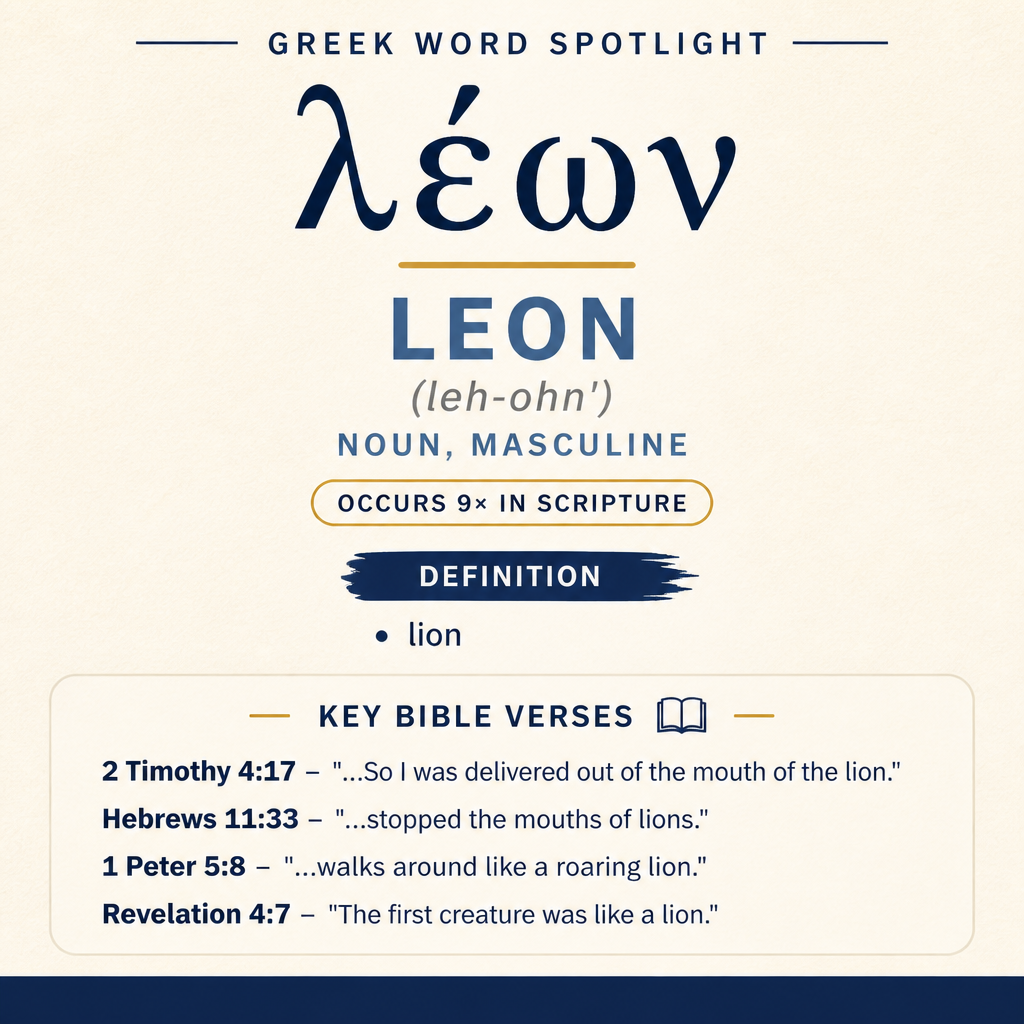
λέων (Leon) means “lion” and occurs 9 times in Scripture, including 2 Timothy 4:17, Hebrews 11:33, 1 Peter 5:8, and several Revelation passages.
Scripture Occurrences
It appears 9 times in Scripture. References include 2 Timothy 4:17; Hebrews 11:33; 1 Peter 5:8; Revelation 4:7; 5:5; 9:8; 9:17; 10:3.
Learn More →Notable Uses
Hebrews 11:33 speaks of stopping the mouths of lions, and 1 Peter 5:8 compares the devil to a roaring lion. Revelation uses lion imagery for creatures, teeth, horses, a roar, and “the Lion” of Judah (Revelation 5:5).
Learn More →λέων names a “lion,” a concrete animal image that these passages use for peril, power, and vivid comparison. It appears in narrative recollection, exhortation, and multiple visionary descriptions that draw on the lion’s mouth, roar, and fearsome anatomy.
Occurrences
2 Timothy 4:17 — “But the Lord stood by me and strengthened me, that through me the message might be fully proclaimed, and that all the Gentiles might hear. So I was delivered out of the mouth of the lion.”
Here λέων appears in a tight image: “the mouth of the lion.” The phrase sets a scene of imminent danger framed as being within reach of a lion’s jaws, and the deliverance is expressed as rescue from that specific point of threat. Within the verse’s flow, the lion imagery sharpens what “stood by me and strengthened me” accomplished: not merely inner fortitude, but escape from something depicted as ready to consume.
Hebrews 11:33 — “who through faith subdued kingdoms, worked out righteousness, obtained promises, stopped the mouths of lions,”
λέων is plural here (“lions”) and again tied to “mouths.” The line is part of a stacked series of achievements “through faith,” and “stopped the mouths of lions” presents lions as agents of lethal harm whose primary danger is their bite. The wording emphasizes restraint: the mouths are not destroyed but rendered unable to do what mouths do to prey, so that the lion’s defining threat is neutralized.
1 Peter 5:8 — “Be sober and self-controlled. Be watchful. Your adversary, the devil, walks around like a roaring lion, seeking whom he may devour.”
In this warning, λέων belongs to a simile: the adversary “walks around like a roaring lion.” The lion’s roar and predatory search (“seeking whom he may devour”) carry the comparison, casting the adversary’s activity as prowling and hunting rather than passive opposition. The word helps the exhortations “be watchful” and “be sober and self-controlled” land with urgency: the danger is mobile, vocal, and intent on consumption.
Revelation 4:7 — “The first creature was like a lion, and the second creature like a calf, and the third creature had a face like a man, and the fourth was like a flying eagle.”
λέων supplies the first comparison in a set of four. The creature is not called a lion, but “like a lion,” using the animal as a point of resemblance within a carefully balanced sequence (“like a calf… face like a man… like a flying eagle”). In this scene, the lion functions as one recognizable member of a quartet of living-creature likenesses, marking the first creature with a lion-like character in the reader’s imagination without specifying further traits.
Revelation 5:5 — “One of the elders said to me, “Don’t weep. Behold, the Lion who is of the tribe of Judah, the Root of David, has overcome: he who opens the book and its seven seals.””
Here λέων is a title: “the Lion who is of the tribe of Judah.” The elder’s command “Don’t weep” and the announcement “has overcome” set the lion designation in a context of victory and authority. The lion image supports the claim that this figure can do what matters in the scene: “he who opens the book and its seven seals.” Within the verse, the lion is not a threat to the speaker but a powerful identity linked with overcoming and opening what is sealed.
Revelation 9:8 — “They had hair like women’s hair, and their teeth were like those of lions.”
λέων appears in a comparison of “teeth.” The verse lists features with repeated “like,” and “teeth… like those of lions” focuses the lion image on biting equipment—hard, tearing, and dangerous. In the descriptive sequence, the lion reference concentrates dread into one body part, making the creatures’ threat feel immediate and physical.
Revelation 9:17 — “Thus I saw the horses in the vision, and those who sat on them, having breastplates of fiery red, hyacinth blue, and sulfur yellow; and the horses’ heads resembled lions’ heads. Out of their mouths proceed fire, smoke, and sulfur.”
In this vision report, λέων shapes the horses’ appearance: their heads “resembled lions’ heads.” The next sentence then spotlights “their mouths” as the outlet of destructive emissions—“fire, smoke, and sulfur.” The lion-headed comparison therefore sets up the mouth as a place of danger, aligning the lion’s feared anatomy with the vision’s portrayal of harm issuing outward. The lion image works together with the color-saturated armor description to intensify the sense of formidable, unnatural power.
Revelation 10:3 — “He cried with a loud voice, as a lion roars. When he cried, the seven thunders uttered their voices.”
λέων here anchors an auditory comparison: the cry is “as a lion roars.” The lion is invoked not for teeth or mouth but for volume and force of sound. The verse also connects this roar-like cry with a cosmic response: “the seven thunders uttered their voices.” The lion roar comparison thus conveys a cry that is not merely loud but commanding and world-shaking in effect within the scene’s sequence of voices.
Revelation 13:2 — “The beast which I saw was like a leopard, and his feet were like those of a bear, and his mouth like the mouth of a lion. The dragon gave him his power, his throne, and great authority.”
λέων appears in the phrase “mouth like the mouth of a lion,” part of a composite set of animal comparisons (leopard, bear, lion). As in other occurrences, the mouth is the focal point; here it belongs to “the beast,” whose capacity is backed by granted “power… throne… and great authority.” The lion-mouth comparison helps depict the beast’s speaking/consuming aspect as fearsome, a fitting match for the authority the verse immediately attributes to it.
Sense and Usage
Across these passages, λέων remains a concrete animal term, but its narrative force shifts with context. In recollection and commendation (2 Timothy 4:17; Hebrews 11:33), the lion is the emblem of deadly peril centered in the “mouth,” and deliverance is framed as escape from the point where life would be swallowed. In exhortation (1 Peter 5:8), the lion becomes the standard of comparison for an active, searching threat; the word contributes not only danger but also movement and sound (“roaring”), building an atmosphere where vigilance is the fitting response.
In Revelation, λέων is repeatedly drawn into visionary description by analogy (“like a lion,” “resembled lions’ heads,” “as a lion roars,” “mouth like the mouth of a lion”). These comparisons use familiar lion features—head, teeth, mouth, roar—to render strange beings and events graspable. The lion’s anatomy is especially productive imagery: teeth (Revelation 9:8) and mouth (Revelation 13:2) represent the capacity to harm; mouth also stands close to the production of destructive effects (Revelation 9:17) and to the feared place of being caught (2 Timothy 4:17; Hebrews 11:33). Sound imagery appears where the lion’s roar offers a benchmark for overwhelming vocal force (1 Peter 5:8; Revelation 10:3).
One usage differs in tone: “the Lion who is of the tribe of Judah” (Revelation 5:5). There the lion image is not used to mark the enemy’s threat but to announce an overcomer whose success authorizes him to “open[] the book and its seven seals.” Even here, the word’s contribution is not an abstract idea detached from the animal; it is the lion as a title—an identity that fits the scene’s emphasis on overcoming and decisive action.
Imagery
These verses repeatedly return to the lion’s most immediate points of impact on a listener: the roar that can freeze attention and the mouth/teeth that can devour. The same animal image can therefore frame rescue (“delivered out of the mouth of the lion”), faithful triumph (“stopped the mouths of lions”), urgent watchfulness (“like a roaring lion, seeking whom he may devour”), and visionary portrayals of both awe and dread (lion-like creatures, lion-headed horses, a lion-like roar, and a beast with a lion-like mouth). Revelation 5:5 concentrates the image into a name that signals overcoming authority within the vision’s unfolding drama.
Sources: Lexical data from Strong’s Exhaustive Concordance and the Translators Brief Lexicon of Extended Strongs for Greek (STEPBible, CC BY). Occurrence data from the Translators Amalgamated Greek New Testament (STEPBible, CC BY). Scripture quotations from the World English Bible (public domain).





