
Exploring the Meaning of Legeon in Greek
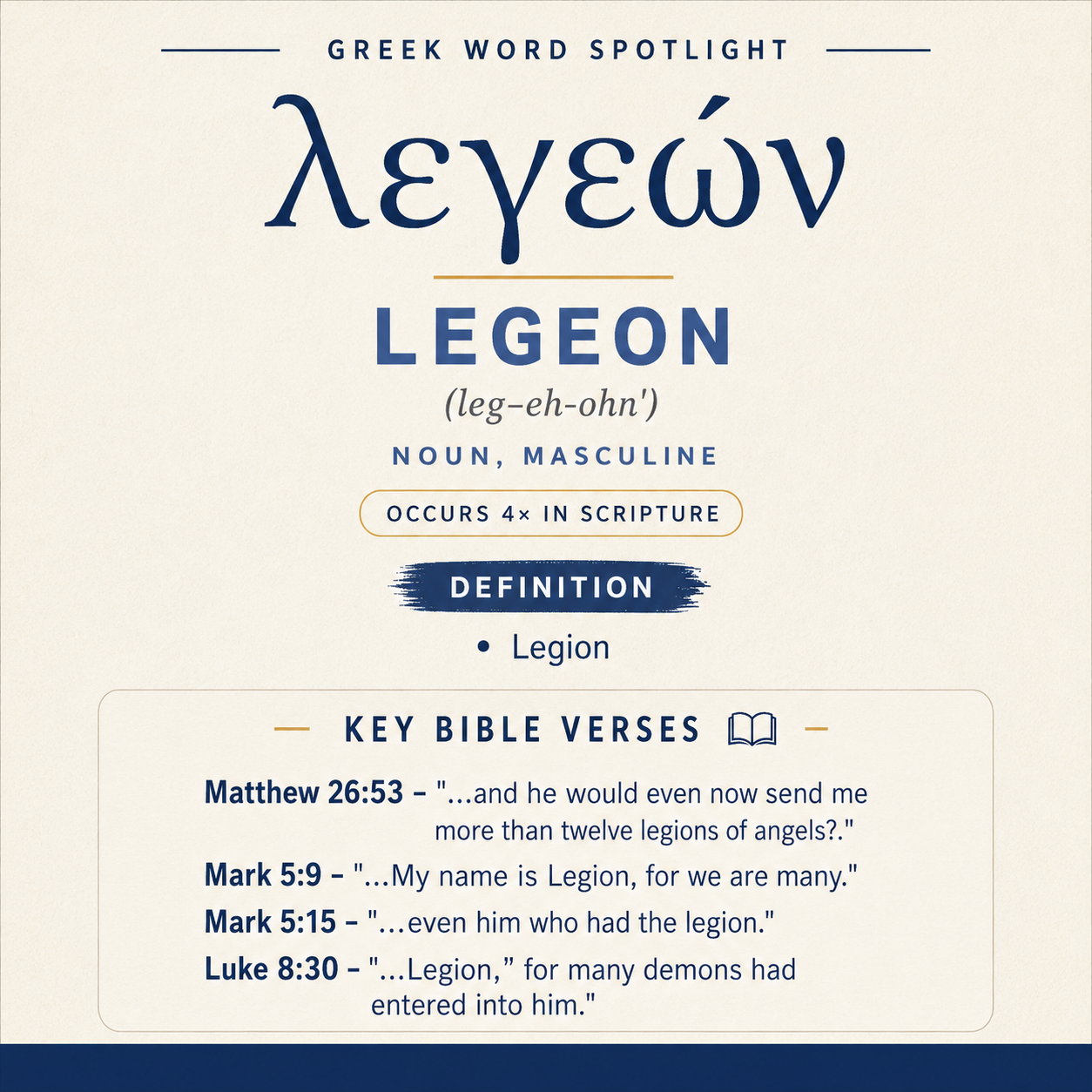
λεγεών means “Legion” and appears in Matthew 26:53; Mark 5:9, 5:15; and Luke 8:30.
Gospel Occurrences
It occurs four times in Scripture, all in the Gospels: Matthew, Mark, and Luke.
Learn More →Narrative Context
In Matthew 26:53, it refers to “twelve legions of angels.” In Mark 5:9 and Luke 8:30, it is the name “Legion,” explained as “for we are many.”
Learn More →λεγεών means “Legion,” appearing in sayings about angelic forces and in accounts of many demons acting as a single named presence. In these passages the term functions as a countable unit (“legions”) and as a self-designation (“Legion”).
Occurrences
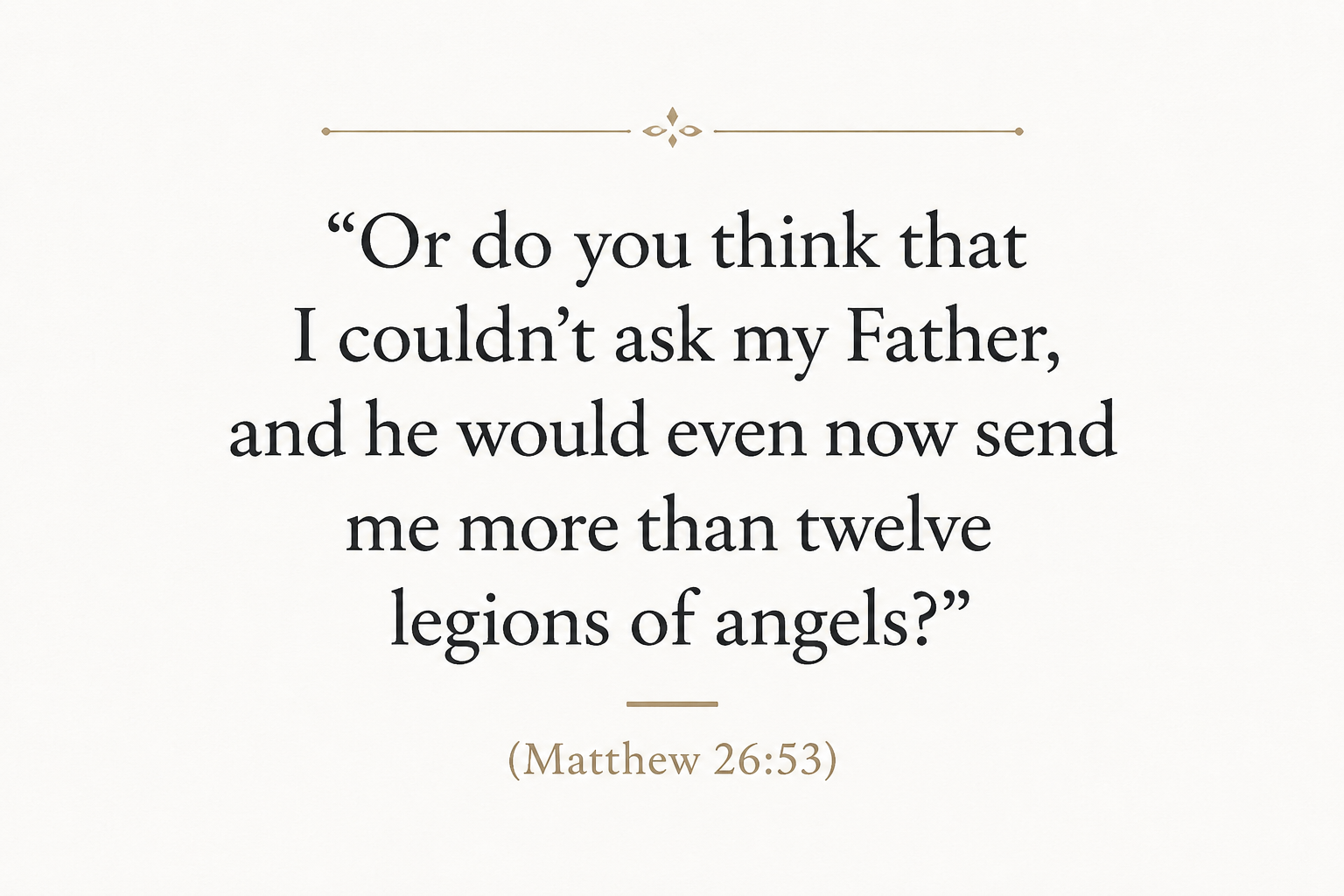
“Or do you think that I couldn’t ask my Father, and he would even now send me more than twelve legions of angels?” (Matthew 26:53)
Here λεγεών is pluralized and placed in a comparative statement (“more than twelve”), so it serves as a measurable way of speaking about the scale of angelic assistance. The verse frames the term within a hypothetical request to “my Father,” emphasizing that such help could be supplied “even now.” In this scene λεγεών contributes a concrete, countable magnitude to the claim: whatever “legions of angels” are, they are numerous enough to be reckoned and exceeded, and their possible arrival would represent an overwhelming reinforcement.
“He asked him, “What is your name?” He said to him, “My name is Legion, for we are many.”” (Mark 5:9)
In Mark the term is presented as a proper name in direct speech: “My name is Legion.” The explanation that immediately follows—“for we are many”—ties λεγεών to plurality and collective identity within a single speaker. The question “What is your name?” expects an individual identification, but the reply uses λεγεών to describe an identity that is one label for many voices (“we”). Within the quoted exchange, λεγεών functions as both a name and a compressed description: it signals that the one addressed is not a solitary agent but a multitude speaking under one designation.
“They came to Jesus, and saw him who had been possessed by demons sitting, clothed, and in his right mind, even him who had the legion; and they were afraid.” (Mark 5:15)
This later Markan occurrence refers back to the same episode, but now λεγεών appears in narration rather than in the demon’s self-report. The crowd sees a visible transformation: the man is “sitting, clothed, and in his right mind,” described as the one “who had been possessed by demons.” The added phrase “even him who had the legion” uses λεγεών as a shorthand identifier for the severity of his former condition. In this scene the word carries the weight of the earlier claim “we are many,” now embedded in a summary label: “the legion” stands for the prior state of possession that has been reversed, and the onlookers’ fear is narrated alongside that recognition.
“Jesus asked him, “What is your name?” He said, “Legion,” for many demons had entered into him.” (Luke 8:30)
Luke parallels the naming exchange, again using λεγεών as the answer to “What is your name?” The explanatory clause is cast slightly differently than in Mark: “for many demons had entered into him.” The term thus functions as a name that gathers up the reality of “many demons” into a single spoken identifier. The emphasis falls on entry and indwelling (“had entered into him”), so λεγεών contributes to a portrait of multiple invasive agents acting together as one named presence. The name therefore operates as a narrative bridge between the singular question (name) and the plural reality (many demons).

Sense and Usage
Across these four passages, λεγεών is used in two closely related ways: as a plural count (“twelve legions”) and as a singular designation (“Legion”). In the plural it behaves like an ordinary countable noun, capable of being numbered and compared (“more than twelve”), and it serves to communicate scale. In the singular it is treated as a proper name in dialogue, but the dialogue itself explains why this name fits: it is attached to plurality (“we are many”; “many demons had entered into him”).
The narrative effect is that λεγεών becomes a compact label for overwhelming multiplicity. The term does not merely indicate that there are “many”; it provides a single handle by which that multitude is spoken of and referenced. Mark demonstrates this most clearly by moving from direct speech (“My name is Legion”) to later third-person narration (“him who had the legion”), showing that the name can become a stable identifier for the entire situation. Luke, by pairing “Legion” with the explanatory note about “many demons,” similarly uses the word to hold together a complex plurality under one named reality.
These uses also show that λεγεών can be framed around different kinds of agents while retaining its core sense. In Matthew it belongs to the sphere of angels, invoked hypothetically as a vast force ready to be sent. In Mark and Luke it belongs to the sphere of demons, not as a neutral headcount but as a name that expresses the collective character of the possessing spirits. The common thread is not the nature of the beings but the magnitude expressed by the term and the rhetorical or narrative weight that magnitude carries: potential overwhelming support in one scene, and an overwhelming oppressive presence in the others.
The syntax in the Gospel accounts highlights how the word works as identification. “What is your name?” draws out λεγεών as an answer that is simultaneously a name and an explanation. Mark’s “for we are many” keeps the speaker’s voice plural, while Luke’s “for many demons had entered into him” shifts the explanation into narration about what has happened to the man. Together, these patterns show λεγεών functioning as a name that interprets the situation for the reader: it signals that what confronts Jesus is not a single demon but a many-ness significant enough to be encapsulated by the term.
Imagery
In these passages λεγεών evokes the image of forces gathered into a single, formidable unit. Matthew’s “more than twelve legions of angels” paints the possibility of immense reinforcement arriving at once, while Mark and Luke use “Legion” to concentrate the terror and intensity of “many demons” into a single spoken name. Mark’s later phrase “him who had the legion” crystallizes the imagery into a before-and-after contrast: a man once defined by that daunting collective presence is now seen “sitting, clothed, and in his right mind,” and the observers’ fear underscores how striking that reversal appears.
Sources: Lexical data from Strong’s Exhaustive Concordance and the Translators Brief Lexicon of Extended Strongs for Greek (STEPBible, CC BY). Occurrence data from the Translators Amalgamated Greek New Testament (STEPBible, CC BY). Scripture quotations from the World English Bible (public domain).




