
Exploring the Meaning of Lalia in Greek
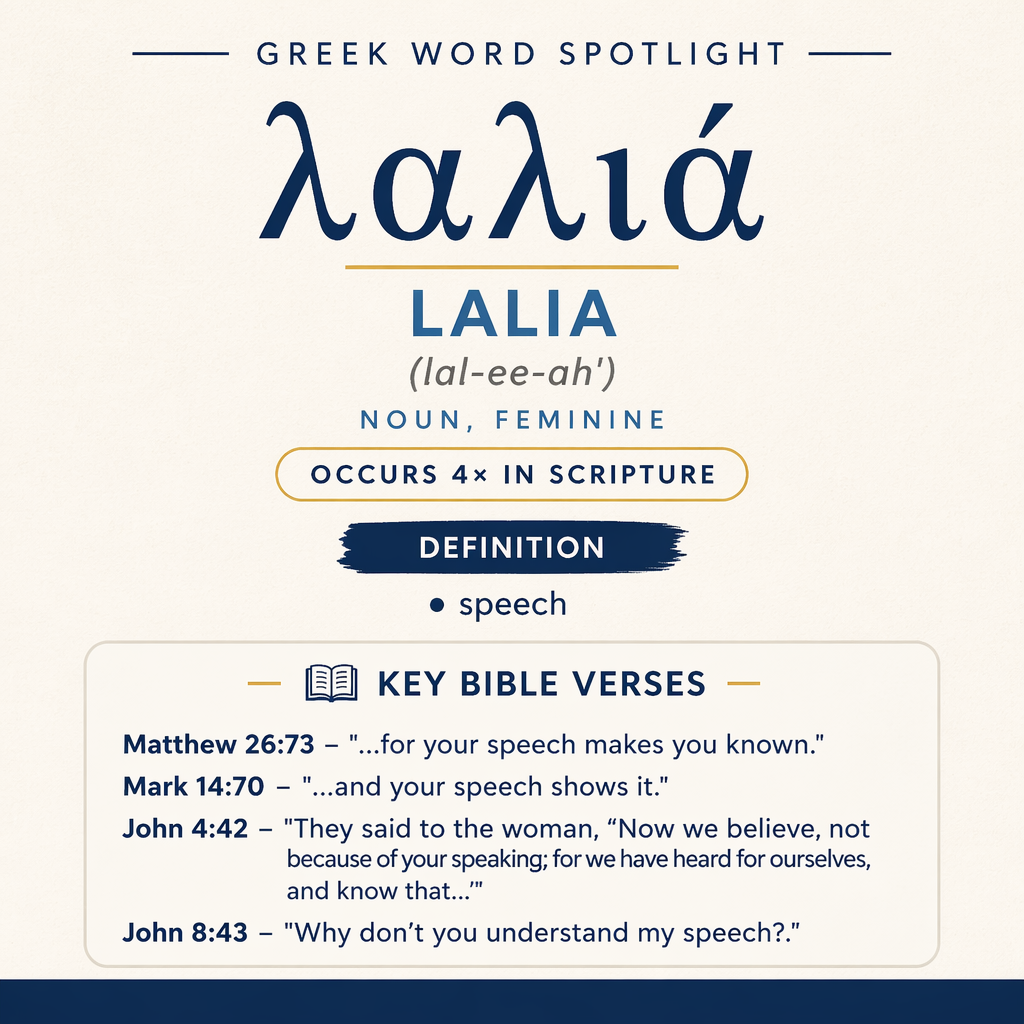
λαλιά means “speech” and occurs four times in Scripture: Matthew 26:73; Mark 14:70; John 4:42; John 8:43.
Core Meaning
λαλιά is defined as “speech.” In its four occurrences, it refers to a person’s speaking or manner of speech.
Learn More →Gospel Occurrences
It appears twice in Peter’s denial scene (Matthew 26:73; Mark 14:70). It also appears in John 4:42 and John 8:43.
Learn More →Contextual Use
In Matthew 26:73 and Mark 14:70, Peter is identified by his speech. In John 4:42 and John 8:43, the term relates to speaking and understanding speech.
Learn More →λαλιά refers to “speech,” and in the New Testament it appears in scenes where spoken expression becomes evidence, a cause of understanding or misunderstanding, or a contrast between report and firsthand hearing. Its occurrences cluster around interpersonal recognition (Peter in the courtyard) and Jesus’ public words (in John), where “speech” is tested for what it reveals and whether it is received.
Root and Related Words
λαλιά is related to the verb laleō (λαλέω), “to speak” (Strong’s G2980). In the passages where λαλιά occurs, the noun highlights speech as something heard and evaluated by others in concrete interactions.

Occurrences
“After a little while those who stood by came and said to Peter, “Surely you are also one of them, for your speech makes you known.”” (Matthew 26:73)
Here λαλιά is the audible feature that “makes you known.” The bystanders treat Peter’s speech as a marker that discloses association: it is not merely that Peter has spoken, but that the manner of his speaking carries identifying force. In the logic of the accusation, speech functions as recognizable evidence—something others can compare against what they expect from “one of them.” The scene is intensely social and observational: the group “stood by,” listened, and drew a conclusion from what they heard.

“But he again denied it. After a little while again those who stood by said to Peter, “You truly are one of them, for you are a Galilean, and your speech shows it.”” (Mark 14:70)
Mark’s wording places “speech” alongside a geographic label (“you are a Galilean”) and presents it as confirming proof: “your speech shows it.” The bystanders move from Peter’s denial to their renewed insistence, grounding their certainty in what his speech displays. The noun still denotes “speech,” but in this courtroom-like moment it is treated as something that “shows” identity rather than something neutral. The repetition (“after a little while again”) also frames speech as persistent: even after denial, the way Peter speaks continues to present itself to listeners and continues to be interpreted.
“They said to the woman, “Now we believe, not because of your speaking; for we have heard for ourselves, and know that this is indeed the Christ, the Savior of the world.”” (John 4:42)
In this testimony, λαλιά belongs to the woman: “your speaking.” The townspeople contrast two routes to belief: belief that would rest on her speech, and belief grounded in their own hearing (“for we have heard for ourselves”). Speech is acknowledged as influential—something that could have been the basis of belief—but it is explicitly set aside as the decisive ground. The sentence holds “speaking” and “heard” in close proximity, inviting the reader to observe a distinction between mediated report (her speech to them) and direct encounter (their hearing for themselves). Speech remains real and effective in the scene, but it is treated as preliminary, pointing beyond itself to what they themselves have now heard and know.
“Why don’t you understand my speech? Because you can’t hear my word.” (John 8:43)
Here λαλιά is Jesus’ own “speech,” and the question turns on comprehension: “Why don’t you understand my speech?” The answer given focuses on the listener’s incapacity: “Because you can’t hear my word.” In this exchange, speech is not presented as lacking clarity on its own; rather, the failure lies in reception. “Understand” and “hear” set speech within the process of communication from speaker to audience: speech is uttered, heard, and understood—or else it remains ungrasped. The pairing of “my speech” with “my word” keeps the emphasis on what proceeds from Jesus and is intended to be heard, but the statement underscores that speech can be present and yet not truly received by those who “can’t hear.”
Sense and Usage
Across these four passages, “speech” is consistently something audible that can be assessed by others, but the assessment takes different forms. In Matthew and Mark, speech is treated as an identifying feature—something that “makes you known” and “shows it.” The bystanders do not argue from a single statement Peter makes; they appeal to his speech as a detectable pattern that, to their ears, aligns him with a particular group and place. Speech in these scenes functions almost like a signature: it is heard in passing, yet it carries social information that others can use in accusation.
In John 4:42, “speech” is the woman’s speaking that has prompted attention and movement toward belief, but the emphasis shifts from identification to epistemic grounding. The people acknowledge her speech as a possible basis for belief (“not because of your speaking”), yet they explicitly relocate the basis to personal hearing (“for we have heard for ourselves”). Speech is thus depicted as capable of initiating response while not necessarily being the final support of conviction. The noun retains its plain sense, but the passage places it within a chain: speaking can lead to hearing; hearing can lead to knowing.
John 8:43 develops a different aspect: speech as intelligible content that requires receptive hearing to be understood. The scene presumes that speech has meaning to be grasped, yet understanding is blocked when hearing fails. By stating, “Why don’t you understand my speech? Because you can’t hear my word,” the verse connects speech to the listener’s capacity, not merely to the speaker’s act. Speech, though uttered, may remain opaque when the hearer cannot truly hear. The noun therefore serves to frame a relational problem: speech exists between speaker and hearer, and the breakdown in that relationship results in non-understanding.
Taken together, these texts portray speech as more than sound. It can reveal identity to observers, it can serve as a witness that moves others toward firsthand experience, and it can become the contested object of understanding when hearing is impaired. Yet in each case λαλιά remains grounded in ordinary communication: people speak, others listen, and the spoken expression becomes consequential—either exposing, persuading, or confronting.
Imagery
The imagery attached to λαλιά in these passages is concrete and public: voices overheard among “those who stood by,” a community responding to “your speaking,” and an audience addressed by Jesus whose inability to “hear” results in failure to “understand.” Speech is pictured as something that travels through a crowd, reaches ears, and yields judgments—about who a person is, why people believe, and whether meaning is grasped.
Sources: Lexical data from Strong’s Exhaustive Concordance and the Translators Brief Lexicon of Extended Strongs for Greek (STEPBible, CC BY). Occurrence data from the Translators Amalgamated Greek New Testament (STEPBible, CC BY). Scripture quotations from the World English Bible (public domain).





