
Exploring the Meaning of Kuklo in Greek
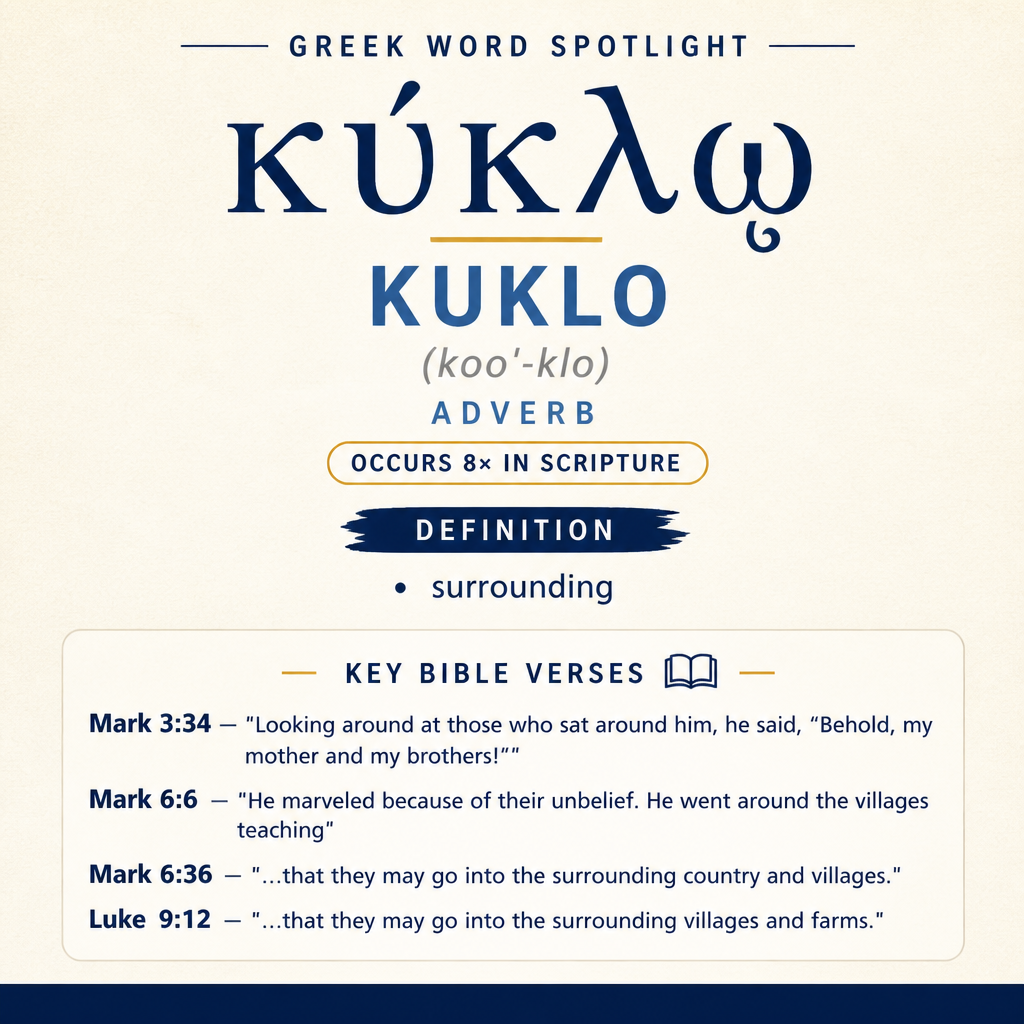
κύκλῳ means “surrounding” and appears 8 times in Scripture, including Mark, Luke, Romans, and Revelation.
Core Sense
κύκλῳ is defined as “surrounding.” It marks what is around someone or something.
Learn More →Gospel Scenes
In Mark and Luke, it describes people sitting around Jesus and movement into surrounding villages and country (Mark 3:34; 6:6, 6:36; Luke 9:12).
Learn More →Wider Contexts
Romans 15:19 uses it for travel “around as far as to Illyricum.” Revelation uses it for beings standing around the throne (Revelation 4:6; 5:11; 7:11).
Learn More →κύκλῳ expresses the idea of what is surrounding. It appears in narrative settings where movement or attention ranges over what is around, and in visionary scenes where beings stand around a central throne.
Occurrences
Mark 3:34: Looking around at those who sat around him, he said, “Behold, my mother and my brothers!
Here the word marks Jesus’ attention as it moves over the circle of people seated around him. The setting is defined spatially: there is a center (Jesus speaking) and a surrounding group (those who “sat around him”), and the “looking around” frames his statement about family as spoken with the surrounding listeners in view.
Mark 6:6: He marveled because of their unbelief. He went around the villages teaching.
In this line the word contributes the sense of surrounding movement as Jesus’ teaching activity extends outward through multiple villages. The action is not confined to one location; it is described as going around, giving the scene a spread of activity over the surrounding area implied by “the villages.”
Mark 6:36: Send them away, that they may go into the surrounding country and villages, and buy themselves bread, for they have nothing to eat.”
The disciples’ request depends on the contrast between where the crowd is now and what lies around them. “The surrounding country and villages” are presented as the accessible places encircling the present location, places where food can be purchased. The word helps define these nearby regions as the practical perimeter to which the multitude might disperse.
Luke 9:12: The day began to wear away; and the twelve came and said to him, “Send the multitude away, that they may go into the surrounding villages and farms, and lodge, and get food, for we are here in a deserted place.”
This occurrence again sets the immediate place (“a deserted place”) against what surrounds it (“the surrounding villages and farms”). The word frames the surrounding settlements and rural holdings as the ring of locations where the crowd can find lodging and food as daylight fades, reinforcing the logistical urgency created by the wearing day.
Romans 15:19: in the power of signs and wonders, in the power of God’s Spirit; so that from Jerusalem, and around as far as to Illyricum, I have fully preached the Good News of Christ;
Paul uses the word to describe the reach of his preaching in terms of a surrounding sweep from a starting point. “From Jerusalem, and around as far as to Illyricum” portrays a ministry that extends in a surrounding range, a broad arc of proclamation rather than a single route or isolated spot.
Revelation 4:6: Before the throne was something like a sea of glass, similar to crystal. In the middle of the throne, and around the throne were four living creatures full of eyes before and behind.
In this throne-room vision the word establishes a clear spatial relationship to the throne: the four living creatures are positioned around it. The surrounding placement intensifies the focus on the throne as the center, while the creatures—described as “full of eyes before and behind”—form a living perimeter encircling that center.
Revelation 5:11: I saw, and I heard something like a voice of many angels around the throne, the living creatures, and the elders. The number of them was ten thousands of ten thousands, and thousands of thousands;
The scene expands from the earlier description by adding “many angels” placed around the central grouping: the throne, the living creatures, and the elders. The word helps depict concentric space: a core set is named, and around it is an immense host whose number is emphasized. The surrounding position supports the sense of a vast assembly arranged in relation to the throne.
Revelation 7:11: All the angels were standing around the throne, the elders, and the four living creatures; and they fell on their faces before his throne, and worshiped God,
Here the angels’ surrounding stance becomes the posture from which worship is enacted. They are “standing around the throne” and then “fell on their faces before his throne,” so the word locates them as an encircling company whose movement in worship is directed toward the same central point.

Sense and Usage
Across these passages κύκλῳ functions as a spatial organizer. In the Gospel scenes it helps readers picture people, places, and practical options in relation to a center. In Mark 3:34 the center is personal and immediate—Jesus and those seated around him—so the word supports a moment of direct address shaped by who is surrounding him. In Mark 6:36 and Luke 9:12 the center is a situation of need in a constrained location, while the surrounding villages, country, and farms define the nearby network of places where the need might be met. The word thus serves as a simple but effective way to frame the environment: it gathers multiple locations into a single surrounding field without needing to list every point on the horizon.
In Mark 6:6 and Romans 15:19 the same idea of surrounding is applied to movement and scope. The action is not merely “to” one place but “around,” implying extension through a surrounding range. Mark depicts itinerant teaching that reaches villages in a surrounding circuit; Romans uses surrounding language to describe a wide span of preaching characterized by breadth of reach. In both, the word contributes a sense of spread: the activity is pictured as ranging over what lies around rather than being fixed to one point.
In Revelation the word’s organizing power becomes vivid and architectural. The throne is the unquestioned center, and κύκλῳ marks who occupies the surrounding space. The four living creatures are positioned around the throne (Revelation 4:6), then an innumerable voice of angels is heard around the throne together with the living creatures and elders (Revelation 5:11), and finally all the angels are standing around the throne and associated figures as they worship (Revelation 7:11). The repeated surrounding placement creates an image of ordered proximity: beings nearest and beings beyond are still defined by their relation to the throne. Even when the text shifts from standing to falling down, the spatial fact remains: they are surrounding a center and acting toward it.
Imagery
The word often carries an implicit center-and-perimeter picture. In the Gospels that center may be a teacher with listeners gathered around, or a remote place with surrounding villages that represent shelter and supply. In Revelation it contributes to a throne-room panorama where surrounding beings form an enveloping assembly; the surrounding ring of creatures and angels frames the throne as the focal point of sight, sound, and worship.
Sources: Lexical data from Strong’s Exhaustive Concordance and the Translators Brief Lexicon of Extended Strongs for Greek (STEPBible, CC BY). Occurrence data from the Translators Amalgamated Greek New Testament (STEPBible, CC BY). Scripture quotations from the World English Bible (public domain).




