Exploring the Meaning of Koustodia in Greek
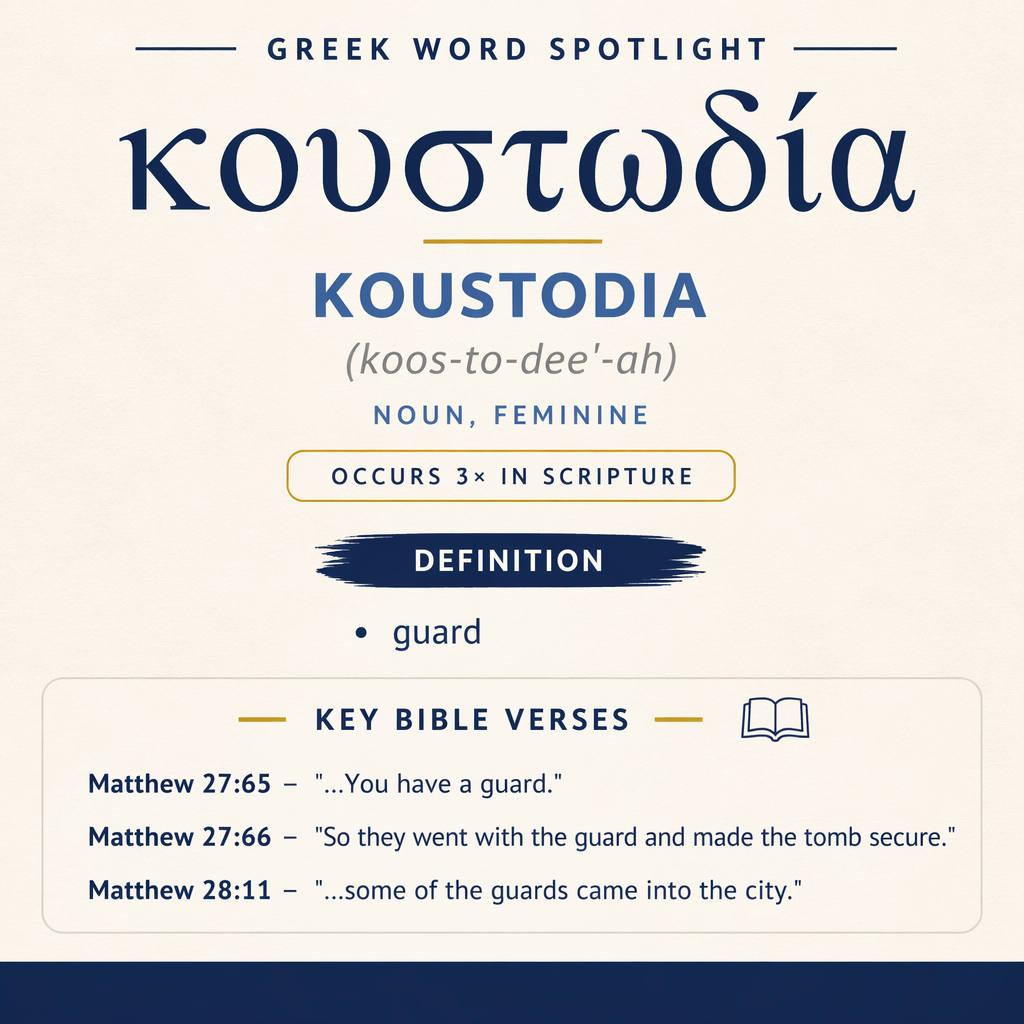
κουστωδία means “guard” and appears three times in Matthew 27:65–66 and 28:11.
Matthew Context
In Matthew 27:65–66, Pilate tells them they have a guard and to make the tomb secure, sealing the stone.
Learn More →Reported to Priests
In Matthew 28:11, some of the guards come into the city and report to the chief priests.
Learn More →κουστωδία denotes a “guard” and appears in the closing scenes of Matthew’s passion narrative, centered on the securing of Jesus’ tomb and the aftermath of the empty tomb. In these contexts it functions as a concrete, on-the-ground measure intended to control access and to certify what has (or has not) occurred.
Occurrences
“Pilate said to them, “You have a guard. Go, make it as secure as you can.”” (Matthew 27:65)
Here κουστωδία is presented as something that can be possessed and deployed: “You have a guard.” The word stands at the hinge between official permission and practical action. Pilate’s directive joins the guard to an immediate purpose clause—“Go, make it as secure as you can”—so that the “guard” is not merely a group standing by, but a means of enforcing security. In the verse’s own logic, security is treated as a matter of taking concrete steps, and the guard is the central resource given for those steps. The term therefore carries the idea of organized watchfulness placed at the disposal of authorities to achieve a secure state.
The briefness of the exchange also shapes how the word is heard. Pilate does not argue or elaborate; he grants access to a guard and pushes responsibility back onto those who requested it. The guard is thus framed as sufficient for the task when combined with the petitioners’ own effort (“as you can”). κουστωδία, in this first occurrence, contributes a sense of officially sanctioned protection directed toward restricting what can happen at a tomb.
“So they went with the guard and made the tomb secure, sealing the stone.” (Matthew 27:66)
This verse narrates the execution of the plan, and κουστωδία appears as an accompanying presence: “they went with the guard.” The guard is not an abstract authorization but an escort that goes to the site. The phrase positions the guard alongside the human agents who initiate the securing of the tomb, implying coordination: they go, and they act, with the guard as part of the operation.
The verse then names two security measures: “made the tomb secure” and “sealing the stone.” Within this description, κουστωδία belongs to a set of steps designed to ensure closure and control. The guard contributes a living, responsive element to that security—able to observe, deter, and intervene—while the sealing of the stone contributes a fixed, physical barrier. Matthew’s wording binds these together in a single movement of securing the tomb, so that the guard becomes part of the broader mechanism of security rather than a separate detail.
Because the tomb is “made … secure” in the presence of the guard, the narrative presents the security as deliberate and thorough. κουστωδία serves the storyteller by underlining that what follows is not the result of casual oversight at the burial place; it occurs in a context where access has been managed and guarded as a matter of intention.
“Now while they were going, behold, some of the guards came into the city, and told the chief priests all the things that had happened.” (Matthew 28:11)
In this third occurrence, κουστωδία shifts from being assigned and stationed to becoming a set of messengers: “some of the guards came into the city.” The guard is no longer described in relation to securing the tomb; instead, members of the guard move away from the site and into an urban setting. The narrative marks this movement as contemporaneous with others’ departure (“Now while they were going”), placing the guards’ actions within the unfolding aftermath.
The guard’s role here is defined by reporting: they “told the chief priests all the things that had happened.” This is still consistent with a guard’s function, since guarding involves observing events and being able to recount them. The verse portrays them as witnesses whose account is valuable to the chief priests. The phrase “all the things that had happened” paints their report as comprehensive, and it gives the guards narrative weight: their testimony becomes part of the story’s explanation of subsequent responses. κουστωδία therefore contributes not only the idea of security personnel but also the idea of a security detail as a source of information—those who were present to prevent interference now become those who relay what occurred despite that preventive setup.

Sense and Usage
Across these three scenes, κουστωδία is consistently concrete: it refers to a guard in the sense of an arranged protective presence. It is treated as something that can be granted (“You have a guard”), something that can accompany an operation (“they went with the guard”), and something that can act as a group whose members can separate and relocate (“some of the guards came into the city”). The term thus functions flexibly within the narrative: it can be spoken of as a single unit (“a guard”) while also naturally allowing reference to members within it (“some of the guards”).
The word’s narrative function is tightly joined to the idea of making something “secure.” In Matthew 27:65, the guard is explicitly linked to the command to secure; in Matthew 27:66, the guard is part of the enacted securing of the tomb; in Matthew 28:11, the guard is implicated in the aftermath because the very people associated with the security measures are now reporting what occurred. In each case, “guard” is not mere decoration but an element that frames the situation as monitored and controlled by human authority.
The progression of usage is also significant. First, the guard is authorized and assigned; second, the guard is present at the securing of the tomb, alongside the sealing of the stone; third, at least some of the guard becomes a channel of communication to the chief priests. This movement from assignment to presence to report gives κουστωδία a storyline of its own within the tight span of Matthew 27:65–28:11. The guard begins as a preventive measure and ends as a body of observers who carry news into the city.
Within the quoted wording, the guard is repeatedly tied to institutional power. Pilate speaks as one who can permit the guard’s use; the chief priests are those who receive the guards’ report. This places κουστωδία at an intersection between political authority (Pilate) and religious leadership (the chief priests), without requiring the term itself to mean anything beyond “guard.” The narrative simply shows the guard as operating within those structures: it is available by command, deployed in an official action, and then brought into an official conversation afterward.
Finally, the term carries an implied contrast between intention and outcome that is created entirely by the immediate contexts. The stated goal is maximum security (“make it as secure as you can”), and the stated actions are securing and sealing (“made the tomb secure, sealing the stone”). Yet the guards still have “all the things that had happened” to report. The word “guard,” as used here, therefore heightens the sense that the situation was meant to be controlled and verified, even as events unfold that require explanation and reporting from those stationed to prevent disturbance.
Imagery
In these passages κουστωδία evokes a vivid scene of guarded boundaries: a tomb approached with official protection, a stone secured and sealed, and guards later entering the city to deliver their account. The imagery is practical and physical—people tasked to watch, a place made secure, and a chain of communication from the guarded site to the chief priests—so that “guard” becomes a key element in how Matthew portrays the tomb as a controlled location and the subsequent report as coming from those assigned to keep watch.
Sources: Lexical data from Strong’s Exhaustive Concordance and the Translators Brief Lexicon of Extended Strongs for Greek (STEPBible, CC BY). Occurrence data from the Translators Amalgamated Greek New Testament (STEPBible, CC BY). Scripture quotations from the World English Bible (public domain).