Exploring the Meaning of Korax in Greek
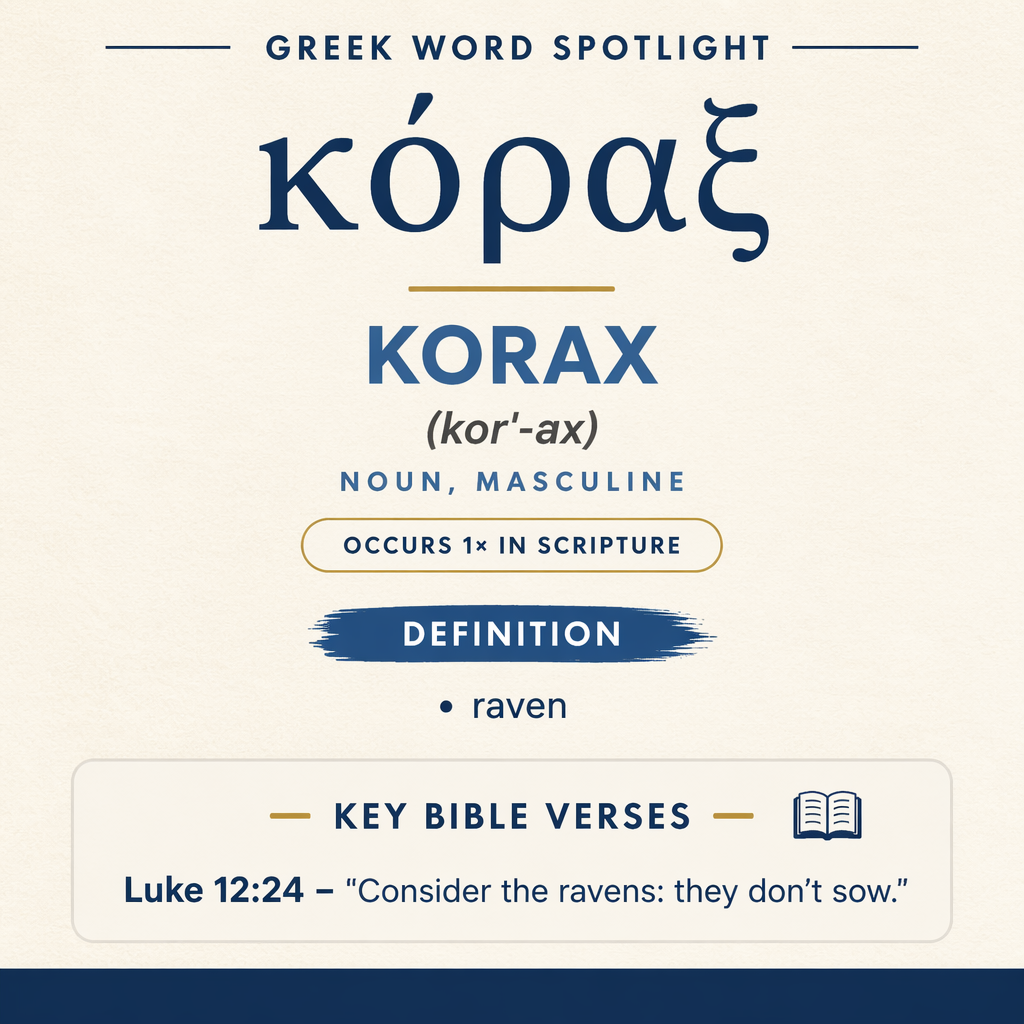
κόραξ means “raven” and appears once in Scripture, in Luke 12:24.
Luke 12:24
In Luke 12:24, ravens are described as not sowing or reaping, yet God feeds them.
Learn More →κόραξ means “raven” and appears once in the New Testament, in Jesus’ teaching in Luke 12:24. In that saying, the raven functions as a concrete example drawn from the natural world to sharpen a comparison about provision and value.
Root and Related Words
Related to κορέννυμι (korennymi), “to satisfy” (Strong’s G2880).
Occurrences
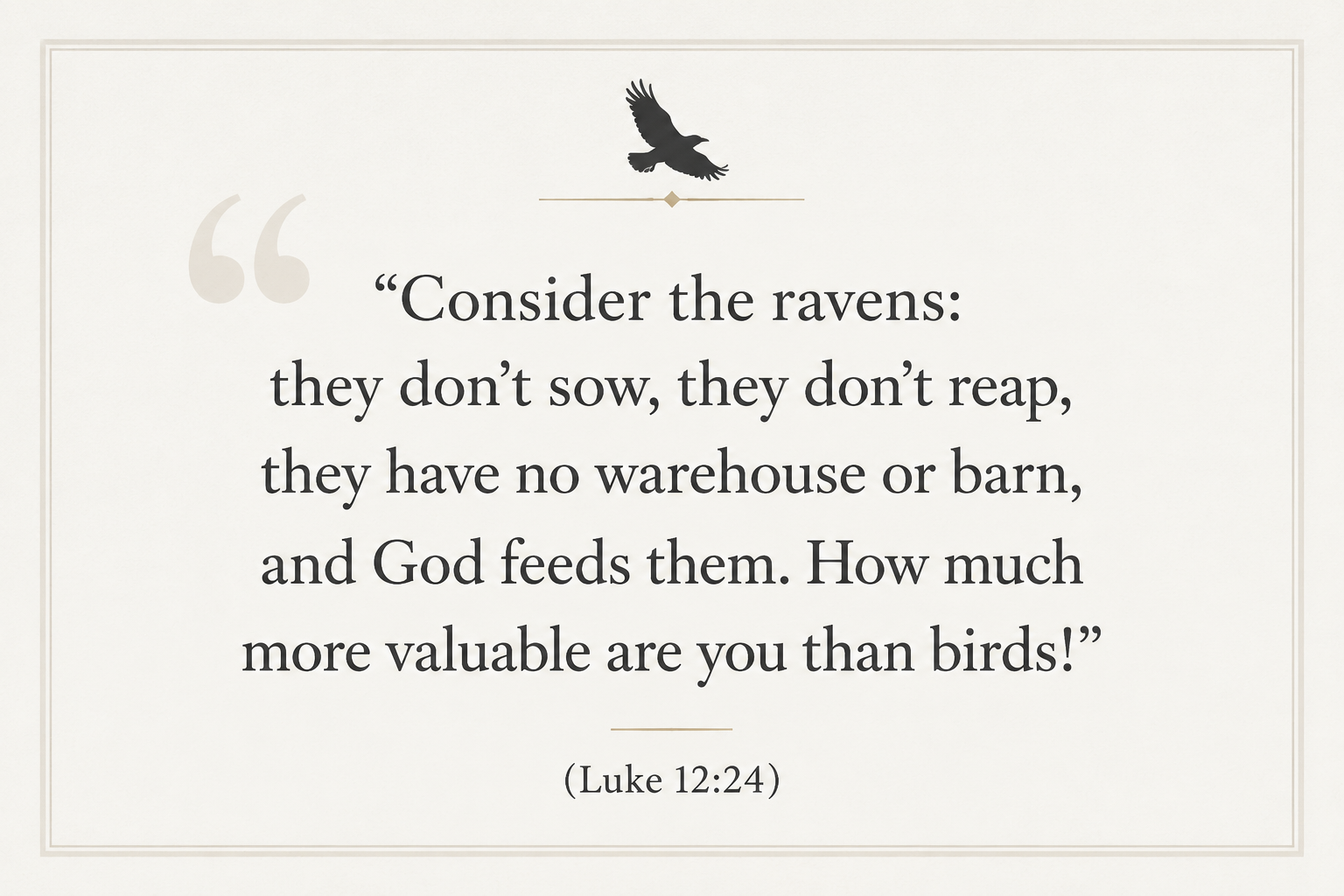
“Consider the ravens: they don’t sow, they don’t reap, they have no warehouse or barn, and God feeds them. How much more valuable are you than birds!” (Luke 12:24)
Here κόραξ names a specific kind of bird within a brief chain of everyday observations: ravens “don’t sow” and “don’t reap,” and they possess “no warehouse or barn.” The word anchors the illustration in a real creature that can be watched, so that the hearer is invited to “consider” something visible and ordinary rather than an abstract principle. The raven is presented in terms of what it lacks—agricultural labor and storage infrastructure—so that its ongoing life (“God feeds them”) stands out as the key point of the example.
In this sentence, the raven is not a decorative detail but the subject of a set of clauses that build a contrast: no sowing, no reaping, no barns, yet still fed. κόραξ therefore carries the weight of a test case. If even a raven, described as outside the human patterns of planting and stockpiling, receives food, that observable reality is used to press the concluding question: “How much more valuable are you than birds!” The noun keeps the comparison grounded by staying with the category of “birds” while first focusing on one named instance of that category.
The immediate context inside the verse also shapes what κόραξ contributes. The saying does not merely assert that birds eat; it draws attention to a bird whose life is portrayed without human-style planning. In that frame, “ravens” mark the starting point for an argument that moves from the lesser to the greater: from the feeding of ravens to the implied care for the hearers addressed as more valuable. κόραξ thus supports the rhetorical movement of the verse by supplying a concrete “lesser” that can be contemplated.
Sense and Usage
In Luke 12:24, “raven” operates as a representative creature in a lesson about provision. The word’s force comes from how it is embedded in a list of negations (“don’t sow,” “don’t reap,” “have no warehouse or barn”) followed by a positive assertion (“God feeds them”). κόραξ, placed at the head of that sequence, evokes an animal life that proceeds without the visible means of food-production and storage that humans often rely on.
The verse uses the raven to highlight a mismatch between means and outcome: no sowing or reaping is paired with being fed. Within that logic, κόραξ serves to concentrate the hearer’s attention on a single, named example before widening out to “birds” in general. The final question keeps the raven from being an isolated curiosity; it turns the observation into a comparative measurement of value. Because the verse explicitly contrasts “you” with “birds,” κόραξ helps establish the lower end of the comparison in a way that is vivid and easy to picture: a bird without barns, yet not unfed.
The imperative “Consider” also shapes usage. κόραξ is not introduced as a distant or rare object but as something suitable for reflection—an observable instance intended to teach. The word therefore functions pedagogically: it points to a creature whose ordinary habits (not sowing, not reaping, not storing) can be recognized and then interpreted within the claim that “God feeds them.” In this use, the raven is not defined by ornamental traits; it is defined by its relation to food and lack of human-style accumulation, making it a fitting example for a teaching that targets worry about material needs through a comparison of values.
Imagery
The imagery carried by κόραξ in Luke 12:24 is plain and concrete: birds alive in the open air, neither planting nor harvesting, with no “warehouse or barn,” yet receiving food. The raven, named explicitly, invites the reader to picture an everyday creature that does not manage supplies as people do, and to feel the force of the concluding question that contrasts the worth of the hearers with that of “birds.”
Sources: Lexical data from Strong’s Exhaustive Concordance and the Translators Brief Lexicon of Extended Strongs for Greek (STEPBible, CC BY). Occurrence data from the Translators Amalgamated Greek New Testament (STEPBible, CC BY). Scripture quotations from the World English Bible (public domain).