Exploring the Meaning of Kome in Greek
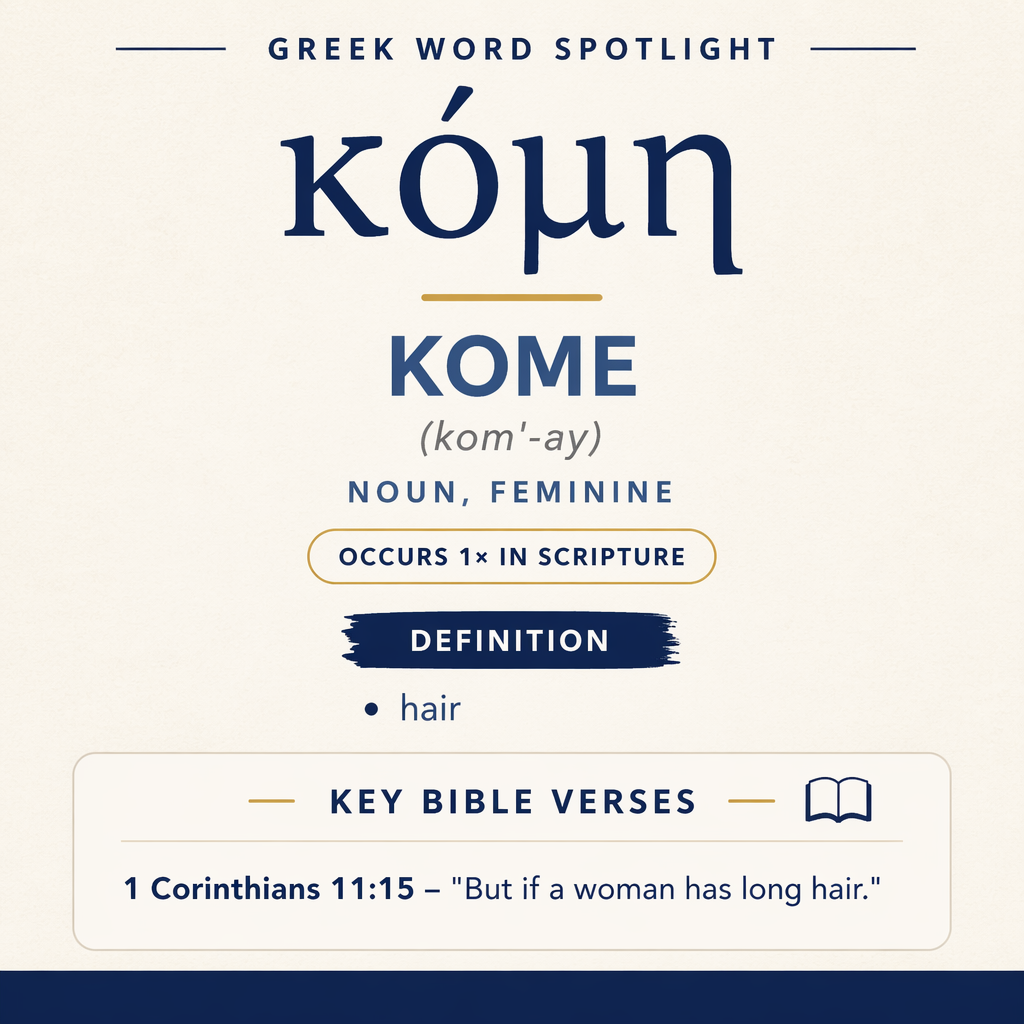
κόμη means “hair” and appears once in Scripture, in 1 Corinthians 11:15.
Verse Context
In 1 Corinthians 11:15, a woman’s long hair is called her glory and given as a covering.
Learn More →κόμη refers to hair, and it appears in Paul’s discussion of women and men in the gathered life of the church. Its lone New Testament occurrence comes in a sentence that treats “long hair” as a woman’s “glory” and speaks of hair being “given … for a covering.”
Root and Related Words
κόμη is connected with the verb komizo (κομίζω), “to bring/be repaid” (Strong’s G2865). The relationship invites attention to the way the verse frames hair as something “given,” a feature treated as received rather than self-generated within the sentence’s own wording.

Occurrences
“But if a woman has long hair, it is a glory to her, for her hair is given to her for a covering.” (1 Corinthians 11:15)
Here κόμη appears twice in the same line of reasoning. First, it is part of a condition: “if a woman has long hair.” Hair is treated as a visible, embodied feature that can be described by length, making it suitable for the kind of public, observable example the sentence uses. The clause does not argue about hair in the abstract; it points to a concrete state of having it in a certain way (“long”), so κόμη functions as a tangible marker within the comparison being drawn.

Second, κόμη is the subject of an explanatory statement: “for her hair is given to her for a covering.” The verse’s logic pivots on this “for,” presenting the hair itself as the reason that “long hair” can be called “a glory to her.” Within the sentence, hair is not merely decorative; it is described with purposeful language (“given … for a covering”), so κόμη carries the weight of something that provides an actual covering in the immediate argument. The statement also uses possessive language (“her hair”), keeping the focus on personal embodiment and on what belongs to the woman in view, rather than on an external garment or an object detached from the person.
The verse also pairs κόμη with an evaluative term (“glory”), locating hair within the sphere of honor and fittingness in the setting Paul is addressing. In this single sentence, κόμη contributes to a chain of ideas: a woman’s long hair → glory → because hair is given → for a covering. The word thus serves as the hinge between what can be seen (“long hair”) and what is inferred (“glory” and “covering”) without the verse needing to define hair in technical terms.
Sense and Usage
The verse uses κόμη in a straightforward, physical sense: hair as a feature of the body. Yet it does more than name a body part. By speaking of “long hair,” the sentence treats hair as something that can be borne in an observable condition—its length being a salient quality for the point being made. The use of κόμη therefore supports an argument that depends on shared, everyday recognition of what hair is and what it looks like when it is “long.”
At the same time, the statement “her hair is given to her for a covering” presents hair as fulfilling a covering function. κόμη, as used here, stands at the intersection of the natural and the socially meaningful: it is part of a woman’s body, and the verse frames it as a divinely bestowed provision (“given”) that serves a role (“for a covering”). Within the wording of the sentence, hair is not treated as neutral. It is evaluated (“glory”), owned (“her hair”), and purposed (“for a covering”). That combination shows how κόμη can participate in reasoning about propriety and appearance without ceasing to denote something thoroughly physical.
The repetition of κόμη in the same verse also subtly distinguishes two angles on the same reality. “Has long hair” describes a condition; “her hair is given … for a covering” supplies an explanation of significance. The verse thus moves from description to interpretation while keeping κόμη constant. That stability allows the argument to remain grounded: the interpretive conclusion (“glory”) is tied to something concrete and bodily rather than to an invisible quality. In this way κόμη functions as a bridge between what is visible and what is valued.
Finally, κόμη appears in a gender-specific sentence (“if a woman has long hair”), so the word is drawn into a discussion where the body is not merely biological but also publicly meaningful within communal life. The sentence’s own structure shows that hair, in this context, can be treated as a sign-bearing feature without becoming detached from its literal sense. κόμη remains hair, but hair that is long, personal (“hers”), received (“given”), and functional (“for a covering”).
Imagery
In 1 Corinthians 11:15, κόμη carries imagery of something that both adorns and shelters: “long hair” is spoken of as “a glory,” and the same hair is described as “given … for a covering.” The verse thus evokes the picture of hair as an inherent covering that is at once visible and meaningful, combining the ordinary reality of hair with the language of honor and protection found in the sentence itself.
Sources: Lexical data from Strong’s Exhaustive Concordance and the Translators Brief Lexicon of Extended Strongs for Greek (STEPBible, CC BY). Occurrence data from the Translators Amalgamated Greek New Testament (STEPBible, CC BY). Scripture quotations from the World English Bible (public domain).