Exploring the Meaning of Koloboo in Greek
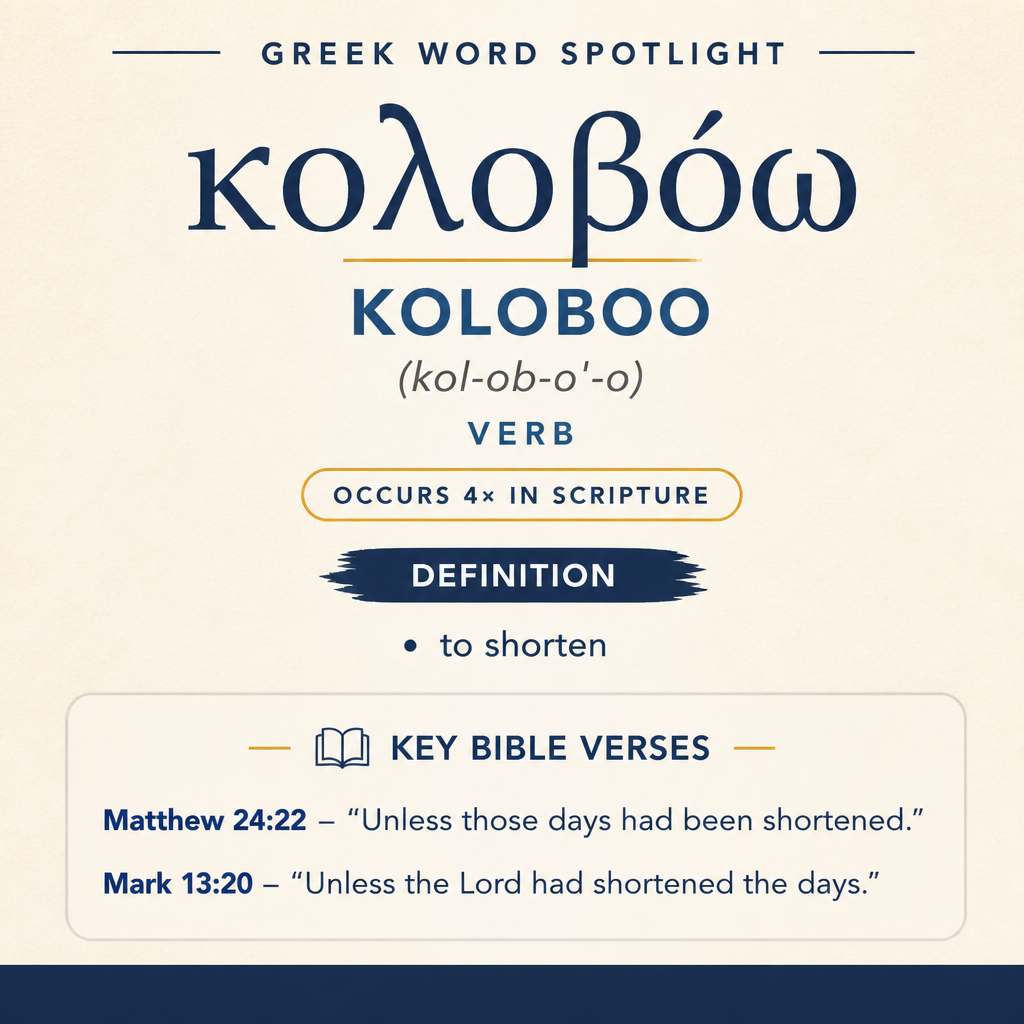
κολοβόω means “to shorten” and occurs 4 times in Scripture, including Matthew 24:22 and Mark 13:20.
Scripture Occurrences
κολοβόω occurs 4 times in Scripture. It appears in Matthew 24:22 and Mark 13:20.
Learn More →Context in Verses
In Matthew 24:22 and Mark 13:20, it describes days being shortened so no flesh would be saved otherwise.
Learn More →κολοβόω means “to shorten.” It appears in Jesus’ teaching about days of distress being reduced so that “no flesh” is lost, with the action framed as God’s deliberate intervention for the sake of the chosen.
Root and Related Words
Strong’s associates κολοβόω with the verb κολάζω (kolazo), “to punish” (Strong’s G2849).

Occurrences
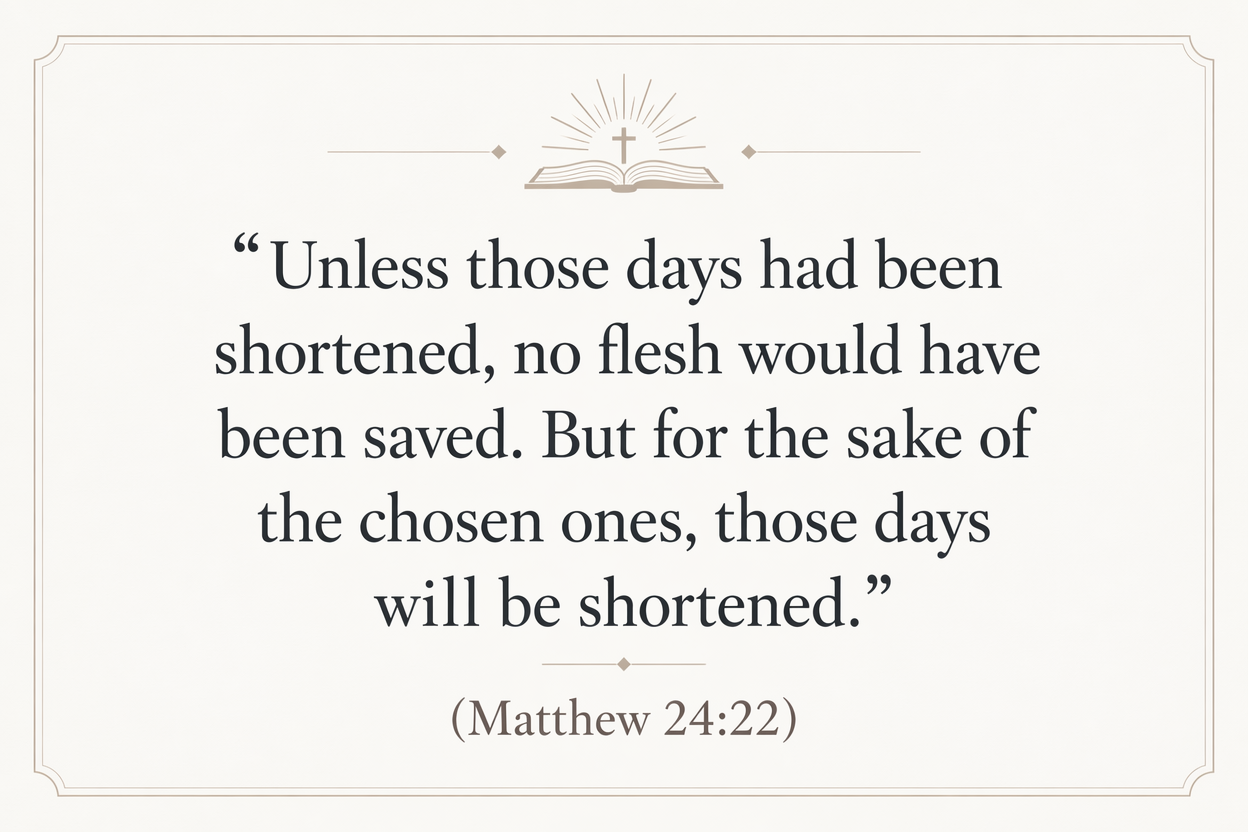
“Unless those days had been shortened, no flesh would have been saved. But for the sake of the chosen ones, those days will be shortened.” (Matthew 24:22)
Here κολοβόω describes a decisive change to “those days.” The first sentence sets up a condition: if the days were not shortened, the outcome would be comprehensive loss—“no flesh would have been saved.” The verb therefore functions as the hinge between a catastrophic trajectory and the possibility of survival. In the second sentence, the shortening is not presented as accidental or gradual; it is anchored in a stated purpose clause, “for the sake of the chosen ones.” Within this frame, the verb marks a limitation placed on the duration of the crisis: the days are bounded so that the destructive effect does not run its full course. The future-oriented phrasing, “will be shortened,” portrays the reduction as something assured and ordered, not merely hoped for.
“Unless the Lord had shortened the days, no flesh would have been saved; but for the sake of the chosen ones, whom he picked out, he shortened the days.” (Mark 13:20)
Mark’s wording makes the agent explicit: “the Lord” is the one who shortens. The same stark consequence is named—without the shortening, “no flesh would have been saved”—but the verse casts the shortening in completed terms: “had shortened” and “he shortened the days.” That verbal perspective emphasizes the act as a concrete intervention rather than a mere possibility. The verse also elaborates the beneficiaries: “the chosen ones, whom he picked out.” In this setting, κολοβόω does not describe the suffering itself; it describes a constriction of its timespan. The clause structure (“Unless…; but…”) highlights the contrast between what would happen under an unshortened duration and what does happen when the Lord limits the days. The shortening is thus portrayed as the decisive factor that prevents the otherwise total result implied by “no flesh.”
Sense and Usage
Across these occurrences, κολοβόω consistently applies to “days,” not to people, and its force lies in restricting duration. The object is a defined period already underway or anticipated (“those days,” “the days”), and the verb depicts that period as capable of being altered—cut down from what it would otherwise have been. The definition “to shorten” plays out as an act that changes the endpoint of time rather than adjusting the intensity of events within the time. In both passages, the shortening is framed in relation to an extreme human outcome: “no flesh would have been saved.” The verb therefore carries a strong sense of practical consequence: the reduction in days is not a minor scheduling change but a limit that makes the difference between universal loss and the preservation implied by “saved.”
The two accounts also show how the same idea can be presented with different temporal viewpoints. Matthew states the result as certain (“will be shortened”), keeping the focus on the coming reduction as part of the larger warning and reassurance embedded in the discourse. Mark narrates the same shortening with a completed perspective (“he shortened”), stressing that the Lord’s action stands as the determining cause within the logic of the sentence. In both cases, the shortening is purposeful and selective in its stated motivation: “for the sake of the chosen ones.” That repeated phrase ties the verb to divine regard for a particular group, and it frames the shortening as mercy expressed through limitation of time. The verb’s sense is thus shaped by its context: shortening is not merely an abstract comparison of lengths, but an intervention that curtails a period whose unrestrained length would yield intolerable consequences.
Because κολοβόω is used with “days,” it evokes the concrete experience of time passing—days accumulating, fatigue extending, danger persisting—and then pictures that accumulation being interrupted. The verb implies a before-and-after: what the days would have been, and what they become once shortened. In both verses, that contrast is grammatically explicit: “Unless… had been shortened… But… will be shortened” (Matthew), and “Unless… had shortened… but… he shortened” (Mark). The repeated logic gives the word a consistent rhetorical function: it marks the point at which the threatening scenario is checked by a limiting act.
Imagery
In these sayings, κολοβόω carries the imagery of time being cut back—days that might have stretched on are instead brought to an earlier close. The word works alongside the sweeping phrase “no flesh” to portray the stakes in stark, bodily terms, and then sets the shortening of time as the means by which that total outcome is averted “for the sake of the chosen ones.”
Sources: Lexical data from Strong’s Exhaustive Concordance and the Translators Brief Lexicon of Extended Strongs for Greek (STEPBible, CC BY). Occurrence data from the Translators Amalgamated Greek New Testament (STEPBible, CC BY). Scripture quotations from the World English Bible (public domain).