
Exploring the Meaning of Klope in Greek
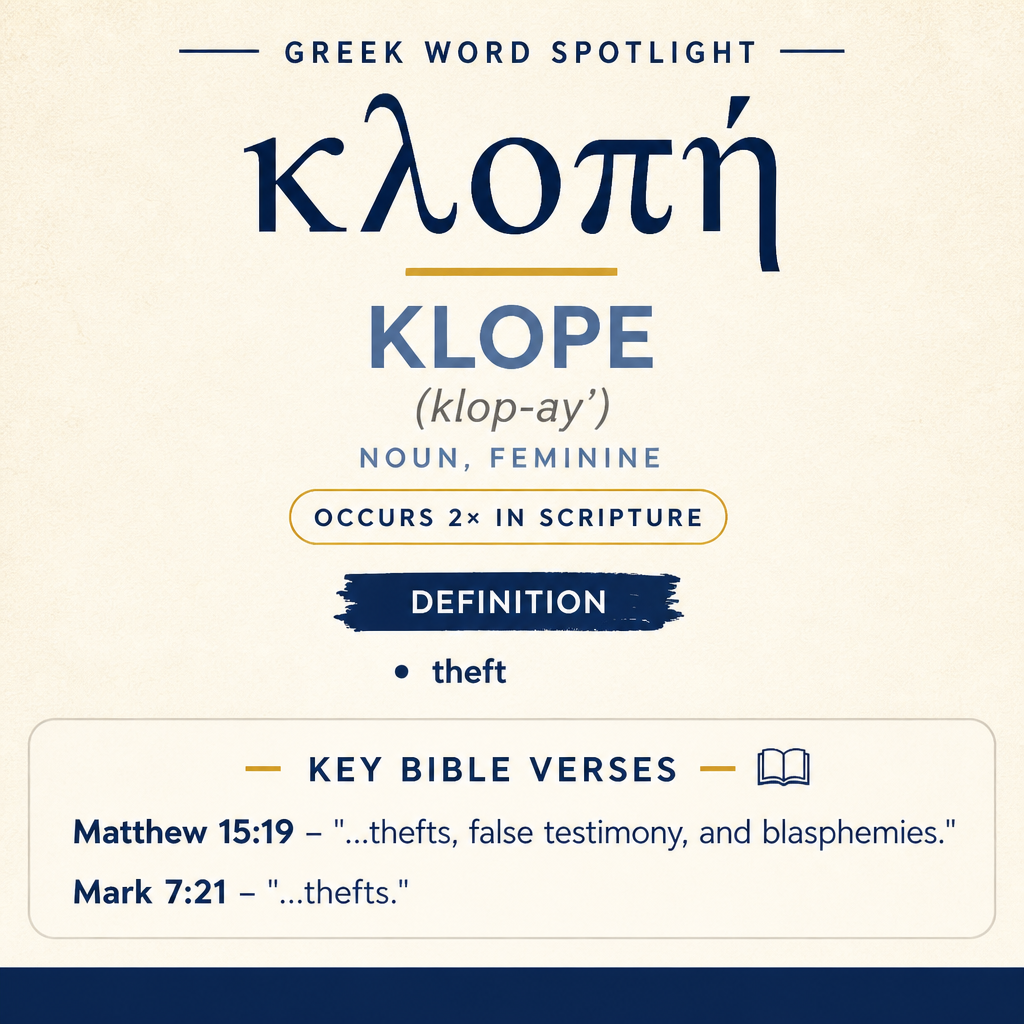
κλοπή means “theft” and appears twice in Scripture: Matthew 15:19 and Mark 7:21.
Scripture Occurrences
It occurs 2 times in Scripture. The references are Matthew 15:19 and Mark 7:21.
Learn More →Context in Lists
In both verses, “thefts” appears in a list of evils proceeding from within the heart. These lists include other sins such as murders, adulteries, and sexual sins.
Learn More →κλοπή means “theft.” It appears in Jesus’ teaching about the kinds of evil that arise from the human heart, in two parallel sayings recorded in Matthew and Mark.
Root and Related Words
κλοπή is related to the verb kleptō (κλέπτω), “to steal” (Strong’s G2813). The noun expresses the act as a named wrong within moral speech.

Occurrences
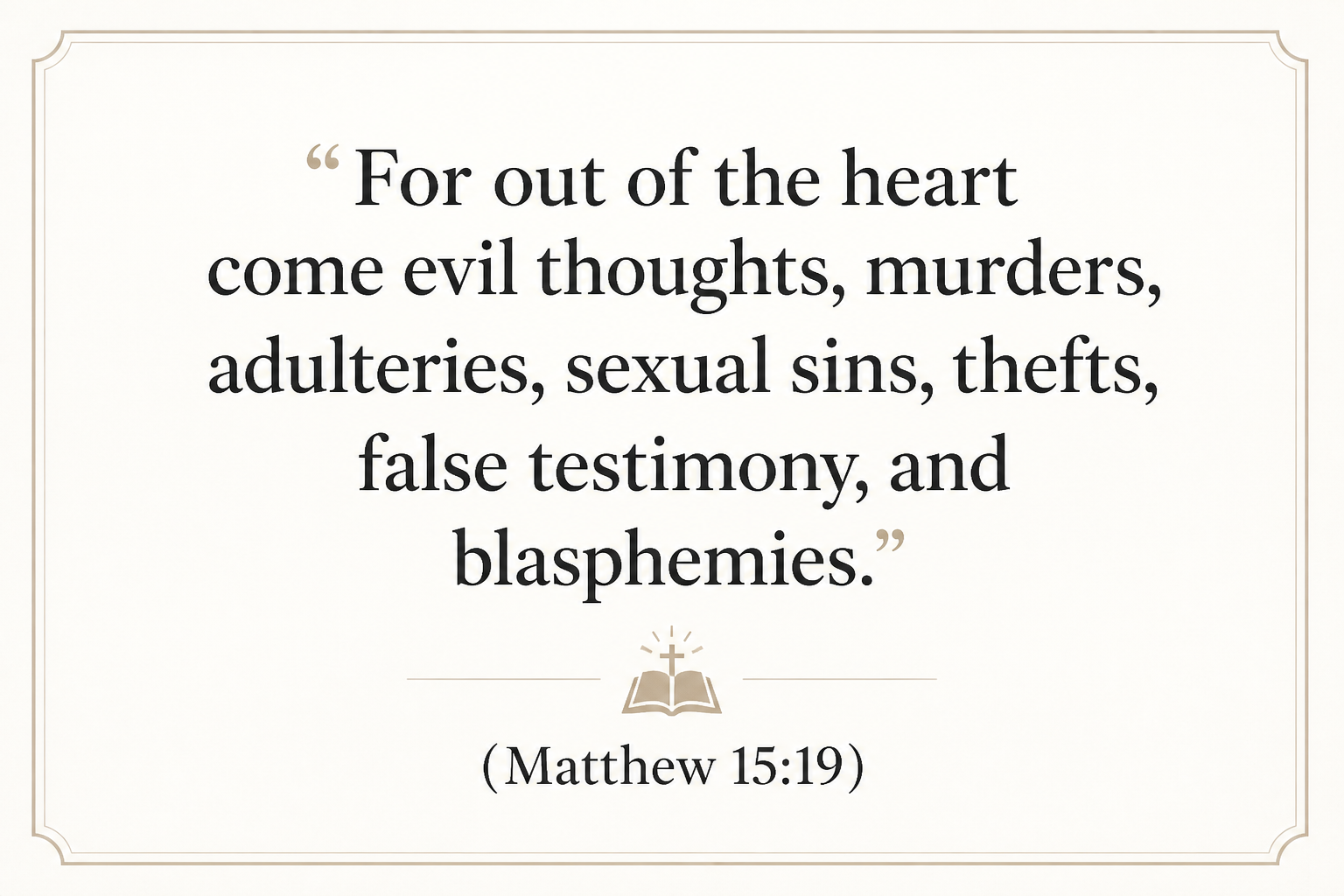
“For out of the heart come evil thoughts, murders, adulteries, sexual sins, thefts, false testimony, and blasphemies.” (Matthew 15:19)
Here κλοπή appears as one item in a compact list of evils that “come” from “the heart.” The sentence does not treat theft as a mere social misstep or a circumstantial failure; it places theft among grave wrongs (“murders,” “adulteries”) and speech-sins (“false testimony,” “blasphemies”), all sourced in the inner person. Within this catalog, “thefts” is plural, presenting stealing as a recognizable class of behaviors rather than a one-time lapse. The phrase “out of the heart” frames theft as springing from inward thoughts and desires before it reaches the level of action against another’s goods. In the immediate structure of the list, theft sits between “sexual sins” and “false testimony,” linking a wrong done by taking what is not one’s own with other outward acts and words that injure neighbor and dishonor God.
“For from within, out of the hearts of men, proceed evil thoughts, adulteries, sexual sins, murders, thefts,” (Mark 7:21)
Mark’s wording presses the same point with a slightly expanded set of inner-source expressions: “from within” and “out of the hearts of men.” The verb “proceed” pictures these evils as issuing from an interior spring. In this setting κλοπή again occurs in the plural (“thefts”), grouped among actions that violate others and corrupt community life. The ordering places “thefts” after “murders,” showing it as a serious moral category within the same stream of inwardly generated evils. Mark explicitly locates the origin in “the hearts of men,” tying theft to the common human problem rather than to a particular group’s external failures. The line’s movement—inner origin to outward outcome—casts theft as an expression of a deeper moral condition, not an accident of environment.
Sense and Usage
Across these two occurrences, κλοπή functions as a concrete example of wrongdoing that can be named and recognized in ordinary life, but its placement in Jesus’ teaching gives it diagnostic weight. Theft is not discussed in terms of property law, restitution, or specific scenarios; it is treated as a moral act that belongs to a broader cluster of evils generated “out of the heart.” That setting supplies the word’s practical force: theft is an outward taking that reveals an inward disorder.
The plural form (“thefts”) is significant for how the word is heard in these sayings. Jesus is not describing a single notorious case; he is identifying a type of act that shows up in many instances and in many hearts. In both lists, theft is one among several items, and that list-format itself teaches something about the word’s use: κλοπή is one name in a vocabulary of evils, the kind of term that can stand in a moral inventory without additional explanation. The word’s meaning is assumed to be intelligible, but the sayings insist on its origin—its source in “evil thoughts” and in what is “from within.”
In Matthew, κλοπή is surrounded by both violent acts (“murders”) and sexual acts (“adulteries,” “sexual sins”), as well as sins of speech (“false testimony,” “blasphemies”). The arrangement does not flatten these into identical offenses, but it does locate theft within the same moral landscape of actions and words that flow from a corrupted heart. Theft, then, is not isolated to the realm of possessions; it belongs to a pattern of harms that break faith with God and neighbor. By placing theft alongside “false testimony,” Matthew also sets it near a category of deceitful speech, inviting the reader to see theft as part of a broader truth-and-integrity failure, even when the act is physical taking rather than verbal lying.
Mark’s phrasing highlights movement: these evils “proceed.” That verb, coupled with “from within,” treats theft as something that emerges from the person, not something imported from outside pressures. In that frame, κλοπή is less a label for one prohibited deed and more a window into what the heart produces when left to its own bent. The saying does not reduce theft to “need” or “opportunity”; it ties it to the interior fountain of “evil thoughts.” The word thus carries explanatory power: naming theft helps name what is going wrong inside.
Although κλοπή appears only in these catalogues here, the two sayings give it a clear functional range within teaching speech: it can serve as a representative wrongdoing in a list, it can be pluralized to indicate repeated or various acts, and it can be used to expose the heart’s role in moral failure. In both Gospels, the word is not used to describe the victim’s experience or the thief’s technique; it is used to classify an act as morally evil and to trace it back to inward origins.
Imagery in Context
The imagery attached to κλοπή in these passages is the imagery of emergence: evils come out, proceed, flow from within. Theft is pictured less as a hidden nighttime act and more as one of the visible products that surface when what is inside is corrupt. The lists themselves form a kind of moral inventory of what the heart can yield—thoughts, deeds, and words—so that “thefts” becomes one recognizable fruit among others, issuing from the same interior source described in both sayings.
Sources: Lexical data from Strong’s Exhaustive Concordance and the Translators Brief Lexicon of Extended Strongs for Greek (STEPBible, CC BY). Occurrence data from the Translators Amalgamated Greek New Testament (STEPBible, CC BY). Scripture quotations from the World English Bible (public domain).




