Exploring the Meaning of Kletos in Greek
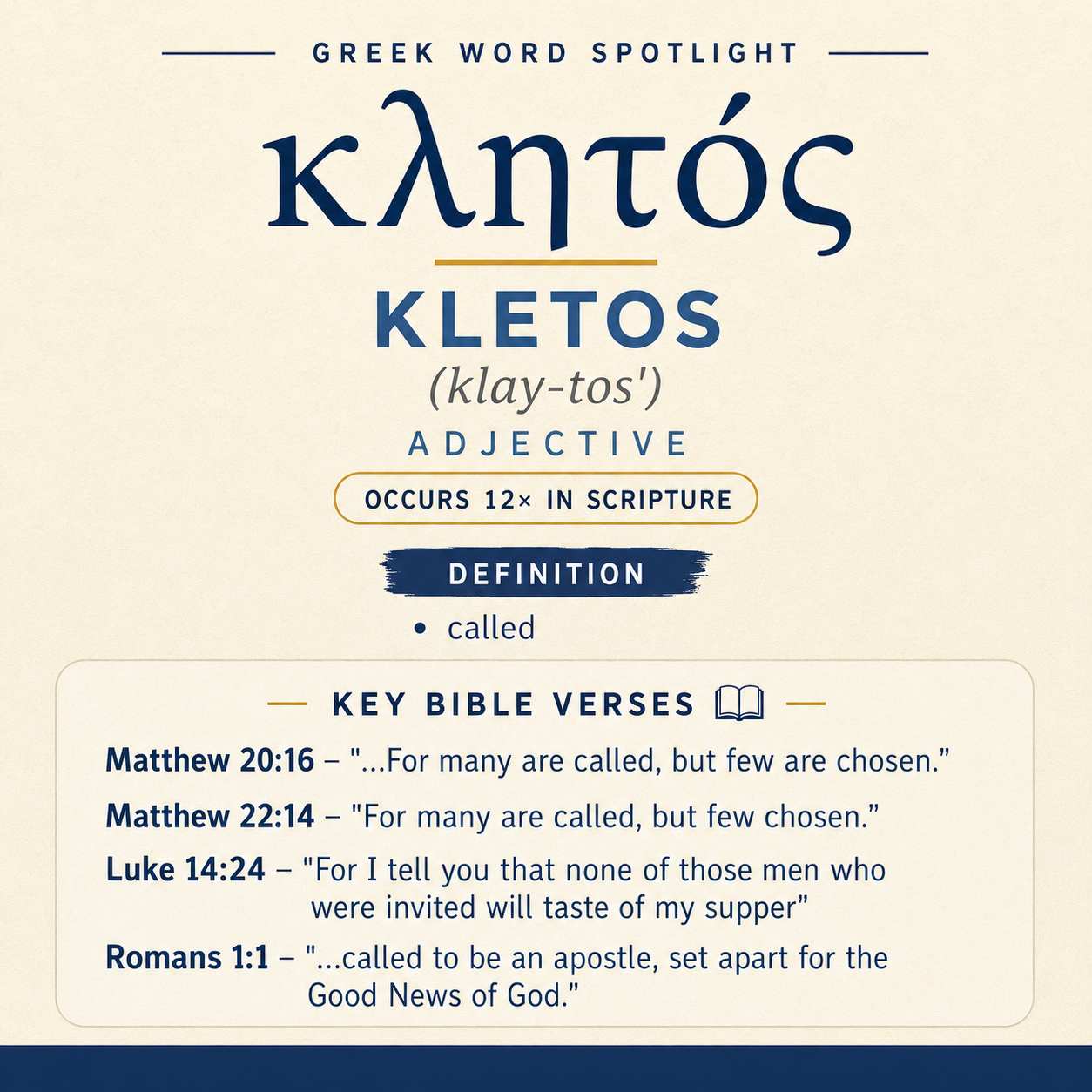
κλητός means “called” and occurs 12 times in Scripture, including Matthew 20:16; Matthew 22:14; Romans 1:1,6–7; and Romans 8:28.
Core Meaning
κλητός is defined as “called.” In Matthew 20:16 and 22:14 it appears in the saying, “many are called.”
Learn More →Gospel Occurrences
In Matthew 20:16 and Matthew 22:14, “called” is contrasted with “chosen.” In Luke 14:24 it is used in the context of invited guests.
Learn More →Pauline Usage
Romans uses κλητός for being “called” to belong to Jesus Christ and “called to be saints” (Romans 1:6–7). Paul also speaks of being “called to be an apostle” (Romans 1:1; 1 Corinthians 1:1).
Learn More →κλητός expresses the idea of being “called,” a description that appears in Jesus’ teaching and repeatedly in early Christian letter openings and theological statements. Across these passages it marks people as those who have received a summons or designation that defines their place in a story, a community, or a purpose.
Occurrences
“So the last will be first, and the first last. For many are called, but few are chosen.” (Matthew 20:16)
Here “called” belongs to a contrast: many receive the call, but “few are chosen.” The word helps frame the saying as an account of broad invitation set alongside a narrower outcome, reinforcing the distinction the verse itself draws between hearing a summons and belonging to the smaller group identified as “chosen.”

“For many are called, but few chosen.” (Matthew 22:14)
Again “called” is placed against “few chosen,” with the compact repetition sharpening the point. In this form the adjective characterizes “many” as people who stand under the description of having been called, while “chosen” marks a different descriptor that applies to fewer.
“For I tell you that none of those men who were invited will taste of my supper.’ ” (Luke 14:24)
In this scene the notion of being “called” is conveyed through the language of invitation: “those men who were invited.” The force of the word in context is tied to a summons to a meal (“my supper”), and the warning—“none…will taste”—shows that an invitation received can still be followed by exclusion from the feast’s enjoyment.
“Paul, a servant of Jesus Christ, called to be an apostle, set apart for the Good News of God,” (Romans 1:1)
“Called” functions as a defining descriptor of Paul’s role: he is “called to be an apostle.” The calling is presented alongside “servant of Jesus Christ” and “set apart,” so the term contributes to his self-identification at the start of the letter by grounding his apostleship in a received summons rather than a self-chosen status.
“among whom you are also called to belong to Jesus Christ;” (Romans 1:6)
The term widens from Paul to the recipients: “you are also called.” The calling is specified with an attachment—“to belong to Jesus Christ”—so the word contributes the idea of a summons into relationship and identity, not merely into a task.
“to all who are in Rome, beloved of God, called to be saints: Grace to you and peace from God our Father and the Lord Jesus Christ.” (Romans 1:7)
“Called” here stands among several descriptors of the Roman believers: they are “beloved of God” and “called to be saints.” The calling language functions as a communal label that shapes how the greeting addresses them; it is part of what names them as a people in a particular standing as the letter begins.
“We know that all things work together for good for those who love God, for those who are called according to his purpose.” (Romans 8:28)
In this statement “called” identifies a group within the sentence’s twofold description: “those who love God” and “those who are called according to his purpose.” The word contributes an additional defining mark for the beneficiaries of the promise that “all things work together for good,” locating their experience within “his purpose.”
“Paul, called to be an apostle of Jesus Christ through the will of God, and our brother Sosthenes,” (1 Corinthians 1:1)
As in Romans, Paul’s apostleship is framed with the adjective: he is “called to be an apostle.” The clause “through the will of God” stands close beside it, so the calling functions to characterize his apostolic identity as something rooted in God’s will, setting the tone for the letter’s authority and address.
“to the assembly of God which is at Corinth—those who are sanctified in Christ Jesus, called saints, with all who call on the name of our Lord Jesus Christ in every place, both theirs and ours:” (1 Corinthians 1:2)
Here “called” is applied to the Corinthian believers: “called saints.” The verse pairs this with “sanctified in Christ Jesus,” and then links them to a wider circle—“with all who call on the name of our Lord Jesus Christ in every place.” Within the verse’s wording, “called” provides a descriptor of identity, while the later “call on” (a different expression in English) depicts an act of worship that belongs to the same shared Christian sphere “in every place.”
“but to those who are called, both Jews and Greeks, Christ is the power of God and the wisdom of God;” (1 Corinthians 1:24)
“Those who are called” marks out a group spanning “both Jews and Greeks.” The word contributes to the verse’s contrast in reception: within this defined group, “Christ” is apprehended as “the power of God and the wisdom of God.” The calling thus functions as the descriptor that gathers a trans-ethnic people who share a particular recognition of Christ.
“Jude, a servant of Jesus Christ, and brother of James, to those who are called, sanctified by God the Father, and kept for Jesus Christ:” (Jude 1:1)
“Called” is the first of three coordinated descriptions of the recipients: “called, sanctified… and kept.” The term contributes the initial identification of the audience as people addressed by a summons, and in the verse’s structure it sits alongside God’s action (“sanctified by God the Father”) and protective orientation (“kept for Jesus Christ”).
“These will war against the Lamb, and the Lamb will overcome them, for he is Lord of lords, and King of kings, and those who are with him are called chosen and faithful.” (Revelation 17:14)
In an apocalyptic battle scene, “called” is one of three descriptors for the Lamb’s companions: “called chosen and faithful.” The word contributes to the identity of “those who are with him” as a marked company; their being “called” is presented as part of what characterizes them in the conflict in which “the Lamb will overcome.”

Sense and Usage
Across these passages κλητός functions as a label that places people under the heading of a received summons. In Jesus’ sayings (Matthew 20:16; Matthew 22:14) it is paired explicitly with “chosen,” so that “called” names a larger set than the smaller set defined by selection. The word therefore serves the rhetoric of warning and differentiation: one can be described by the call and yet be outside the “few” who are “chosen.” Luke 14:24 complements this by using the meal-invitation setting: the invited are real invitees, yet the sentence ends with exclusion from tasting the supper. The calling idea, set in banquet imagery, carries the weight of opportunity joined to accountability within the story’s outcome.
In the epistolary openings, κλητός helps establish identity and authority. Paul uses it for himself in Romans 1:1 and 1 Corinthians 1:1 to describe his apostolic role, and in both contexts the calling stands near other terms of designation (“servant,” “set apart”) and divine initiative (“through the will of God”). Used this way, the word contributes to the letters’ opening posture: the writer’s role is not presented as merely functional but as bound up with a defining summons. The same adjective then shifts to the readers in Romans 1:6–7 and Jude 1:1, where it becomes a communal descriptor (“called to belong to Jesus Christ,” “called to be saints,” “to those who are called”). In those greetings, calling is not an abstract idea but part of how the community is addressed, placing their existence and character under a received designation.
Romans 8:28 uses κλητός within a promise-shaped claim: “all things work together for good” for a group defined in two coordinated ways. “Those who are called according to his purpose” casts the calling as purpose-related, linking the description of the people to an overarching divine intention named directly in the sentence (“his purpose”). In 1 Corinthians 1:24 the word marks out “those who are called” across ethnic lines (“both Jews and Greeks”), and within that category the verse states a shared confession about Christ: “the power of God and the wisdom of God.” Calling thus functions as a descriptor that gathers a people whose unity is expressed in what they recognize in Christ, not in shared background.
Revelation 17:14 places κλητός within a triad—“called chosen and faithful”—to characterize those aligned with the Lamb in conflict. In that setting, calling is not merely an initial invitation but part of the identity of the Lamb’s company as they stand with him against opponents who “war against the Lamb.” The adjective contributes to the portrayal of a defined group accompanying the “King of kings,” marked by descriptors that fit the scene’s contest and outcome.
Imagery in Context
The passages attach the “called” identity to concrete frames: a banquet invitation with the prospect of tasting (Luke 14:24), the formal naming of a people in greeting lines (“to all who are in Rome… called to be saints,” Romans 1:7; “to those who are called… and kept,” Jude 1:1), and the battlefield allegiance of those “with” the Lamb (Revelation 17:14). In each setting, κλητός marks people not simply by what they do, but by how they have been addressed and designated within the narrative world the verse describes.
Sources: Lexical data from Strong’s Exhaustive Concordance and the Translators Brief Lexicon of Extended Strongs for Greek (STEPBible, CC BY). Occurrence data from the Translators Amalgamated Greek New Testament (STEPBible, CC BY). Scripture quotations from the World English Bible (public domain).