
Exploring the Meaning of Klema in Greek
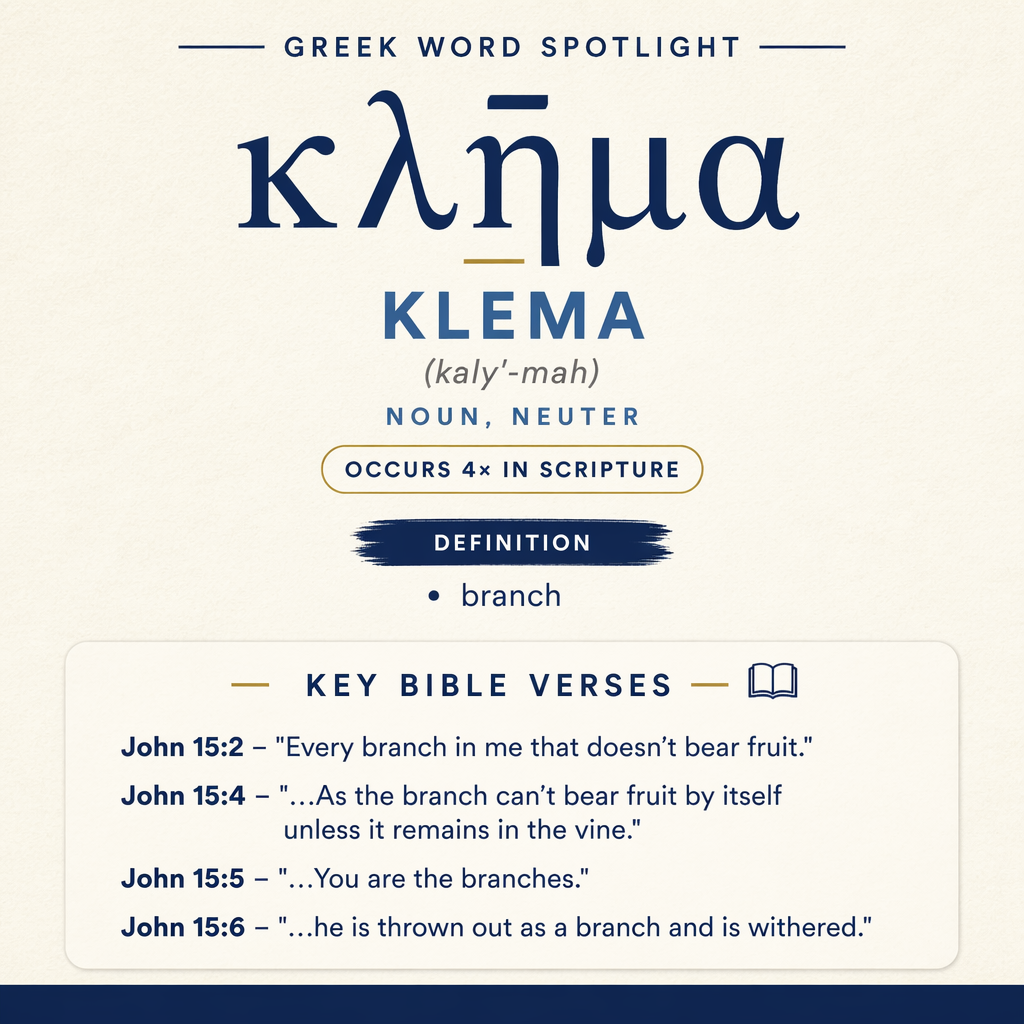
κλῆμα means “branch” and appears four times in Scripture, all in John 15:2, 15:4–6.
Core Meaning
κλῆμα is defined as “branch.” In John 15, it is used in vine-and-branch imagery.
Learn More →Where It Appears
The word occurs 4 times in Scripture. Every occurrence is in John 15:2, 15:4, 15:5, and 15:6.
Learn More →Context in John 15
John 15 describes branches that bear fruit and are pruned, and branches that do not remain and are withered. It also identifies disciples as the branches.
Learn More →κλῆμα means “branch” and appears in the vine-and-branches imagery of John 15:2, 15:4, 15:5, and 15:6. In these verses it names the living extension connected to the vine, viewed in relation to fruitfulness, pruning, removal, and burning.
Root and Related Words
κλῆμα is related to the verb klaō (κλάω), “to break” (Strong’s G2806). The relationship frames the noun within the physical world of plant growth and the handling of plant growth, where a branch can be dealt with by cutting, breaking, or removal as part of cultivation.

Occurrences
John 15:2 — “Every branch in me that doesn’t bear fruit, he takes away. Every branch that bears fruit, he prunes, that it may bear more fruit.”
Here κλῆμα is explicitly located “in me,” placing the branch in a sphere of attachment and belonging. The verse sets two outcomes side by side: a branch that “doesn’t bear fruit” is “take[n] away,” while a fruit-bearing branch is “prune[d]” with a stated purpose, “that it may bear more fruit.” κλῆμα therefore carries the idea of a living growth that is evaluated by what it produces. The word is not a generic piece of wood in the abstract; it is a branch considered within the vine’s management—subject to removal when barren, and to careful cutting when fruitful.

John 15:4 — “Remain in me, and I in you. As the branch can’t bear fruit by itself unless it remains in the vine, so neither can you, unless you remain in me.”
In this line κλῆμα supplies the concrete comparison that anchors the command “Remain in me.” The branch is described in terms of inability: it “can’t bear fruit by itself” and only bears fruit “unless it remains in the vine.” The phrase “by itself” underscores isolation as the decisive problem; the branch’s capacity is tied to its continued connection. By naming the branch, κλῆμα highlights dependence as an agricultural reality: fruitfulness is not generated from detached existence but from remaining where life and nourishment flow—“in the vine.”
John 15:5 — “I am the vine. You are the branches. He who remains in me and I in him bears much fruit, for apart from me you can do nothing.”
κλῆμα appears in a direct identification: “You are the branches.” The word gathers the hearers into a single image: many branches associated with the one vine. The statement that follows explains what such branches look like in practice: the one who “remains in me and I in him” “bears much fruit.” The contrast clause, “apart from me you can do nothing,” gives κλῆμα a sharp boundary: a branch’s identity presupposes attachment. In this verse the branch is not merely present on the vine; it is defined by a mutual remaining (“he…in me and I in him”) that results in abundant fruit.
John 15:6 — “If a man doesn’t remain in me, he is thrown out as a branch and is withered; and they gather them, throw them into the fire, and they are burned.”
In this occurrence κλῆμα is the object lesson for the consequence of not remaining. The branch is “thrown out,” then “withered,” then collected and burned. Each verb pushes the picture forward: first separation from the place of life, then the visible loss of vitality (“withered”), then disposal (“gather…throw…burned”). κλῆμα thus participates in a progression from detachment to desiccation to destruction. The word “as a branch” keeps the scene rooted in the vine metaphor, but the sequence of actions treats the branch as something people can handle once it is no longer living and connected.
Sense and Usage
Across John 15:2–6, κλῆμα functions as a concrete agricultural term placed in a tightly structured argument about fruitfulness and remaining. The branch is consistently portrayed in relation to the vine rather than as a free-standing entity: it is “in me” (15:2), it must “remain in the vine” (15:4), it is named as belonging to the vine’s identity (“You are the branches,” 15:5), and it is judged by what happens when it does not remain (15:6).
Within these verses, the branch is the locus where fruit appears—or fails to appear. The imagery uses ordinary vineyard logic: a branch exists for bearing fruit, and fruit is tied to ongoing connection. When fruit is absent, removal is immediate (“he takes away,” 15:2). When fruit is present, the branch is not left untouched; it is “prune[d]” toward increased yield (“more fruit,” 15:2). When connection is emphasized, the branch illustrates dependence: it “can’t bear fruit by itself” (15:4), while the one who remains “bears much fruit” (15:5). When connection is denied, the branch illustrates what follows detachment: it becomes something that can be discarded, dries out, and is burned (15:6).
Because κλῆμα denotes a branch, it naturally carries the double aspect seen in the passage: it is both a living growth when connected and a lifeless object when separated. John 15 uses that contrast to make the branch a measure of condition—fruitfulness, need for pruning, vulnerability to removal, or uselessness after withering. The same noun can stand in scenes of careful cultivation (pruning a fruit-bearing branch) and scenes of judgment-like disposal (burning withered branches), without changing referent: it remains a “branch,” but its state and outcome depend on remaining.
Imagery
The κλῆμα imagery in John 15 is vivid and practical: a vine with its branches, some producing fruit and undergoing pruning, others removed and later burned. Within this small set of verses, the branch becomes the visible place where the unseen reality of remaining is shown—either in “much fruit” (15:5) or in withering and fire (15:6).
Sources: Lexical data from Strong’s Exhaustive Concordance and the Translators Brief Lexicon of Extended Strongs for Greek (STEPBible, CC BY). Occurrence data from the Translators Amalgamated Greek New Testament (STEPBible, CC BY). Scripture quotations from the World English Bible (public domain).





