
Exploring the Meaning of Kephalaion in Greek
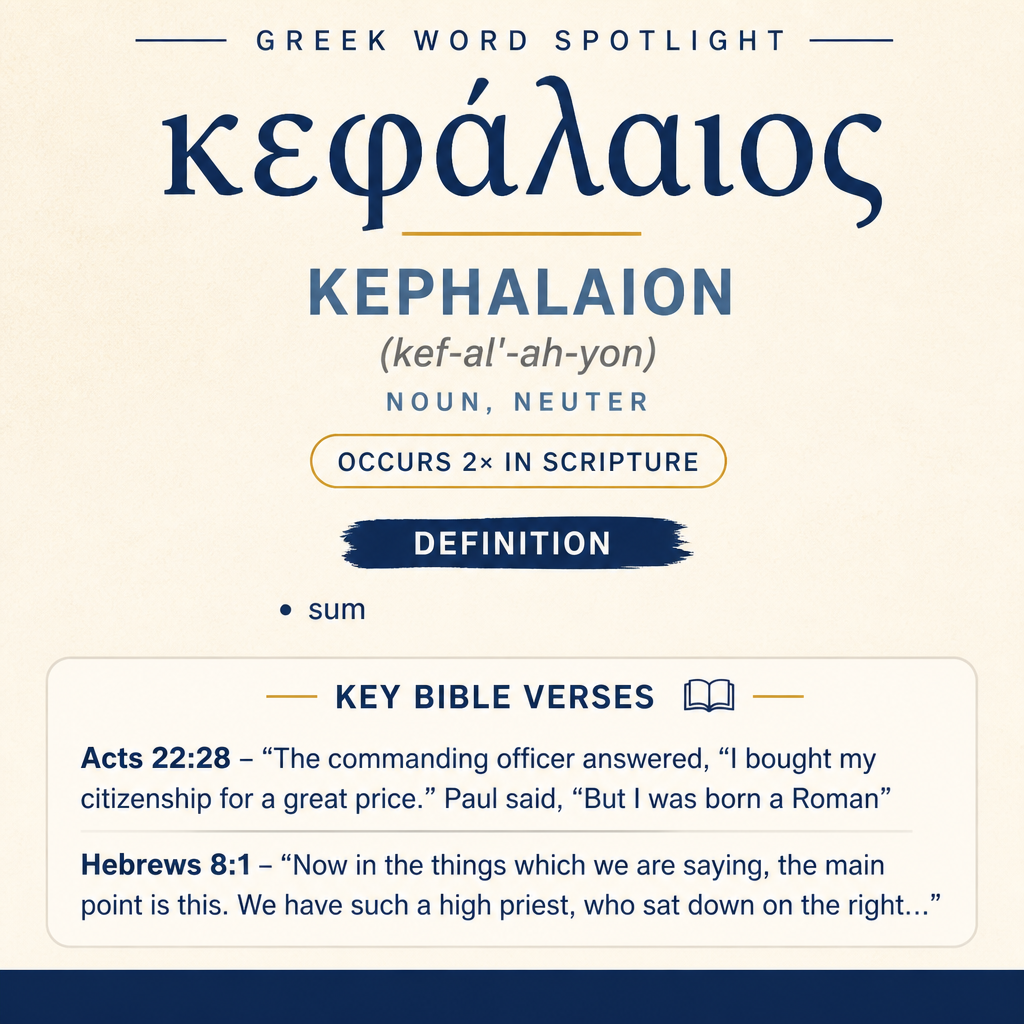
κεφάλαιος means “sum” and appears in Acts 22:28 and Hebrews 8:1.
Scripture Occurrences
This word occurs 2 times in Scripture: Acts 22:28 and Hebrews 8:1.
Learn More →Context Snapshot
In Hebrews 8:1 it introduces “the main point” in what is being said. Acts 22:28 includes it in a statement about citizenship and its cost.
Learn More →κεφάλαιος means “sum” and appears in Acts 22:28 and Hebrews 8:1. In each setting it marks what is taken as the decisive total or central outcome of what is being discussed.
Root and Related Words
κεφάλαιος is related to kephalē (κεφαλή), “head” (Strong’s G2776). The connection helps explain why the term can be used to signal what stands at the top of an account or what gathers things into a single total.

Occurrences
“The commanding officer answered, “I bought my citizenship for a great price.” Paul said, “But I was born a Roman.”” (Acts 22:28)
In this exchange, two ways of acquiring the same civic standing are set side by side: purchase at “a great price,” and birth (“I was born a Roman”). κεφάλαιος contributes the idea of a “sum” by fitting the officer’s language of cost: the point of emphasis is the total outlay required to obtain citizenship. The verse contrasts that purchased total with Paul’s claim that his status did not come by a paid amount at all, but by origin. In this scene, “sum” naturally belongs to the sphere of transaction—an amount that can be counted as the total price of a privilege.
“Now in the things which we are saying, the main point is this. We have such a high priest, who sat down on the right hand of the throne of the Majesty in the heavens,” (Hebrews 8:1)
Here the writer explicitly signals a turning point in the discussion: “Now in the things which we are saying, the main point is this.” κεφάλαιος serves to gather what has been said into a single concentrated statement, functioning as the “sum” of the argument at that moment. That “sum” is immediately expressed as a claim about “such a high priest,” further described as one “who sat down on the right hand of the throne of the Majesty in the heavens.” The word therefore marks the author’s intended takeaway: not a new topic introduced at random, but the collecting of the preceding discourse into one stated conclusion that governs how the reader is to weigh everything else being said.
Sense and Usage
Across its two New Testament uses, κεφάλαιος applies “sum” in two complementary ways, each grounded in the immediate wording of the passage.
First, “sum” can be concrete and measurable. In Acts 22:28 the officer frames his citizenship in terms of purchase and expense: “I bought my citizenship for a great price.” The “sum” idea fits that commercial register: a total cost paid to secure a legal standing. Paul’s response (“But I was born a Roman.”) sharpens the contrast by offering an alternative route that does not involve a paid total. The narrative force depends on the listener feeling the weight of what the officer has said—citizenship that had to be obtained at a costly total—and then hearing Paul’s claim as qualitatively different.
Second, “sum” can be rhetorical and summarizing, capturing the total of an argument in a single heading statement. Hebrews 8:1 uses discourse-marking language (“Now in the things which we are saying”) and then points to the author’s chosen “main point.” In that setting, “sum” is not an amount of money but an amount of meaning: the total import of a line of teaching. The writer does not leave the “sum” as an abstract label; the content follows immediately—“We have such a high priest”—and the description that he “sat down on the right hand of the throne of the Majesty in the heavens” supplies the concentrated claim meant to stand as the gathered total of what is being argued.
Read together, these uses show κεφάλαιος as a word suited to totals: either the total of a price (“a great price”) or the total of a discussion (“the main point”). In each case the surrounding words make clear what is being totaled. The term does not merely point to something important; it designates what can be taken as the collected whole, whether the whole amount paid or the whole point to be carried forward.
Imagery
The imagery associated with κεφάλαιος is the imagery of reckoning. In Acts 22:28 the verse evokes the counting up of “a great price,” a total that stands behind a purchased identity. In Hebrews 8:1 the “sum” shifts from coins to conclusions: the writer presents a single sentence as the gathered outcome of what has been said, and the picture that follows is exalted and spatial—“the right hand of the throne of the Majesty in the heavens”—as though the argument’s total is being placed in its highest position.
Sources: Lexical data from Strong’s Exhaustive Concordance and the Translators Brief Lexicon of Extended Strongs for Greek (STEPBible, CC BY). Occurrence data from the Translators Amalgamated Greek New Testament (STEPBible, CC BY). Scripture quotations from the World English Bible (public domain).




