Exploring the Meaning of Katha in Greek
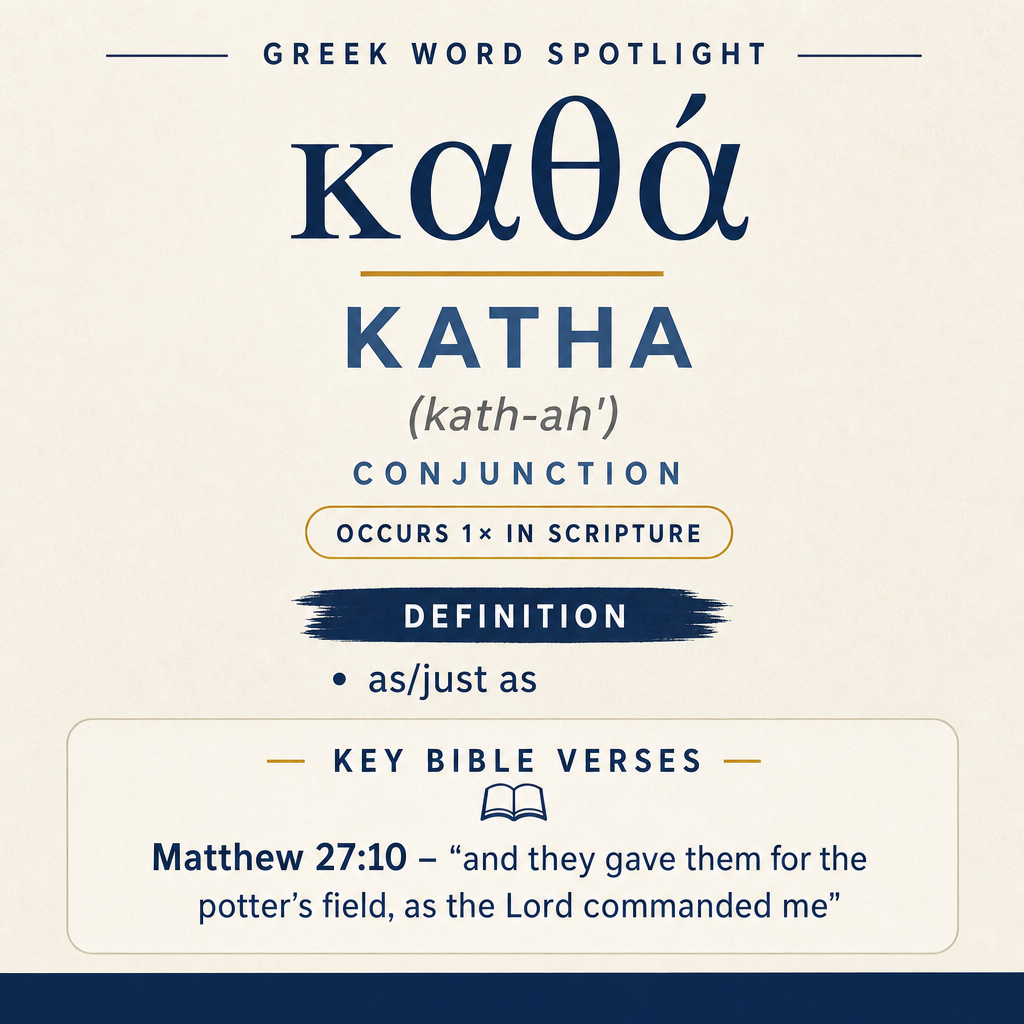
καθά means “as/just as” and appears once in Scripture in Matthew 27:10.
καθά expresses a comparison of manner: “as/just as.” In the single New Testament occurrence given, it links an action (“they gave them for the potter’s field”) to a standard (“as the Lord commanded me”).
Root and Related Words
καθά is related to kata (κατά), “according to” (Strong’s G2596), and hos (ὅς), “which” (Strong’s G3739). The relationship points to a connective function: the word draws one clause into alignment with another clause or reference point, so that what happens is presented in the same way as something else.

Occurrences
“and they gave them for the potter’s field, as the Lord commanded me.” (Matthew 27:10)
Here καθά introduces the measure or pattern by which the preceding action is understood. The sentence reports a concrete transaction (“they gave them for the potter’s field”) and then immediately frames that act by comparison with an authoritative directive (“as the Lord commanded me”). By using καθά, the clause about the Lord’s command does not merely follow as an added detail; it functions as the defining standard for interpreting the act of giving. The giving is presented as corresponding to what was commanded—its significance is located in its conformity to that command.

The comparison created by καθά is not an abstract analogy but a direct alignment between deed and directive. The wording “as the Lord commanded me” is cast as the controlling reference point: the reported action is narrated as matching the Lord’s command in the relevant respect. In this way καθά binds together the human action (“they gave”) with the divine instruction (“the Lord commanded”), making the latter the lens through which the former is read.
Sense and Usage
The sense “as/just as” in καθά is comparative and connective. It marks that what is being described should be taken in the same way as something else—whether the point of comparison is a command, an example, or a stated pattern. In Matthew 27:10 the comparison is explicitly between an action and a command: the action is narrated in a way that corresponds to the command.
Because καθά is a small linking word, much of its force lies in what it attaches to. In the cited line it attaches the clause “the Lord commanded me” to the prior clause about giving for “the potter’s field.” That attachment does two things at once. First, it supplies the rationale for the action without turning the sentence into an argument; the comparison implies that the action belongs under the heading of obedience. Second, it sharpens the reader’s sense of fit between what happened and what was spoken. The word “as” makes the connection one of correspondence rather than mere sequence: the command is not simply earlier information; it is the standard that the action matches.
In practical terms, καθά is well suited for moments where a writer wants to show that an event or decision stands in line with a known requirement. The comparison can be heard as “in the manner that” or “in keeping with,” but in this passage it is expressed straightforwardly as “as,” letting the comparison do its work with minimal explanation. The result is a compact clause that situates an observed act inside an established framework: what is done is “just as” the Lord’s command specified.
Imagery
Even in this brief excerpt, καθά carries a faint but concrete imagery of alignment: a deed being set alongside a directive and shown to match it. The scene described is tangible—giving something “for the potter’s field”—and the comparison introduced by καθά places that transaction under the shape of a spoken command, as an act carried out in correspondence to what “the Lord commanded.”
Sources: Lexical data from Strong’s Exhaustive Concordance and the Translators Brief Lexicon of Extended Strongs for Greek (STEPBible, CC BY). Occurrence data from the Translators Amalgamated Greek New Testament (STEPBible, CC BY). Scripture quotations from the World English Bible (public domain).