Exploring the Meaning of Kateuthuno in Greek
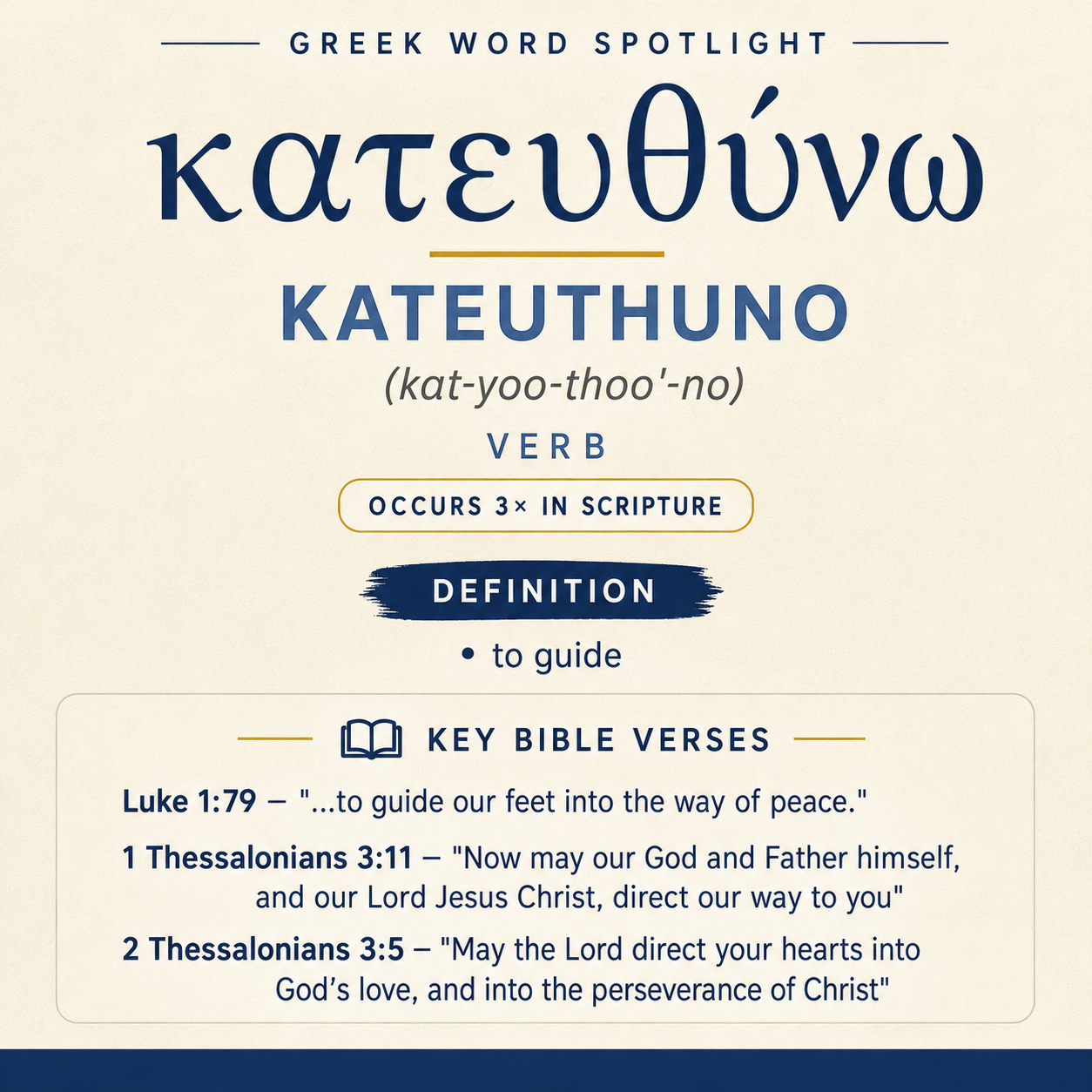
κατευθύνω means “to guide” and appears in Luke 1:79, 1 Thessalonians 3:11, and 2 Thessalonians 3:5.
Scripture Occurrences
It occurs 3 times in Scripture: Luke 1:79; 1 Thessalonians 3:11; 2 Thessalonians 3:5.
Learn More →Verse Contexts
In Luke 1:79 it guides feet into the way of peace; in the Thessalonian letters it directs a way and hearts.
Learn More →κατευθύνω means “to guide” and appears in three New Testament passages: one in Luke’s opening canticle and two in Paul’s letters to the Thessalonians. In each setting it frames a petition or purpose that God would bring someone along a right course—feet, a journey, or the inner direction of the heart.
Root and Related Words
κατευθύνω is connected with the verb euthyno (εὐθύνω), “to straighten” (Strong’s G2116), and with kata (κατά), “according to” (Strong’s G2596). These related forms place the idea of guidance alongside imagery of straightening and orientation “according to” a standard or aim.

Occurrences
“to shine on those who sit in darkness and the shadow of death; to guide our feet into the way of peace.” (Luke 1:79)
Here “to guide” stands parallel to “to shine,” so guidance is pictured as something that happens when light breaks into a place defined by “darkness” and “the shadow of death.” The object of the guidance is concrete—“our feet”—which makes the request vivid: guidance is not only a change of understanding but a directed movement of life. The destination is equally concrete in its phrasing, “into the way of peace,” so the verb describes being brought onto a path and kept on it toward a settled end named “peace.” In this line, guidance is framed as deliverance from a deadly setting into a defined way forward.

“Now may our God and Father himself, and our Lord Jesus Christ, direct our way to you.” (1 Thessalonians 3:11)
In this prayer-wish, “direct” (the same guiding idea) is applied to “our way,” and the direction is “to you,” referring to the Thessalonian believers addressed in the letter. The subject of the petition is explicit: “our God and Father himself, and our Lord Jesus Christ,” so the guidance envisioned is not merely prudent planning but a course set by divine action. The scene is travel-like in its language—there is a “way,” and that way needs directing toward a particular destination. The verb therefore contributes a sense of purposeful ordering: the hoped-for outcome is a path that successfully reaches the people Paul longs to visit.
“May the Lord direct your hearts into God’s love, and into the perseverance of Christ.” (2 Thessalonians 3:5)
This occurrence shifts from feet and roads to the inner life: the Lord is asked to “direct your hearts.” Guidance is thus applied to the seat of intention and affection, not simply to outward movement. The guiding action has a double goal, expressed as entry “into God’s love” and “into the perseverance of Christ.” The preposition “into” in both phrases gives the request a directional feel: hearts are to be brought along until they arrive within a sphere characterized by divine love and steadfast endurance. The verb’s contribution is to present love and perseverance not as abstract topics but as a lived course into which the Lord can bring and keep a community.
Sense and Usage
Across these three contexts, “to guide” consistently describes a directional act that moves someone from one state or location toward a defined end. Luke 1:79 expresses it as guidance of “feet,” emphasizing visible, lived conduct: guidance results in walking “into the way of peace.” In 1 Thessalonians 3:11, the same guiding idea is extended to communal mission and relationship—“our way to you”—so guidance includes opening and ordering the concrete steps that make fellowship possible. In 2 Thessalonians 3:5, the focus moves inward to “your hearts,” where guidance concerns the deep orientation of a person or community, bringing them “into” realities named by relationship to God and Christ.
The three objects—feet, way, hearts—show how the verb can bridge outward motion and inward direction without changing its central idea. Guidance in these passages is not portrayed as generic assistance; it has a clear telos each time: “the way of peace,” “to you,” “into God’s love…into the perseverance of Christ.” In each case, the request assumes there is a course that can be set and a goal that can be reached, and it locates the effective agency of that setting with God (“our God and Father himself, and our Lord Jesus Christ”) or with “the Lord.” The word therefore functions as a prayerful verb: it is used to ask for guidance rather than to describe self-guidance, and its outcomes are framed as gifts received rather than achievements claimed.
Even within these few attestations, a small semantic contour emerges: guidance is pictured as bringing someone onto a “way” and carrying them “into” a desired sphere. Luke’s line uses path imagery explicitly (“way”), while Paul’s petitions keep the directional frame through “way” and repeated “into.” This recurring spatial language makes “to guide” feel like more than advice; it is the setting of direction that results in arrival.
Imagery
Luke 1:79 anchors the imagery of κατευθύνω in movement from darkness into a path, where light enables feet to find “the way of peace.” Paul’s uses echo that same directional picture: a “way” that reaches people, and “hearts” brought into love and perseverance. Taken together, the word carries the feel of being led along a course that God himself establishes, from peril or uncertainty toward a named destination.
Sources: Lexical data from Strong’s Exhaustive Concordance and the Translators Brief Lexicon of Extended Strongs for Greek (STEPBible, CC BY). Occurrence data from the Translators Amalgamated Greek New Testament (STEPBible, CC BY). Scripture quotations from the World English Bible (public domain).