Exploring the Meaning of Katatoxeuo in Greek
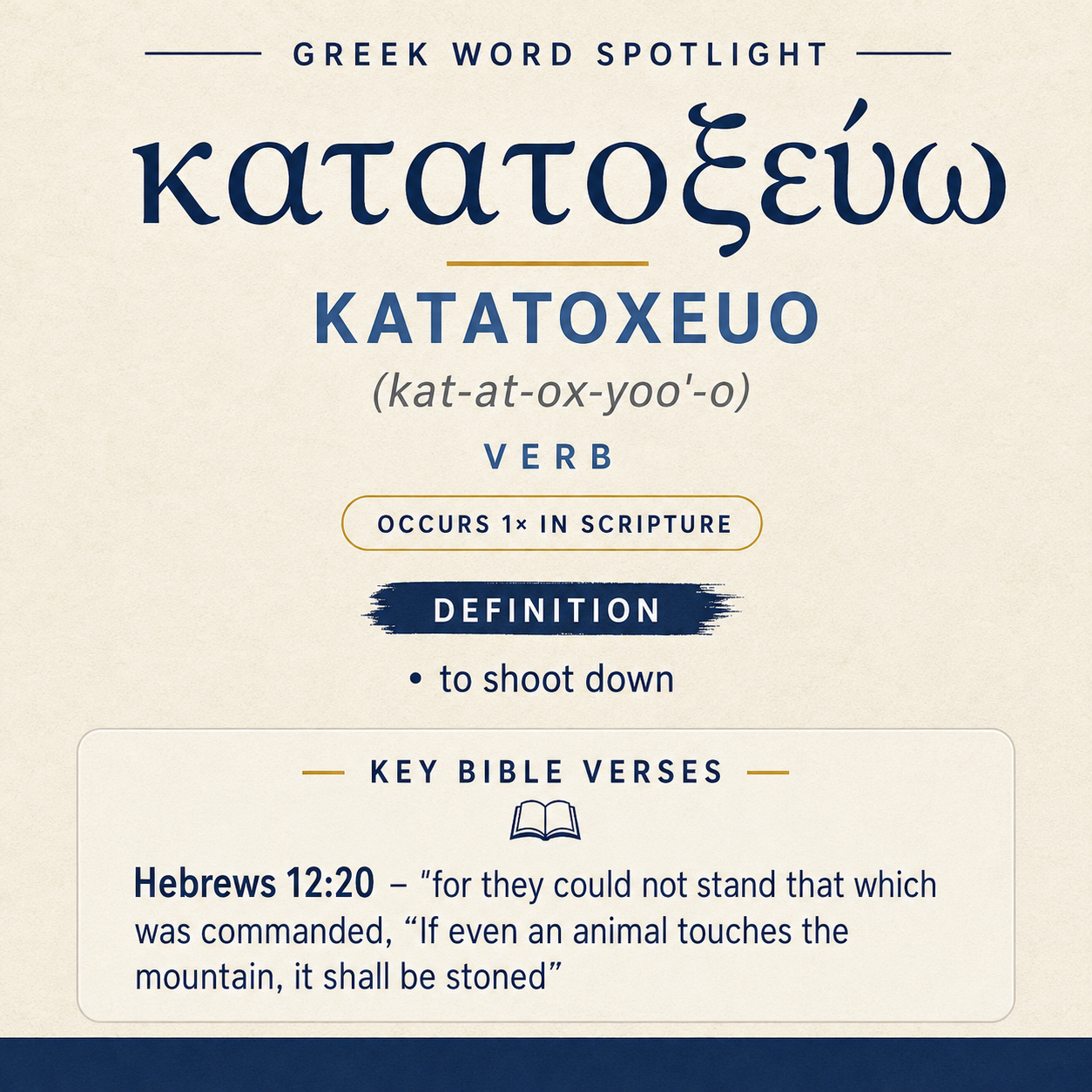
κατατοξεύω means “to shoot down” and appears once in Scripture in Hebrews 12:20.
Biblical Occurrence
This verb occurs 1 time in Scripture. Its single occurrence is in Hebrews 12:20.
Learn More →Verse Context
In Hebrews 12:20, the command states that if even an animal touches the mountain, it shall be stoned.
Learn More →κατατοξεύω means “to shoot down,” and it appears once in the New Testament in a warning tied to the commanded boundaries around a mountain (Hebrews 12:20). In that setting it belongs to a cluster of penalties that enforce distance from what is forbidden to touch.
Root and Related Words
κατατοξεύω is built from kata (κατά), “according to” (Strong’s G2596), and toxon (τόξον), “bow” (Strong’s G5115). Together these elements form a verb whose imagery is naturally at home in the world of projectile weapons and decisive enforcement.

Occurrences
“for they could not stand that which was commanded, “If even an animal touches the mountain, it shall be stoned”.” (Hebrews 12:20)
Hebrews 12:20 recalls an order so strict that even an animal’s accidental contact with “the mountain” triggers an immediate, violent response: “it shall be stoned.” Within that commanded scene, κατατοξεύω contributes the idea of being “shot down” as an alternative mode of execution alongside stoning. The point is not to describe a hunting scene or a battlefield engagement, but to portray an enforced boundary whose violation is met with lethal action. The verb’s force intensifies the portrayal of an atmosphere where what is “commanded” is not tolerable to breach—“they could not stand” it—because the sanction for crossing the line is swift and deadly.
Because the reference frames the sanction as a general rule (“If even an animal touches…”), the verb’s contribution is categorical rather than personal: it paints the penalty in a way that does not depend on the offender’s intent or status. An animal, which cannot be expected to understand a command, is still subject to a response that includes being “shot down.” The severity of the consequence reinforces the seriousness of the boundary itself. In the verse’s compressed quotation, the imagined action of shooting down functions as a visible, concrete expression of the command’s weight: the mountain is not to be approached, and enforcement is envisioned in terms that leave no room for negotiation.
Sense and Usage
In its single attested New Testament use, κατατοξεύω operates as a verb of lethal, targeted force: “to shoot down” is the kind of action that ends the intrusion by removing the intruder. The immediate literary setting anchors the word within a legal-sounding command (“that which was commanded”) and a conditional clause (“If even an animal touches…”), so the verb’s sense is not merely descriptive of violence but bound to penalty. It belongs to the register of sanctioned judgment rather than spontaneous aggression.
The scenario also shapes how the act of shooting down is heard: it is not an act requiring close contact, but an act that can be carried out at a distance. In a context where the very act of “touch[ing] the mountain” is forbidden, the notion of executing the penalty without approaching the offender matches the logic of the prohibition. Stoning already implies keeping space while administering death; “shoot down” similarly imagines a penalty executed from a remove. Thus the word’s sense, as used here, supports the larger rhetorical effect of the command: distance is demanded, and distance is maintained even in enforcement.
Within Hebrews 12:20 the word’s imagery also helps translate an abstract reality—“they could not stand that which was commanded”—into something tangible. A command that cannot be “stood” is one whose strictness overwhelms; the mention of a penalty as stark as being shot down makes that strictness concrete. The verb therefore strengthens the verse’s emotional and moral tone: the command is not a mild caution but a boundary with fatal consequences, conveyed through the bluntness of a killing action.
Imagery
In Hebrews 12:20, κατατοξεύω evokes the picture of a forbidden mountain perimeter guarded by uncompromising sanctions. Alongside the explicit wording “it shall be stoned,” “to shoot down” adds the imagery of decisive punishment that meets a touch with death, underscoring how absolute the command is and how perilous it is to cross what has been set apart.
Sources: Lexical data from Strong’s Exhaustive Concordance and the Translators Brief Lexicon of Extended Strongs for Greek (STEPBible, CC BY). Occurrence data from the Translators Amalgamated Greek New Testament (STEPBible, CC BY). Scripture quotations from the World English Bible (public domain).