
Exploring the Meaning of Katarithmeo in Greek
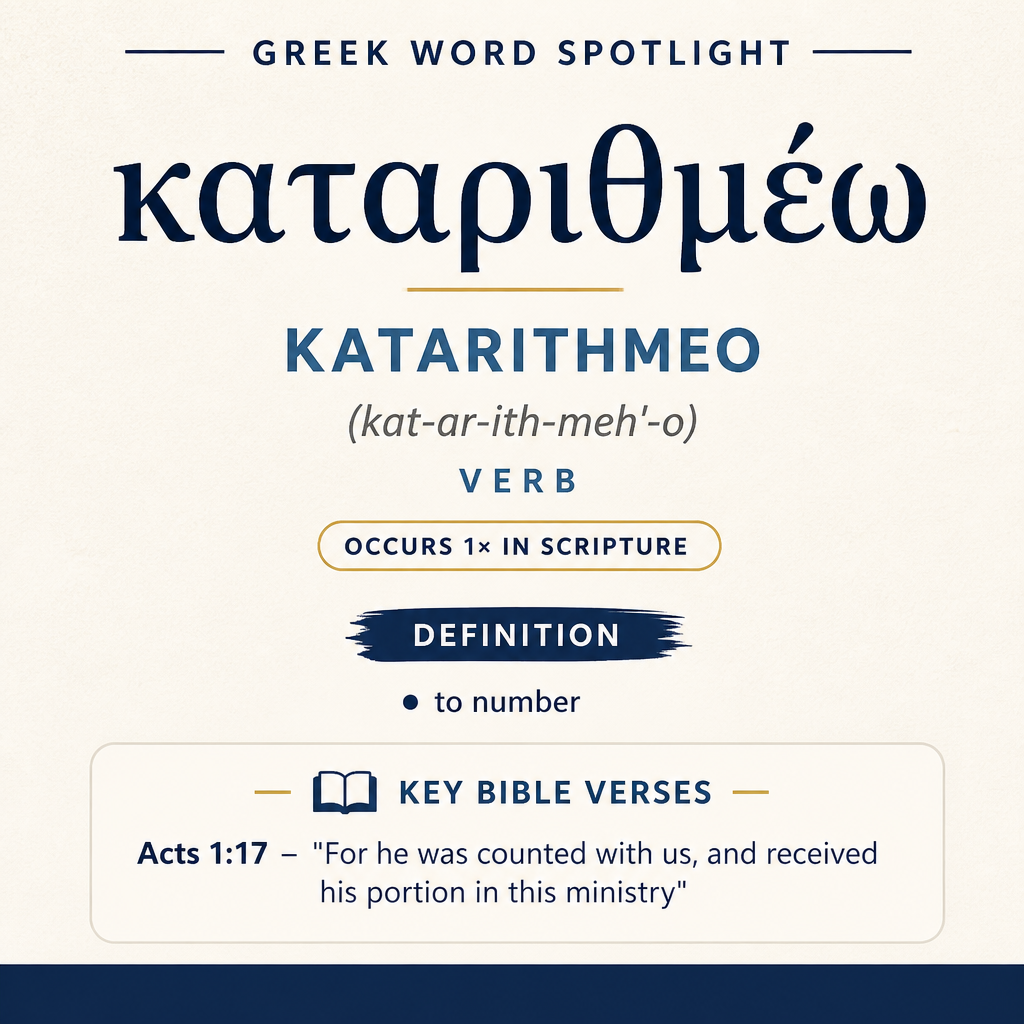
καταριθμέω means “to number” and appears once in Scripture in Acts 1:17.
Acts 1:17 Context
In Acts 1:17, it is used in the statement, “For he was counted with us, and received his portion in this ministry.”
Learn More →καταριθμέω means “to number.” It appears once, in Acts 1:17, where it describes how a particular person stood in relation to the apostolic group and its work.
Root and Related Words
καταριθμέω (Katarithmeo) is associated with kata (κατά), “according to” (Strong’s G2596), and arithmeo (ἀριθμέω), “to number” (Strong’s G705). Together these related elements frame the verb’s idea of numbering in a way that fits an established measure or reckoning.

Occurrences
“For he was counted with us, and received his portion in this ministry.” (Acts 1:17)
In Acts 1:17 the verb marks a formal inclusion: the person spoken of “was counted with us.” The statement is not merely that he happened to be present, but that he belonged to the group by a recognized reckoning—he stood within the circle that could be spoken of as “us.” The verse then pairs this being counted with a concrete outcome: he “received his portion in this ministry.” The numbering language therefore sits alongside the language of allotment and share. In this line, to be counted with the apostles is tied to participation in their ministry as an assigned portion, implying that the counting is the way the community speaks about who truly shares in the work.
Sense and Usage
With its basic sense “to number,” καταριθμέω here functions as a verb of recognized membership. Numbering can be as simple as tallying, but in this passage the act of numbering is relational: it expresses that a person is included within a defined set (“with us”). The context supplies the kind of set in view—a ministering body—and shows that the counting is not an abstract calculation but a categorizing of persons in relation to an office or task.
The sentence structure makes the verb serve a clarifying purpose. The clause “was counted with us” stands parallel to “received his portion,” so the counting explains the basis on which the portion was received. The verse does not describe the mechanics of the numbering, but it does show its effect: it establishes a recognized identity and share. In this way, “to number” carries the weight of communal acknowledgment, the sort of reckoning that can be stated as a fact about someone’s standing.
Because Acts 1:17 uses the verb with the prepositional idea “with,” it highlights counting as inclusion within a company rather than counting as enumeration of objects. The word’s contribution is to express a boundary—there is an “us” that can be spoken of, and there are those who are or are not counted within it. The verse also shows that this boundary is tied to ministry: being counted is connected to receiving a portion “in this ministry,” so the numbering is not merely social but bound up with participation in an assigned service.
Imagery
The verse links counting with receiving a portion, so the word carries the imagery of a reckoning that assigns someone a recognized place and share. In Acts 1:17, the counting is the kind that places a person into the total of a group and, by that placement, connects him to an allotted participation in a shared ministry.
Sources: Lexical data from Strong’s Exhaustive Concordance and the Translators Brief Lexicon of Extended Strongs for Greek (STEPBible, CC BY). Occurrence data from the Translators Amalgamated Greek New Testament (STEPBible, CC BY). Scripture quotations from the World English Bible (public domain).




