
Exploring the Meaning of Katadelos in Greek
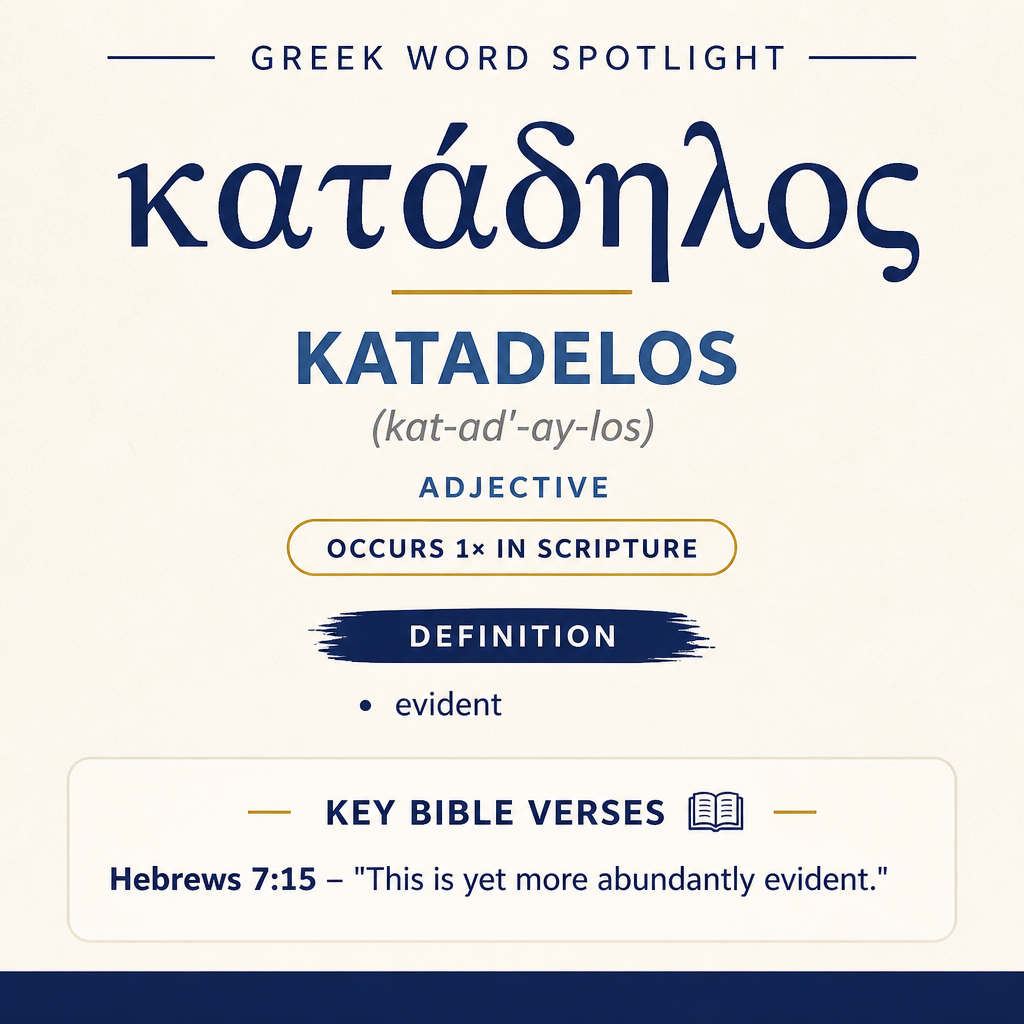
κατάδηλος means “evident” and appears once in Scripture, in Hebrews 7:15.
Scripture Occurrence
It occurs 1 time in Scripture. Its single occurrence is in Hebrews 7:15.
Learn More →Verse Context
In Hebrews 7:15, it describes what is “more abundantly evident” regarding another priest arising after the likeness of Melchizedek.
Learn More →κατάδηλος means “evident” and appears in the New Testament in a single place, within an argument about priesthood in Hebrews. In that setting it functions as a marker of what is plainly shown by the stated condition.
Root and Related Words
κατάδηλος is connected with δῆλος (delos), glossed “Urim” (Strong’s G1212), and with κατά (kata), glossed “according to” (Strong’s G2596). The compound form brings these elements together in one adjective.

Occurrences
“This is yet more abundantly evident, if after the likeness of Melchizedek there arises another priest,” (Hebrews 7:15)
Here κατάδηλος stands inside a tightly reasoned sentence. The verse asserts that something becomes “more abundantly evident” under a stated condition: “if after the likeness of Melchizedek there arises another priest.” The adjective therefore serves as the writer’s assessment of how clear the point is once the premise is granted. It is not presented as a private insight or a hidden inference, but as a conclusion that is visible from the way the argument is framed.

The wording “yet more abundantly” intensifies the claim of evidentness. The statement does not merely say that the matter is evident; it treats the situation as one where the clarity increases when the comparison (“after the likeness of Melchizedek”) and the event (“there arises another priest”) are placed side by side. κατάδηλος contributes the sense that the reader is meant to recognize an obvious connection between the rise of “another priest” and the larger point being argued in the surrounding discussion.
Sense and Usage
In its lone attestation, κατάδηλος expresses evidentness in the context of logical demonstration. The verse gives an “if” clause, and the adjective evaluates what follows from that clause as something that can be seen plainly. In other words, the word belongs to the language of manifest conclusions: when the stated condition holds, the conclusion is presented as evident rather than tentative.
The placement of the adjective also shows that this evidentness is not treated as bare visibility, but as clarity produced by the relationship between two items in the sentence. The comparison “after the likeness of Melchizedek” sets a pattern, and “there arises another priest” names a development measured against that pattern. κατάδηλος functions as the author’s signal that the relationship between pattern and development yields a conclusion that stands out, especially when the condition is considered.
Because the verse pairs κατάδηλος with an explicit conditional (“if”), the word’s force is not to replace reasoning but to underscore the strength of the reasoning. The sentence invites the reader to follow the condition and then to recognize the conclusion as evident—indeed, “more abundantly evident”—once the premise is in view.
Imagery
Although κατάδηλος is an evaluative adjective rather than a concrete object, its imagery in Hebrews 7:15 is the imagery of something brought into clear view. The verse pictures a point emerging into fuller clarity when “another priest” is considered in relation to “the likeness of Melchizedek,” as though the comparison makes what is true stand out plainly.
Sources: Lexical data from Strong’s Exhaustive Concordance and the Translators Brief Lexicon of Extended Strongs for Greek (STEPBible, CC BY). Occurrence data from the Translators Amalgamated Greek New Testament (STEPBible, CC BY). Scripture quotations from the World English Bible (public domain).




